Across Jamaica, with regional forms [1]
Jonkonnu and Bruckins: Performance, masquerade and emancipation
Jonkonnu combines masking, music, character, costume and street performance, while Bruckins is associated in official heritage descriptions with celebrations of emancipation and nineteenth-century cultural mixing. These are not merely quaint entertainments; they give insight into public space, festive freedom, changing social rank and the politics of collective gathering. [2]
A costume may preserve historical imagery while gaining new meaning in later generations. Asking who organized the performance, who funded it, who was mocked, and who could participate can reveal a social history that a simple dance definition misses.
A character changes when the street changes
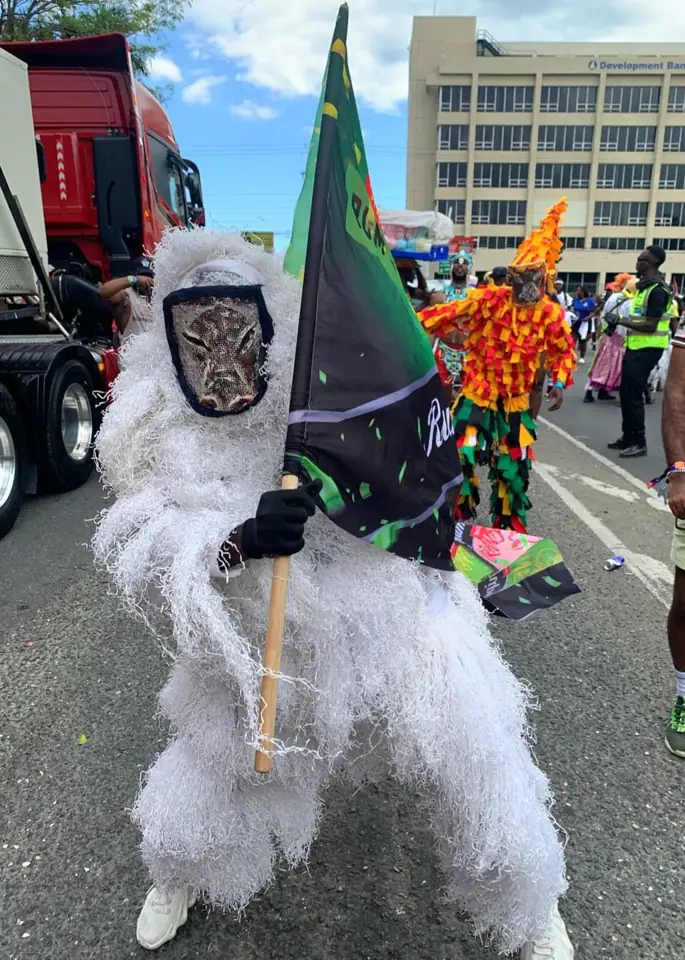
The photograph shows Jonkonnu characters in a Jamaica Carnival parade in April 2025. That date is part of the evidence. The image demonstrates a contemporary public appearance of costumed characters; it cannot be used as an illustration of exactly how a Christmas performance looked two hundred years earlier. A parade also changes the relationship among performer, route, spectators and camera. What is recognizable can be carried into a new occasion without making the new occasion identical to an older one.
Source & credit
Source & credit
Look closely at the costume and the surrounding crowd. What makes a character legible at a distance? How might movement, sound and proximity change what a still photograph communicates? These are visual questions the image can support. Questions about the performer’s intention, the name of a character or the community’s interpretation need a caption, interview or programme rather than an imaginative answer supplied by the viewer.
Bruckins belongs beside Jonkonnu as another account of public performance and historical memory, but the two should not be merged. Emancipation observances ask who is being commemorated and how freedom is represented. Watch the Seville Jubilee film as a separate example of public remembrance, then compare it with the carnival photograph. The value is in the difference of occasion: a national heritage form, a local practice and a contemporary parade can overlap without becoming one continuous scene. The accompanying sources let readers follow the forms separately.
The street could become a space for another kind of authority
Masquerade changes who can command attention. Costume, movement and sound turn an ordinary street into a performance space where a character can interrupt familiar social roles. That is one reason Jonkonnu deserves more than a list of spectacular figures: the encounter between performer and public is part of its significance.
Bruckins brings another historical relationship into view through emancipation commemoration. The date gives a public occasion meaning, while the people performing make that memory present through movement. These traditions should remain distinct, but both show how Jamaicans made history publicly visible and audible. The performance is an action taken by people in a particular setting, not merely an illustration placed after the written account. [1]
Tony’s Call: Visual comparisons should identify the exact time and community of each image. A twenty-first-century festival photograph does not prove precisely how an eighteenth-century gathering looked.