Rural Jamaica, towns and the recording era [1]
Mento and Quadrille: Long before ska was the soundtrack of Jamaica
Mento tells stories about work, courtship, poverty, authority and everyday humor. Its acoustic sound often includes banjo, guitar, percussion and rhumba box. Quadrille, by contrast, reveals how European-derived social dances were transformed in Jamaican practice, with different styles incorporating local movement and musical interpretation. [2]
The first widely available commercial mento records date to the mid-twentieth century, but that does not mark the birth of the musical practices. Live performance has a longer, less fully documented history than commercial recording. Mento and Trinidadian calypso are related through Caribbean exchange, but they are not the same genre. [3]
The song tells a story; the band gives it a setting
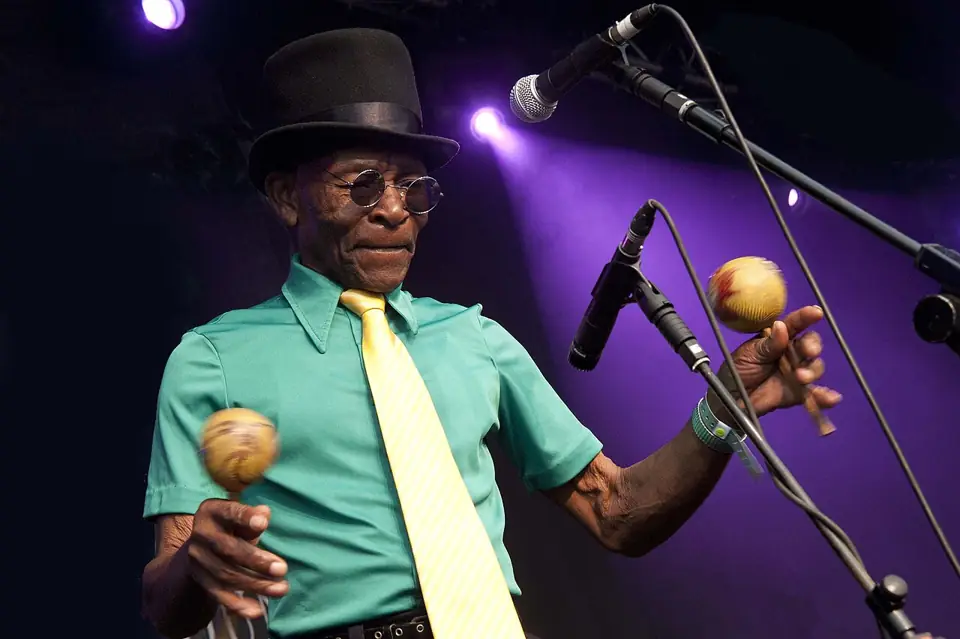
Begin with the Jolly Boys recording, then return to Louise Bennett. One offers an ensemble performance associated with mento; the other foregrounds a singer and folklorist’s delivery of a market song. Compare the texture around the voice, the placement of repeated lines and the relationship between humor and rhythm. Those are audible observations a listener can make without assuming the recordings represent the entire history of either tradition.
Source & credit
A commercial record fixes one performance so it can circulate beyond its original audience. That gives the music a new life, but also encourages listeners to mistake the recorded arrangement for the definitive version. A song performed at a gathering can be longer, shorter, more interactive or differently accompanied. The question is not which version is more authentic in the abstract. It is who performed, for whom, with what equipment and under what circumstances.
Quadrille introduces another dimension: music coordinates a social arrangement of dancers. JCDC’s public categories distinguish ballroom, camp and contra styles. That distinction is a useful correction to the idea that all Jamaican quadrille follows one uniform pattern. A still image of a dance would not show the sequence; a film can, while still requiring identification of the particular style and group. The mento player here is not labeled as quadrille accompaniment. Read the lyric and social context together, but keep the identity of the performance intact. That is how listening becomes interpretation rather than background sound.
Let the song remain more than a prelude
Give mento and quadrille time on their own terms before moving to ska. A market song can carry a household’s predicament; a quadrille figure coordinates people through a sequence of movements. Follow the voice in one recording and the dancers in the other. Their different ways of gathering people are worth knowing in their own right. [1] [2]
Tony’s Call: Pair lyrics with social context and annotate the humor. Songs that sound carefree can be sharply critical of economic inequality and relationships of power.
Sources and notes
- Smithsonian Folkways. Louise Bennett, Jamaican Folk Songs: work, dance and banana-loading songs. ↩
- Jamaica Information Service. Jamaica’s Heritage in Dance: public descriptions of named forms, places, instruments and occasions. ↩
- Jamaica Cultural Development Commission. Traditional folk-form categories and public performance. ↩