STORIES & ORAL HERITAGE
Brer Anancy: the voice, the wit and the world behind the stories
Jamaican stories belong to tellers. Hear native Jamaican voices, read named historical versions and meet a trickster whose victories are not always kind.
A tale is more than its plot
Brer Anancy can speak like a neighbour, bargain like a trader and behave like a spider within the same story. His world is not a zoology lesson. It is a place to examine appetite, danger, reputation and the use of language. The small character may defeat the powerful one. He may also cheat a friend, take another person's work or discover that someone smaller is cleverer still. The interesting question is often who pays for his victory.
A small character could expose a large imbalance
Anancy’s attraction is partly that power and size do not always travel together. Talk, timing and an ability to read another character’s desire can overturn a seemingly unequal contest. In a society whose history includes extreme inequalities, that possibility gives the stories an obvious resonance. It is an interpretation of their appeal, not a key that assigns every animal a fixed historical identity.
The less comfortable tales matter just as much. Anancy can use the same ingenuity to appropriate another creature’s work or place someone weaker in danger. The audience is left enjoying the performance while recognising the cost of the victory. That tension helps stories remain useful across generations: they give people a memorable way to talk about appetite, authority and exploitation without becoming a single lesson in good behaviour. [1]
This collection begins with Jamaican tellers rather than a generic “African folktale” label. George Parkes of Mandeville, Sarah Vassel of Bog in Westmoreland, Adolphus Iron of Claremont and the storytellers of Maroon Town belong in the credits. Their particular versions make Jamaica's storytelling geography visible. Anancy, Anansi, Ananse, Nancy, Brer and Bredda occur in different editions and performances; a spelling difference does not by itself establish a separate tradition.
Source & credit
Listen before deciding how the words should look
Begin with Miss Lou's National Library recordings. Her Jamaican upbringing and her work in Creole are documented by the library. Then hear Amina Blackwood Meeks's festival performance and Winsome Monica Minott's author reading. These are Jamaican voices addressing different audiences. An archival interview, a festival telling and a contemporary literary adaptation are valuable for different reasons; none needs to impersonate a conversation caught secretly in a village yard. [2]
Follow the shift between the teller's voice and a character's voice, the pause before a revelation and the words repeated for pleasure or suspense. Our listening prompts are invitations to notice those choices, not fabricated transcripts. A written version supplies a different kind of access. It lets a reader return to a phrase and compare it with another tale, but it cannot stand in for all the sound and movement of a telling.
Open the Jamaican listening room →
What the 1924 pages preserve
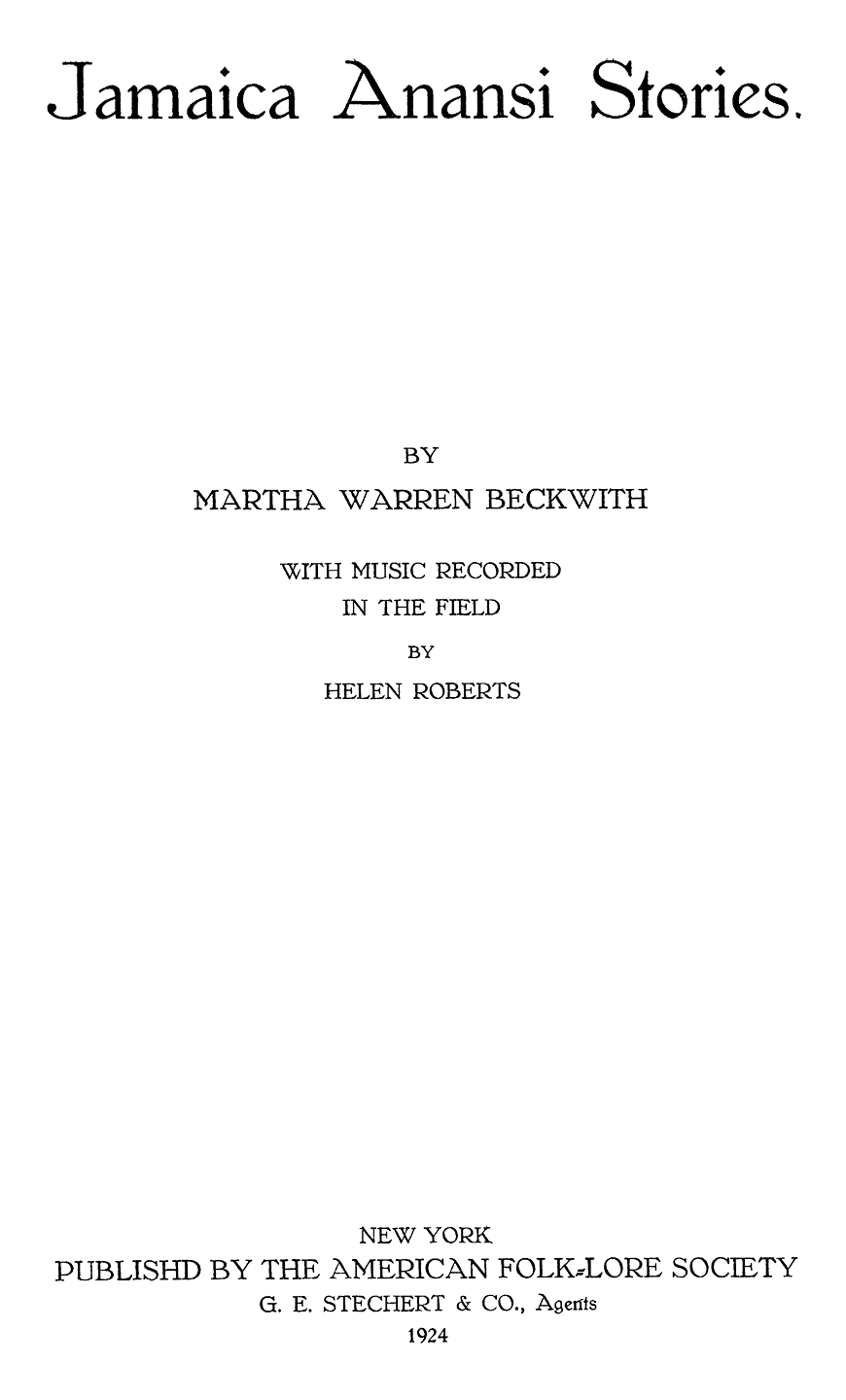
Beckwith's preface places her collecting visits in 1919 and 1921 and says that more than sixty Jamaican storytellers contributed. Roberts recorded music during the second visit, sometimes from a phonographic record Beckwith had made. Beckwith also acknowledges what dictation loses: pace, action and changes of voice. This is an important admission from the collector herself, not a reason to dismiss the tellers' artistry. [1]
The complete tale entries reproduced here preserve the edition's narrative wording. Page-number interruptions and reference markers have been removed for reading; song words are retained where printed. The spelling represents a historical transcription practice, not a rulebook for how Jamaicans must write today. No computer voice reads these transcriptions. Modern MP3 files supplied alongside musical scores in the electronic edition are not treated here as recordings of the original Jamaican speakers.
Anancy is not a simple good-behaviour mascot
Read Turtle's Escape beside Anansi and Mosquito. In the first, an intended victim uses ingenuity to survive Anansi. In the second, Anansi keeps the reward after another creature has done essential work. One rewards cleverness against a threat; the other lets cleverness become exploitation. Calling both “be clever” would erase the distinction.
Zobel Marshall's Anansi's Journey offers an influential interpretation of the figure's transformation from Ghana to Jamaica and his relation to resistance. We use that work as a scholarly framework, with access to the publisher's account rather than the full monograph. The tales themselves still need to be read individually. A trickster's successful deception does not automatically tell us that every victim represents an enslaver or that every audience endorsed the trick. [3]
Beyond the spider
The same collection moves into magical spouses, dangerous visitors, children, birds, riddling and songs. In The Tree-wife, a song follows a trail that ordinary sight cannot follow. Settling the Father's Debt makes interpreting a riddle an economic resource. Bird Arinto gives decisive action to a boy described as unable to walk, then makes Anansi's claim to his achievement collapse. These differences deserve room beside familiar spider tricks.
A living heritage needs living practitioners
The Jamaica Information Service's report on Blackwood Meeks's 2022 book launch connects her storytelling work with conferences, festivals and young participants. The ACIJ/Jamaica Memory Bank describes a wider audiovisual archive covering storytelling and oral history. These sources give routes for further learning; an inventory entry is not the same thing as a recording already streaming on this page. [4]
For family reading, use the tone filter before choosing. Some historical versions include killing, cruelty, coercion and frightening visitors. Those elements are identified at the individual tale; they have not been quietly removed and the result passed off as the original. If you retell a story more gently, call it your adaptation and keep the original teller in the conversation.
Scholarship & sources
- Beckwith, M. W. (1924). Jamaica Anansi stories. With music recorded in the field by Helen Roberts. American Folk-Lore Society. Primary preface, selected complete tales, song words and teller attributions consulted.
- National Library of Jamaica. Miss Lou 100: Louise Bennett-Coverley exhibition. Institutional biography and the library's story/proverb recordings.
- Zobel Marshall, E. (2012). Anansi's journey: A story of Jamaican cultural resistance. UWI Press. Publisher description and chapter outline.
- Reckord, E. H. (2022, November 20). Storyteller, Dr. Amina Blackwood Meeks, launches book. Jamaica Information Service. Account of The Children Ought to Know and the festival.
- Minott, W. M., & Rethinking Fables. My journeys with Ananse; a chapter from Travels of Ananse. First-person account of growing up with stories in Jamaica and recorded author reading. Modern adaptation, not historical field audio.
- African Caribbean Institute of Jamaica / Jamaica Memory Bank. AV collections. Institutional collection description; not every holding is publicly streamed.