STORIES & ORAL HERITAGE
Beyond Anancy: magical households, birds, riddles and warning tales
The repertoire is wider than one spider. Songs carry warnings, children expose false claims and riddles turn everyday work into interpretation.
The spider does not own every role
The phrase “Anansi story” can name a storytelling repertoire as well as a plot in which Anansi appears. Beckwith notes that the label was used broadly for storytelling, riddling and song in the communities she visited. Her collection gives a useful invitation: keep listening when a bird, an ordinary child or a mysterious visitor takes the centre of the account. [1]
The household could be a place of wonder and danger
The magical tales move familiar concerns into extraordinary circumstances. A spouse, a visitor, a debt or a child’s encounter can become the centre of danger. Songs and riddles then do practical work within the plot: they reveal a hidden identity, carry information or make escape possible. Their importance is clearer when the story is followed as an unfolding problem rather than mined for a moral at the end.
These stories also broaden what counts as Jamaican oral heritage. The spider is famous, but a repertoire includes different characters, moods and kinds of knowledge. A family could encounter humour in one telling and fear or grief in another. Preserving that range honours the tellers’ imaginative work and explains why a collection needs more than repeated examples of a clever trickster winning. [1]
Birds, sound and evidence
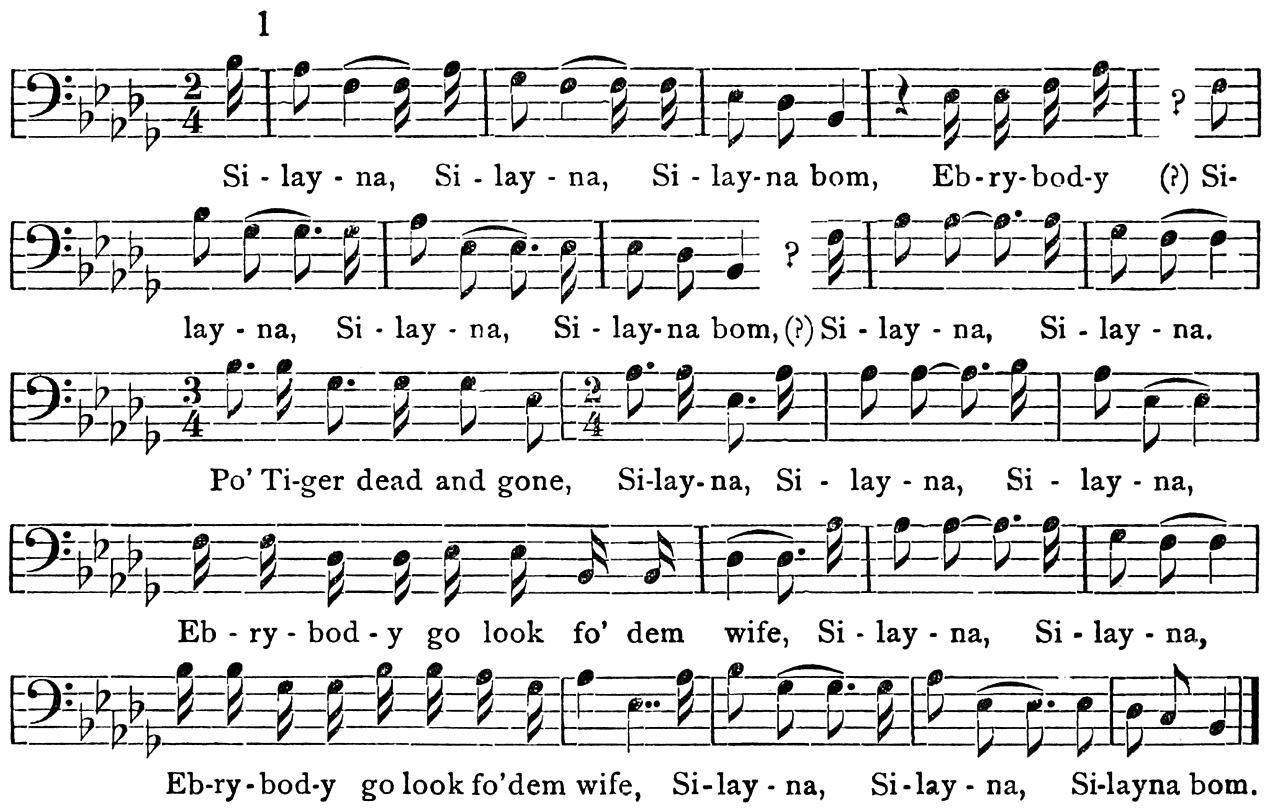
In The Golden Cage, the printed page places a short account of a king's daughter beside bird-song words. The song is part of the record we read, rather than background music added by this guide. In Bird Arinto, a boy's song helps him manage a threat; the tongue later provides evidence against a false claim. Neither tale needs to be an actual historical event to be worthy of attention.
Ask what the song changes. Does it reveal something a powerful character wants hidden? Does it call another being closer, create delay or preserve a warning? Those are reading questions, not a universal explanation of Jamaican song. Each tale gives a different answer. Written syllables cannot reconstruct every detail of a historical performance.
Source & credit
Magic households and dangerous hospitality
Thomas White's The Tree-wife gives a household a magical origin and lets a voice follow a trail. Alfred Williams's The Barking Puppy makes a warning persist after the warning animal is destroyed. The latter includes graphic cruelty and a violent ending; it belongs in our darker-reading category. Calling both harmless bedtime stories would misdescribe the page.
Folktale, legend and oral history also ask different questions. A tale can arrange impossible events to examine human conduct. A person's memory of a particular event has another relationship to evidence. The ACIJ/Jamaica Memory Bank collects across these areas, but their presence in one institution does not make them the same genre. Keep the teller, setting and kind of claim attached to the record. [2]
Riddling belongs beside narrative
Simeon Falconer's Settling the Father's Debt turns apparently impossible answers into explanations drawn from household life: borrowing, selling, illness and bodily discomfort. The listener has to reinterpret what has been said. That is a different pleasure from waiting for Anansi to reveal his plan, though both reward close attention to language.
Try stopping before the explanations. Let a listener offer an interpretation, then return to Falconer's version. A wrong guess is not evidence that someone lacks cultural knowledge; the wording deliberately hides its reference. In her preface, Beckwith describes riddling as a social pastime in which people took turns proposing puzzles.
A household collection of your own
Ask a relative which version they remember, who told it, where the telling happened and whether it included a song. With permission, record their own words rather than prescribing how Jamaican they should sound. Keep the date, their preferred name, language and any limits on sharing. A family recollection is worth preserving even if it differs from a published version.
When a story changes in your retelling, name the change. You might shorten an episode, soften a frightening ending or move the scene to a place a child knows. Those can be worthwhile choices. They become misleading when the result is passed off as the exact words of a named historical teller. This collection lets the historical text and your response remain visible together.
Sources & editions
- Beckwith, M. W. (1924). Jamaica Anansi stories. With music recorded in the field by Helen Roberts. Preface and named tales consulted in full. Reading interpretations are the guide's.
- African Caribbean Institute of Jamaica / Jamaica Memory Bank. AV collections. Institutional distinction between folklore material and oral testimony.