Who Could Afford a Veranda?
A veranda can look like a decorative detail. In a household history, it raises larger questions: who could obtain materials, who built the house, who controlled the land and how a family used the space. A building’s appearance cannot answer those questions by itself. Nor should Jamaica’s houses be arranged on a simple ladder from supposedly primitive to modern.
Architecture is an economy made visible
Louis P. Nelson’s Architecture and Empire in Jamaica examines buildings and landscapes from the late seventeenth century to emancipation. Its scope includes merchant premises, plantation buildings, fortified houses and the architecture of free Black Jamaicans, connecting Jamaican construction to West Africa and Britain. This is a social history of architecture rather than a catalogue of attractive great houses. [1]
Source & credit

Source & credit
For this building study, examine the thatched roofs and their relationship to the people and donkey in the Library of Congress photograph. Record the visible forms without treating the catalogue’s period terminology as a description of the residents.
Miscellaneous Items in High Demand, PPOC, Library of Congress · Public domain · Image record ↗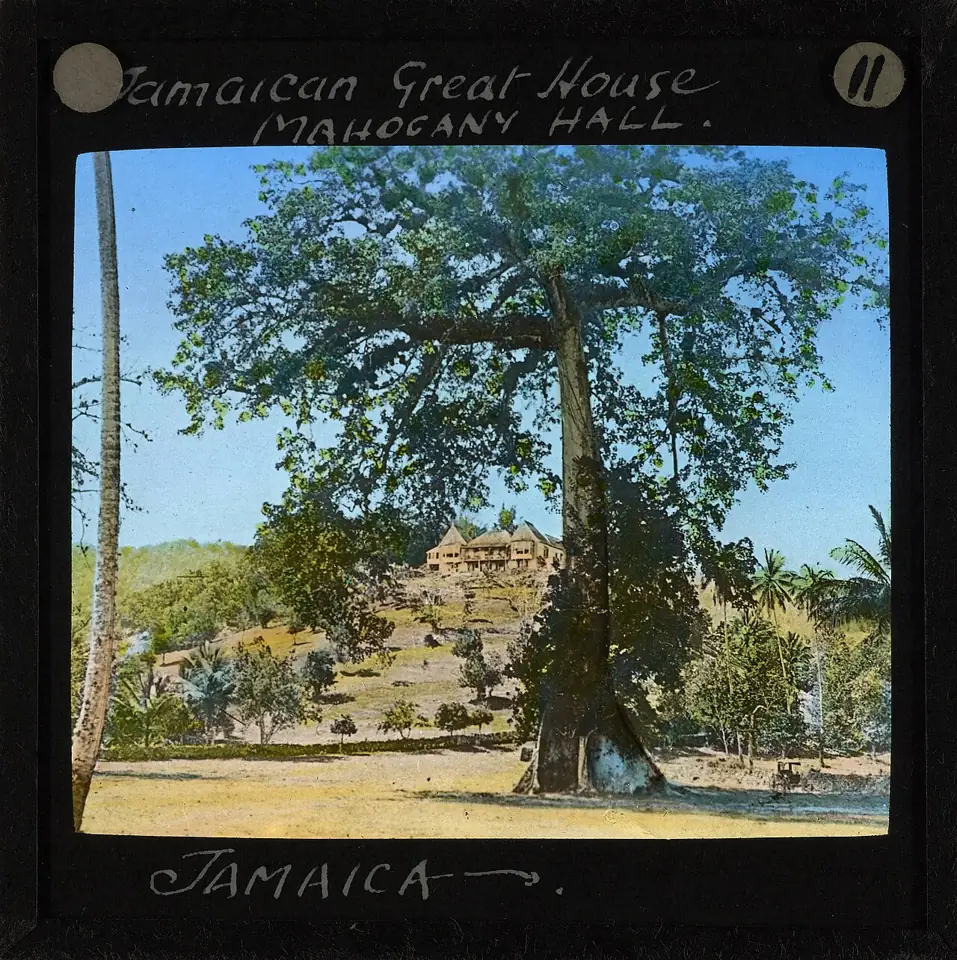
Source & credit
Keep the archive’s broad date range beside your sketch. Compare this residence’s elevated siting and scale with the smaller homes, then separate what the image shows from questions about who built and maintained it.
Unknown author · Public domain · Image record ↗That approach changes what belongs in the view. The owner’s residence and the works that generated income need to be considered together. So do the buildings associated with trade and the households outside the planter class. Their relationships make wealth and power more intelligible than a style label alone. A Georgian façade is evidence of a building form; explaining what paid for it requires an economic history.
A porch does not belong only to the wealthy
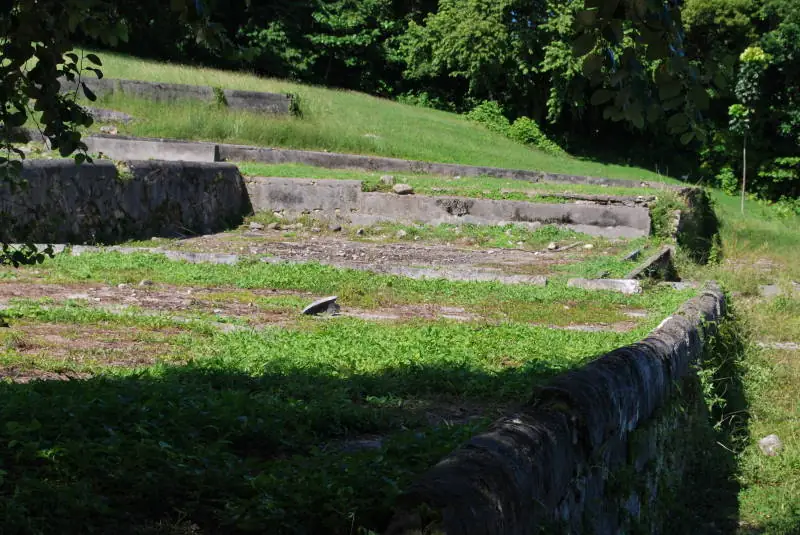
At Seville House 16, researchers identified evidence of a probable porch facing the village path. [2]
This specific finding warns against treating every outdoor frontage as a marker of elite comfort. A porch or veranda needs its site, date and household context. A small domestic structure can include transitional space between path and home without resembling a grand house. The useful comparison asks what that space allowed people to do, not simply how decorative it was.
Preservation should keep a building’s changes legible
Harmony Hall is a helpful comparison because its gallery history includes restoration and adaptation, not just the survival of an untouched nineteenth-century house. Read the separate article for the documented chronology and its source disagreement. An altered building can preserve history in layers: the earlier structure, the choices made during restoration and the later uses of its rooms. Removing every addition may make one period clearer while making another disappear.
On a visit, compare the façade with doors, routes through the building and its relationship to the surrounding plot. Ask which elements are original, repaired or redesigned. The answer should come from dated plans, photographs or documented work, rather than from the confidence of a tour narrative. Beauty is worth noticing. It becomes more meaningful when we also notice resources and labour.
Craft turned resources into a public statement
A veranda offered shade and a place at the threshold between house and yard, but its scale and ornament could also display resources. The visible result combined an owner’s purchasing power with the skill of people who designed, built and maintained it. Architectural beauty was made through work, not generated by a wealthy surname.
This helps explain why the same feature can appear in houses with very different social histories. The veranda’s practical usefulness could persist while materials, size and decorative ambition changed. Comparing an elite residence with a more modest dwelling reveals shared responses to living in Jamaica alongside unequal access to space and expense. The architecture becomes more intelligible when climate, craft and social standing remain in view together. [1]