Why the music carries: sound systems, dancehall and Jamaican public life
A speaker outside a shop, a bass line beyond a bend in the road, a dance advertised on a wall: these are clues to a history of technology, enterprise and public performance. They are not proof that every Jamaican lives for a party.
Start with the equipment and the gathering
A Jamaican sound system is more than a powerful stereo. It is an apparatus, a crew, a repertoire and a reputation. Engineers build and tune the set; selectors choose and sequence recordings; microphone performers address the gathering. The audience answers through movement, attention, approval and sometimes rejection. The music therefore changes in the encounter between records and people. Julian Henriques’s field research with Stone Love engineers in Kingston documents the learned listening and technical adjustment behind what can sound, to an outsider, like undifferentiated volume. [1]
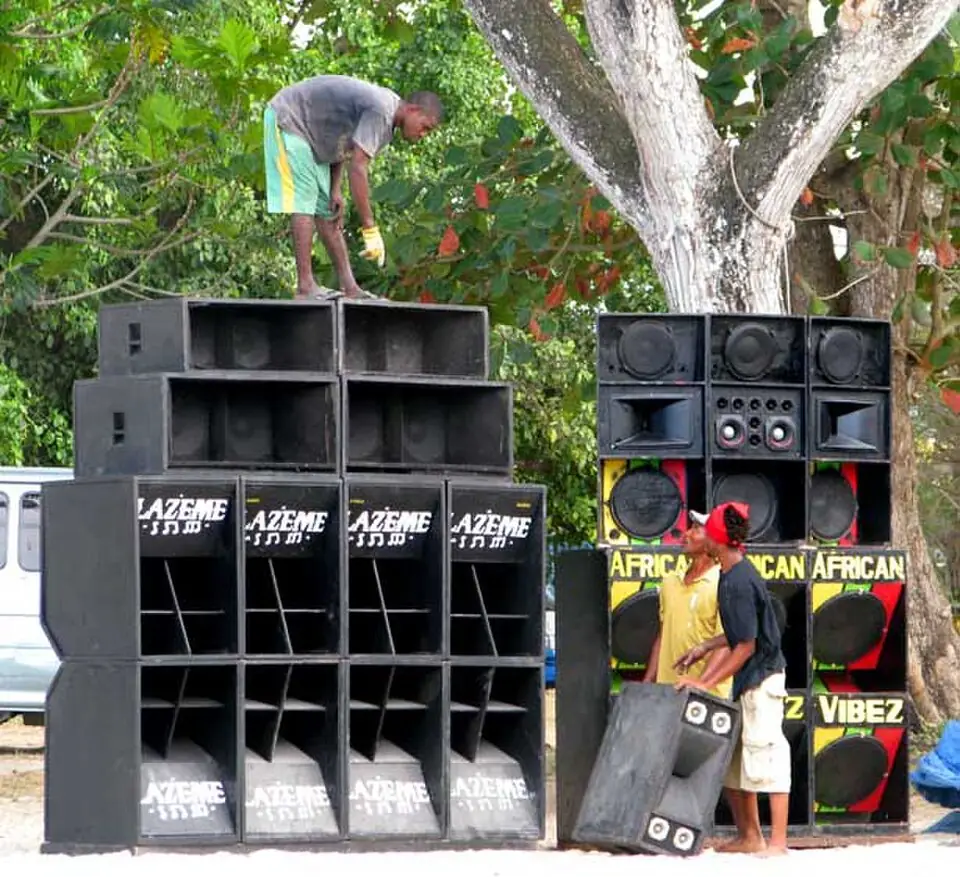
Source & credit
Look closely: Notice the people lifting equipment and the separate speaker cabinets. A sound system requires material work as well as selecting music. This is a modern Negril scene, not a photograph of the first Kingston systems.
Look at a speaker stack as working equipment. Bass, middle and high frequencies need different treatment; amplifiers, crossovers, microphones and speaker enclosures have to function together. Loading, wiring, checking, transporting and repairing the set are labor. When you see people setting up early for an evening dance, you are seeing a small production enterprise rather than simply a machine being switched on.
The dance came before the modern genre
“Dancehall” can name a musical genre, but it also points to the social spaces in which people gathered to dance. Sound systems developed in the mid-twentieth-century Jamaican recording culture, playing imported records and then increasingly locally produced music. The Museum of Arts and Design’s sound-system programme follows the movement through ska, rocksteady, reggae, dub and dancehall, while emphasizing the competitive exchanges among operators and audiences. That sequence is a useful orientation; it should not be read as one style abruptly disappearing when the next arrived. [2]
The sound could bring recorded music into a yard or an open gathering place without requiring a resident orchestra. Operators competed through selection, presentation and the character of their equipment. They helped make a record matter by putting it before an audience. The street dance and the recording studio were consequently connected parts of a music economy. A recording’s afterlife in public performance could be as consequential as the moment it was made.
The digital turn: one rhythm, many performances
A useful landmark is Wayne Smith’s 1985 recording “Under Mi Sleng Teng,” produced by King Jammy. The Music Voyager episode Dancehall Marathon visits Jammy and discusses the record as an early all-digital rhythm that transformed Jamaican production. Its surviving transcript supplies the historical explanation even though PBS marks that episode’s stream unavailable. Calling it a turning point is more defensible than claiming that no electronic experiment preceded it. [6]
The riddim—the underlying rhythmic track—helps explain why a listener may recognize the accompaniment beneath different voices. Reuse can be a field for variation: what changes is the vocal entry, lyrical argument, delivery and relationship to other performances. The history therefore involves producers and equipment as well as named singers and deejays. An electronic rhythm does not erase live skill; it changes where that skill is exercised. Listen for both continuity in the backing and difference in the voice rather than deciding that familiar accompaniment means the same song is playing again.
A voice beyond the tourism soundtrack
UNESCO’s account of Jamaican reggae places its emergence particularly within marginalized communities in western Kingston. It identifies social commentary, collective emotional expression and religious praise among its functions, alongside multiple musical influences. Reggae was inscribed on the Representative List of the Intangible Cultural Heritage of Humanity in 2018. This recognition concerns reggae’s living heritage; it does not make every genre, song or contemporary party interchangeable with reggae. [3]
What dancehall asks you to notice
Dancehall’s microphone performance, repeated rhythmic frameworks, dance, dress and interaction make it more than a list of songs. Henriques’s account describes the set as an instrument that reprocesses a recording in public performance, with engineers listening for balance and character as well as power. Sound-clash competition makes the distinct identity of a sound particularly important. [4]
A useful way into the culture is to ask who is doing what. Who chooses the next record? Who speaks? When does the gathering respond? Does the music stop for an announcement? Is the event organized around dancing, a visiting performer or competition? These questions reveal a social structure that a playlist cannot. They also leave room for women, dancers, promoters, vendors and audiences rather than treating the person holding the microphone as the sole creator of the night.
Why you hear music as you drive
Music can mark a social gathering, advertise a business, entertain workers or customers, accompany a family occasion, or announce that an event is getting underway. A roadside bar and a formal sound-system dance may both use amplified music without being the same activity. Gospel from a gathering is not dancehall because it travels beyond the building. Nor should the loudest sound you encounter become your definition of the parish.
The mobile sound-system tradition helps explain why public amplification has a cultural history here. But the meaning of a particular scene must be established locally. Ask a host what is happening; look for a dated event notice; distinguish a venue open to paying guests from a private yard. The sound may invite attention without giving permission to enter, film people or treat a neighborhood as a spectacle.
Residents have different tastes, work schedules and tolerances for noise. Enjoyment and annoyance can coexist. Respect for Jamaican creativity does not require pretending that unwanted volume has no consequences. Avoid the lazy explanations that Jamaicans are “naturally musical,” that poverty makes loudness necessary, or that the whole country shares one appetite for nightlife. They substitute a stereotype for history.
Go with understanding, and leave room for choice
Tony’s Call: Choose a clearly advertised public event and arrange the return journey before going. Ask about the actual start time, admission, seating, toilets and step-free access. Carry hearing protection and stand away from speaker stacks. Get consent before filming people, particularly dancers at close range. A restaurant session or seated concert may be a better entry point than an all-night street dance. None is a test of whether you are Jamaican enough.
Best for: People who want to understand public sound, musical labor and contemporary expression. Skip if: High volume or a late return would undermine your day. Next step: Listen to Jamaica Information Service’s Reggae Routes programme on Black Scorpio Sound, which identifies 30 Headley Avenue in Kingston. It is an audio introduction to a named sound, not an invitation to turn up at that address. [5]
Listen to an economy and a public argument
A dancehall account needs to explain the conditions of circulation as well as the sound. The recorded track, the selector's sequence and the audience's response are different contributions to an event. A recording preserves one contribution in a repeatable form; a session gives it timing, company and a particular reception. That difference helps explain why a hit on headphones is not a complete description of dancehall as a social setting.
Read the older music articles without making them rungs on a ladder whose final step is dancehall. Mento, religious drumming and other forms continued to have their own occasions and bearers. Connections between musicians and techniques matter, but a shared rhythmic feature cannot establish a single uninterrupted lineage. Compare what changed in amplification, recording, performance roles and audience rather than claiming that every new genre simply replaced the one before it.
Lyrics and controversy deserve the same historical care. Distinguish a song's speaker, a performer's public persona and an audience's interpretation. An analyst may examine language, sexuality, violence or aspiration without treating one artist as representative of all Jamaicans. The useful question is what a particular performance makes discussable and who can answer back. If you attend an event, verify the venue and program, transport home and your comfort with volume and crowd conditions. The history supplies context; it does not make every session an appropriate choice for every visitor.
Sources and notes
- Julian Henriques. Auditory and Technological Culture: the Fine-tuning of the Dancehall Sound System “Set”. Research Catalogue: Kingston fieldwork, named engineers and apparatus. ↩
- Museum of Arts and Design. Jamaican Sound System: curatorial history of recordings, public gatherings and musical change. ↩
- UNESCO. Reggae music of Jamaica, inscription 2018. ↩ · 2017 nomination film: source identity, duration and rights holders.
- Henriques. Field observations and interviews on tuning, learned listening and sound-clash evaluation. ↩
- Jamaica Information Service. Reggae Routes: Reggae & Sound System Culture, audio programme on Black Scorpio. ↩
- Music Voyager / PBS. Dancehall Marathon: surviving transcript of the King Jammy visit and digital-production discussion; episode streaming marked expired July 1, 2026. ↩
Historical framing comes from the cited institutional and field-research accounts. Roadside interpretation and visitor etiquette are this guide’s practical recommendations; they are not claims that every community behaves alike. Third-party playback depends on the publisher.