Windrush: the journey, the voices and the lives beyond the gangplank
Sam King was returning to a country where he had already served in wartime. His life helps carry this story beyond the famous gangplank and into work, belonging and the struggle to have that belonging recognised.
A famous arrival was not the beginning of Caribbean Britain
The Empire Windrush reached Tilbury in June 1948; the House of Commons Library distinguishes the ship’s arrival on 21 June from passengers disembarking on 22 June. The latter date is now commemorated as Windrush Day. The National Archives also documents the earlier postwar voyages of the Ormonde and Almanzora in 1947. Windrush is a powerful landmark, but treating it as the first Caribbean presence in Britain would erase what came before. [1] [2]
Sam King had crossed the Atlantic before
Sam King’s 1948 passage was a return journey. The Windrush Foundation, which he later co-founded, traces his life from his family’s Jamaican farm to an RAF recruitment advertisement in The Gleaner. He volunteered in 1944, trained in Britain and served in the RAF before returning to Jamaica after the war. When he boarded the Empire Windrush, Britain was a place he already knew.
He rejoined the RAF, later worked for the Royal Mail and became mayor of Southwark in 1983–84. In 1995 he and Arthur Torrington founded the Windrush Foundation. The passenger became one of the people preserving the passengers’ history. That sequence gives the arrival photograph a different scale: a farm, wartime service, a return home, another departure, work and public leadership. It is one man’s documented route, not a template for everyone aboard. [7] [5] [1]
Keep a ship, a journey and a generation distinct. The named vessel carried a particular group at a particular date. “Windrush generation” later became a shorthand for a much wider history of movement, settlement and family. A person can belong to that history without appearing on the famous passenger list. The distinction matters for both public history and family research.
Listen before turning the travelers into a symbol
The Pathé film below gives us short replies to a reporter. It also supplies commentary, editing and a requested song. Begin with one answer: what was asked, and what does the traveler explain? The sequence is an encounter produced for a cinema audience, not an unedited survey of everyone's reasons for moving. The publisher’s upload starts with an unrelated celebrity item; this player begins around the start of the Windrush sequence. [3]
Source & credit
A passenger’s statement, a reporter’s question and the narrator’s explanation can pull in different directions. Listen for those changes of speaker. A short answer about hope, work or home belongs to the person giving it; the commentator’s claim about a whole group is another layer. The individual passenger’s account remains distinct from the narrator’s description of the group.
A passenger list is another portrait, with other limits
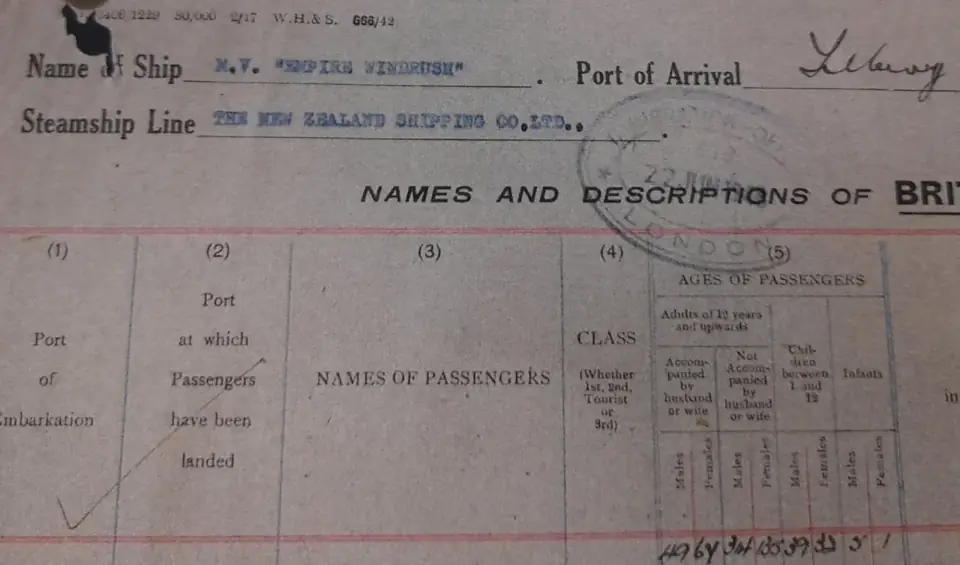
Goldsmiths offers a searchable transcription of the National Archives manifest, representing 1,027 passengers through recreated landing cards. It warns that the document’s condition may have introduced transcription errors and advises checking the original. “Last country of residence” is not the same field as birthplace, and a recreated card should not be mistaken for a surviving card carried by the passenger. [4]
The list is useful because it turns a collective image into names and recorded particulars. Choose one entry and keep each field separate. Then ask what another source can add: a later address, occupation, relative or personal account. An entry's absence of an explanation does not mean the traveler had no plan. It means the document was created for another purpose.
Examine the searchable passenger record ↗
Keep Jamaica in the story after the ship leaves
The National Library of Jamaica’s exhibitions follow named people, including Sam King, Cecil Baugh and John Mitchell Richards. Its account places King in Portland and Richards in the Fair Prospect/Windsor area. These biographies restore an earlier Jamaican life to a familiar British arrival image. A journey began in households, education, work and relationships before a camera reached the gangplank. [5]
The Jamaican and British perspectives should remain connected. Migration did not make the place left behind irrelevant. A personal history can follow obligations, correspondence and return alongside work and settlement abroad. Those questions are useful lines of inquiry rather than claims about every traveler on this voyage. For descendants, begin with the named person's own account whenever one survives, then place it beside the administrative record.
Citizenship needs its own chronology
The ship arrived before the British Nationality Act 1948 came into force on 1 January 1949. It is therefore misleading to describe the June passage as a journey enabled by that Act already being in operation. The Act's later framework belongs to the broader history of nationality and empire; it should not be moved backward to make the dates convenient. [6]
The later Windrush scandal brings another distinction into view: lawful belonging and having the documents accepted as proof of it are not the same practical situation. The Commons Library describes long-standing residents wrongly treated as unauthorized immigrants, with consequences for work, services and, in some cases, detention or removal. Its account places the wider public exposure of the problem in 2018. [1]
Read that history beside the original film. Public visibility on a newsreel did not protect every later life from administrative exclusion. The reason to keep names, records and testimony together is not simply genealogical curiosity. It is that institutions can demand a documentary account whose categories do not capture all the ways someone has lived as part of a society.
Put the voices into a longer listening sequence
Return to Una Marson’s 1940 interview and the Jamaican nurse’s 1941 account. Those sources put Jamaican voices in Britain before the Windrush arrival. They do not supply the biography of an unnamed passenger in the 1948 film, but they do correct the idea that Caribbean people became audible only on one celebrated June day. Follow the broadcasting and music articles for other routes through which people, skills and sound crossed the Atlantic.
Una Marson: a Jamaican voice shaping the microphone → · The nurse’s 1941 account → · Before-1950 listening guide →
Source & credit
Look closely: Read the ship and arrival-port fields before listening to the interviews. This photograph shows the list’s header, not a complete manifest or proof that every passenger came from Jamaica.
Sources and notes
- House of Commons Library, Windrush Day 2026: arrival/disembarkation dates and the later scandal. ↩
- The National Archives, Ormonde, Almanzora and Windrush: 1947 predecessors and differing date conventions. ↩
- British Pathé, Pathe Reporter Meets (1948), official upload. Luke McKernan’s account of the five newsreels and Pathé’s issue/release date. ↩
- Goldsmiths, Windrush passenger list: transcription, recreated cards and stated limitations. ↩
- National Library of Jamaica, Windrush 75: Jamaican biographies. A Journey of 7000 Miles: the earlier NLJ exhibition. ↩
- British Nationality Act 1948, original enacted text: commencement on 1 January 1949. ↩
- Windrush Foundation, Sam King: family farm, 1944 RAF recruitment, return migration, Royal Mail, mayoralty and the Foundation. Retrospective account from the organisation he co-founded; checked 17 October 2026.