Castleton Gardens: Scientific Beauty and the Colonial Plant Economy
Castleton Botanical Gardens is a rewarding landscape in its own right. Established on 19 November 1862, it developed as a major tropical botanical collection. But the history of botanical gardens is not only a catalogue of rare trees. Across the colonial world, plant collection and experimentation supported the movement of commercially valuable species and the expansion of plantation economies. A full account must examine what was cultivated at Castleton, who supplied the plant material, who maintained the grounds and which local farmers benefited. [1]
Castleton also reminds us that Jamaica's inland environments deserve as much historical attention as the coastal resort corridor. Botany, transportation, watershed management and rural labor all shaped the landscape travelers see today. [2]
Evidence: JNHT heritage listing; JIS St. Mary heritage sites.
From Bath to the Wag Water valley
Castleton began with a decision to move botanical work. The Heritage Trust dates its foundation to 19 November 1862 after dissatisfaction with the site at Bath, St. Thomas. Its location on both sides of the Kingston–St. Mary road placed a scientific collection beside a route through the hills. A visitor passing through the valley was encountering an institution made by people, as well as a river landscape.
Kew was one of the connections that made that institution possible. JNHT records more than 4,000 species received from the English garden at one period, and 180 palm species in Castleton’s palmetum in 1897. These are historical collection figures, not a census of what grows there now. They give substance to the idea of an imperial plant network: specimens and classifications moved between institutions, while their survival depended on work in the Jamaican garden.
The Trust also lists Bombay mango, navel orange, tangerine, poinciana and Spathodea among introductions planted here in the late nineteenth and early twentieth centuries. That account identifies planting at Castleton; it does not establish that every Jamaican orchard or roadside tree descended from a particular specimen in these grounds. The distinction lets us connect familiar trees to institutional history without giving the garden a monopoly on the island’s agricultural knowledge. [1]
1862: a garden established through an imperial plant network
The Heritage Trust dates Castleton’s establishment to November 19, 1862, following dissatisfaction with the earlier garden at Bath. Planting and exchanges with Kew linked the garden to a wider botanical network. The site was therefore a managed institution for collecting and cultivating plants, not simply a piece of scenery that happened to be beautiful. [1]
Source & credit

Source & credit
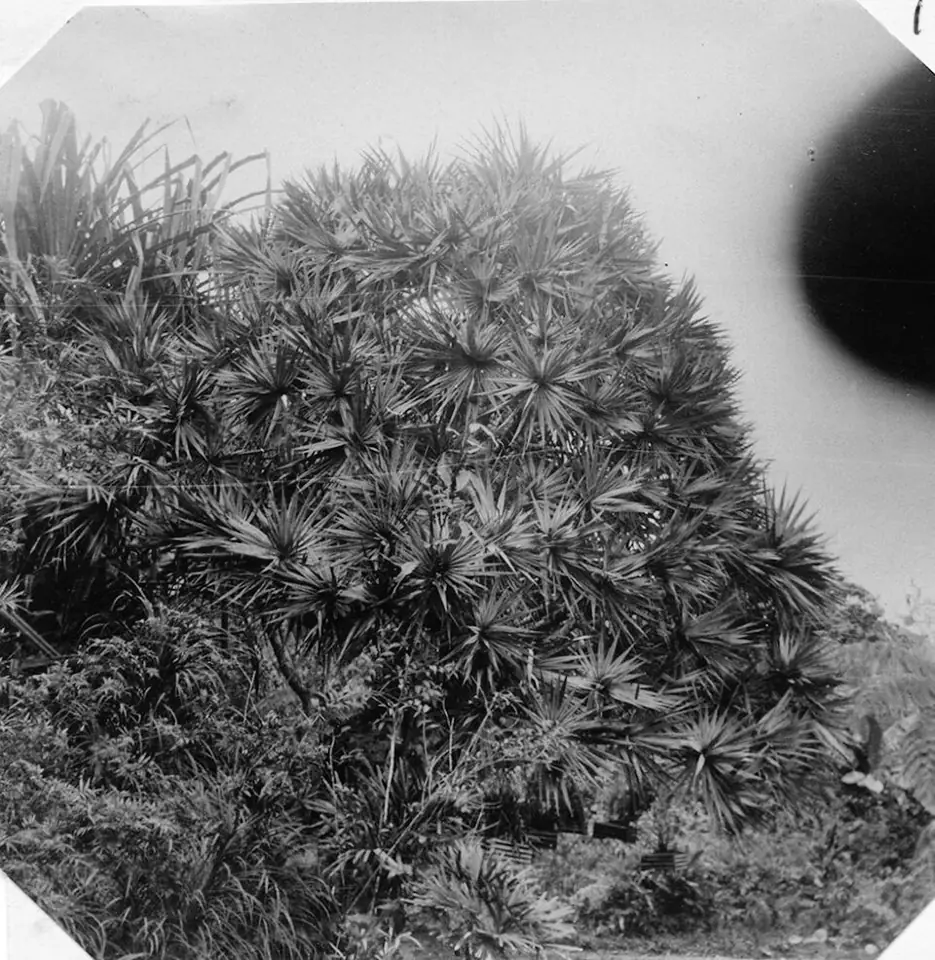
The garden appears as a composed scene. Maintenance and plant collection remain historical questions beyond what the image shows.
Adolphe Duperly & Sons · Public domain · Image record ↗Collections could serve science, ornament and economic ambition at the same time. Introducing a plant required decisions about suitability and care; maintaining it required continuing labor. The garden’s pathways and planted spaces embody that history of selection. The 1905 photograph makes an earlier visitor’s view visible and is clearly separated from present-day access information.

Source & credit

Source & credit
Carleton H. Graves’ stereographic view was made for an audience looking at the landscape from elsewhere.
Carleton H. Graves · Public domain · Image record ↗What the photographs show, and what changed
The 1905 Adams photograph, the Duperly view made before 1922 and the image published in 1915 are separate historical encounters with Castleton. They show how trees, paths and planted spaces became a subject for visitors and publishers. They are not a sequence of annual surveys. Different lenses, framing and plant growth prevent an exact measurement of change from these views alone.
Their abundance creates another imbalance: the landscape is visible, while the people maintaining it are much less well documented in these frames. A species count tells us something about collection; it does not tell us the gardeners’ wages, names, working conditions or botanical expertise. Those details require staff records and local testimony. The photographs show the cultivated landscape more clearly than the lives of the people maintaining it.
Read the garden alongside the farm
A botanical collection and a household garden both involve sustained knowledge of plants, but they give that knowledge different public standing. The formal garden can appear in institutional reports and international exchanges; practical cultivation may survive in family practice and oral accounts. Put Castleton beside the foodways and small-farming stories to see both kinds of expertise. The comparison is a way of asking who gets recognized as knowledgeable, rather than claiming that all cultivation followed the same history.
On a visit, begin with a plant label, the cultivated ground and the river’s position. Compare those observations with the dated photographs. A modern path does not prove the survival of a historic layout, and an old view does not establish safe river conditions today. Castleton rewards a slower encounter: the botanical collection explains one part of the place, while the surrounding valley and the work of care keep it connected to Jamaican life.
Foodways and cultivation → · Follow the working coast at Annotto Bay →
Sources and notes
- Jamaica National Heritage Trust. Castleton Botanical Garden: establishment, planting and historical collections. ↩
- Ministry of Agriculture, Fisheries and Mining. Castleton Botanical Gardens. (page unavailable at the October 12, 2026 link check; use the Heritage Trust citation above) ↩
- Jamaica National Heritage Trust, Castleton Botanical Garden: 1862 establishment, Kew exchanges and planting. ↩