How Jamaicans speak: place, class and the voices between
From Port Maria’s fishing talk to the cane country of Trelawny, Jamaican voices carry histories of work, family, schooling and movement. Listen to people explaining their lives, then examine what geography and class actually explain—and what the ear too easily assumes.
One country, more than one way of speaking
A Jamaican may talk one way over a fence, another when presenting a report, and another when telling a story that depends on a familiar turn of phrase. Those changes do not require a new personality or a journey across a parish line. They require a different relationship, purpose or audience. The useful question is not simply “Which accent is that?” It is “What is this person doing with language here?”
Patwa, also written Patois or Patwah, is commonly called Jamaican Creole in linguistics. It has a grammatical structure and a history of its own. UWI’s course on its structure and usage treats it as a language, with orthography, literature and applications beyond familiar conversational settings. Calling it broken English misses the object we are trying to understand. Sharing much vocabulary with English does not make two grammatical systems identical. [1]
Jamaican English is also Jamaican. A person can speak standard English with a recognizably local pronunciation. Irvine-Sobers’s investigation of formal professional speech makes this especially clear: local norms contain systematic variation. A British or American sound is not the necessary destination of every educated Jamaican voice. Her study examines the speech of a particular institutional cohort; its strength is detailed analysis, not a claim to represent every household. [2]
| Term | What to examine | Useful question |
|---|---|---|
| Language / variety | Grammar, sound patterns and vocabulary together | Which system or combination of resources is being used? |
| Dialect | Differences in grammar and vocabulary as well as sound | Which features recur within a community? |
| Accent | Pronunciation | Which vowel or consonant actually differs? |
| Register / style | Choices associated with a task, audience or stance | Does the same person change in another setting? |
The history is contact—and unequal power
Jamaican speech developed through contact involving African languages and varieties of English under colonial slavery. Describing the result as a simplified imitation hides both the contact processes and the people who made a functioning language in conditions they did not choose. Scholarship differs over how the continuum formed and how its intermediate varieties should be modelled. A history of social stratification is relevant; a single story of rural speech slowly becoming urban English is insufficient. [2]
The familiar terms basilect, mesolect and acrolect help describe a range from Creole structures furthest from standard English through intermediate patterns to English-oriented varieties. They are analytical terms, not grades of intelligence. Mufwene’s critical review of Patrick challenges treating the endpoints as pure everyday speech or assigning a separate, uniform grammar to everything in the middle. He also questions the assumption that rural varieties simply lag behind urban development. This disagreement matters: a convenient diagram can become a misleading history. [4]
Patrick’s Kingston research asks how variation patterns with social influences and how intermediate speech is organized. That is a more demanding question than sorting everyone into three boxes. The continuum describes relationships among forms, including bilingual choices, mixed resources and meaningful shifts within one conversation; it is not a ladder that people must climb. [3]
Source & credit
African origins, settlement and movement
Joseph Farquharson’s scholarly survey places the language’s development in a changing population rather than a timeless mixture. Early Africans brought under British occupation included people transferred from other colonies; later direct arrivals from Africa outnumbered that earlier group. The African regions contributing to Jamaica changed over time. His account identifies Akan as a major source of African vocabulary while also recognizing other African languages. The history therefore cannot be reduced to “English plus one African language.” [12]
The same survey distinguishes evidence for emergence from a precise founding date: the late seventeenth century is important, while eighteenth-century descriptions are uneven and filtered through European judgments. After emancipation, the end of large-scale forced arrivals changed the conditions of language contact. Twentieth-century rural-to-urban movement then brought local varieties together and contributed to dialect levelling. Farquharson nonetheless describes continuing boundaries, especially in vocabulary. Geographic difference remains a subject for research even where movement has blurred some contrasts.
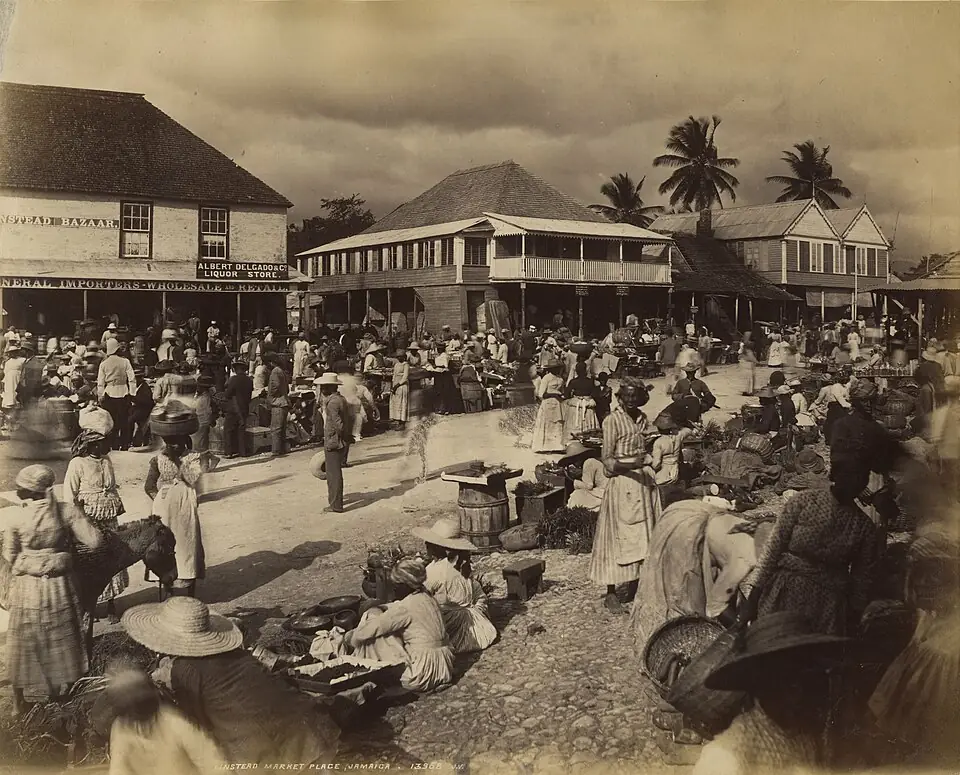
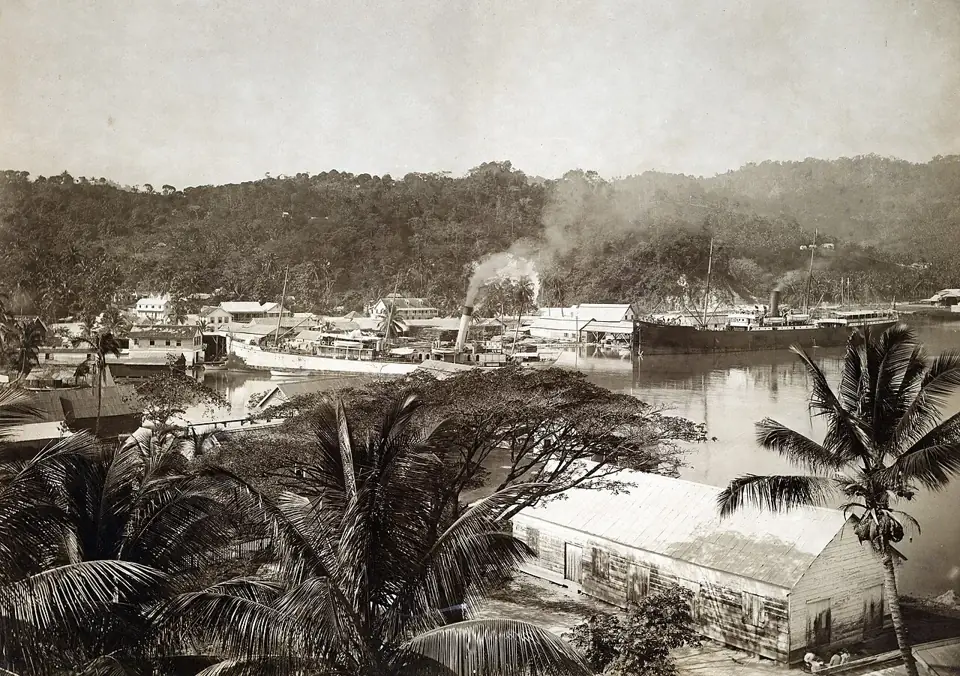
For our parish guides, that means the useful unit is often a network of settlements and people, not an administrative outline. A family with rural relatives, work in a town and migration abroad can participate in several speech communities. This is the guide’s interpretation of why settlement and movement belong beside sound: the route a person’s life follows may explain more than the parish printed on a birth record. Photographs of markets and harbours show places to investigate those connections; they do not supply the missing speech evidence.
Geography: a sound boundary is not automatically a parish boundary
There are documented regional differences. Initial h is a useful example. Irvine-Sobers’s review of the literature notes that it is not phonemic in many Creole varieties, while western varieties, including examples from Trelawny and St. Elizabeth, have evidence of a meaningful /h/ contrast. “Phonemic” means that the sound can distinguish words; it is a different claim from noticing that a speaker sometimes says an h. In other varieties, an h can appear without carrying that same contrast. [2]
This is why the casual expression “dropping your h” needs care. It assumes that a speaker has begun with an English sound system and omitted something. That may describe a particular use of English; it does not adequately describe every Creole system. Equally, a strongly pronounced h is not by itself proof of western birthplace, education or income. The same sound can participate in a regional contrast, careful English pronunciation, emphatic speech or hypercorrection.
Here is a practical geographic distinction: the place where a recording was made, the place where a person grew up, and the places where their speech habits developed are different kinds of information. A recording labelled Port Antonio may include workers who moved there, students with other home districts, or several people on one reel. A town name on an archive record locates a session. It does not authenticate a permanent “Portland accent.”
LISTEN · REAL FIELD RECORDING
Port Maria, St. Mary
1952 · SR 7 · Cassidy collection, Smithsonian
Oswald Miller is catalogued as a fisherman; the other speaker is tentatively identified as a boatbuilder. The reel includes songs as well as an occupational interview.
Listening question: Follow the occupational explanation; distinguish it from any song. Do not assign every voice to the named fisherman.
Full reel side, not an isolated or transcribed excerpt. Field locality does not establish every speaker’s birthplace or social class. Original archive player ↗ · Finding aid & credits ↗ · Original reel inventory ↗
Source & credit
Country and town: connected lives, different expectations
“Country” and “town” are social descriptions as well as places. A listening study by Dyer and Wassink used a casual, unscripted exchange among three Jamaican women of different ages and social backgrounds. Listeners did not simply classify voices according to the speakers’ actual origins or the number of Creole forms they used. An urban upper-middle-class woman could be heard as rural, while a woman born in a rural district could be heard as having a Kingston voice. Age and expectations complicated the judgments. The study is small; it demonstrates a problem with simplistic classification rather than providing a national error rate. [5]
The lesson is substantial. A listener can be hearing identity through age, delivery, assumed confidence and a familiar social stereotype. Someone may correctly notice a sound but incorrectly infer the speaker’s life. That makes “I can always tell which parish” a proposition to test, not evidence on its own. Ask what features you heard, whether they recur, and whether the speaker’s biography actually supports the inference.
LISTEN · REAL FIELD RECORDING
Deeside area, Trelawny / St. James
1952 · SR 2, side b · Cassidy collection, Smithsonian
The inventory lists Eglon Menzie, Wedan Miller on wild-hog hunting, Sedyu Leris on pineapple culture, and Chas. Samuel Johnson on corn growing.
Listening question: Listen for how a working process is explained. These are multiple speakers and subjects, not one representative northwest accent.
Full reel side, not an isolated or transcribed excerpt. Field locality does not establish every speaker’s birthplace or social class. Original archive player ↗ · Finding aid & credits ↗ · Original reel inventory ↗
LISTEN · REAL FIELD RECORDING
Hamden estate area, Trelawny / St. James
1952 · SR 3, side b · Cassidy collection, Smithsonian
Wilmot Brown discusses planting cane; James Brown discusses carpentering. The archive’s Hamden label and spelling are retained.
Listening question: Compare the cane and carpentering explanations with Deeside. Occupation, question and speaker change as well as location.
Full reel side, not an isolated or transcribed excerpt. Field locality does not establish every speaker’s birthplace or social class. Original archive player ↗ · Finding aid & credits ↗ · Original reel inventory ↗
These northwest recordings allow a more grounded comparison: keep the archive, broad period and occupational-interview purpose reasonably similar while changing the locality or speaker. They still do not isolate geography. Different occupations, ages, questions and relationships can affect speech. Listen first for how an explanation is built—sequence, repeated words, pauses and responses to the interviewer—before deciding that an unfamiliar form must belong to a parish.
Class: who gets heard as competent?
Class is not a sound. It concerns unequal access to money, institutions, credentials and influential networks. Accent enters that system because listeners assign social meanings to it. Education, occupation and family background can be related without being interchangeable. A farmer may have extensive schooling; a professional may use Patwa fluently; a wealthy person may have family speech habits that do not fit a stranger’s stereotype.
Irvine-Sobers’s analysis is useful precisely because it examines individual variables instead of treating “good English” as one indivisible sound. In her formal-speech sample, some pronunciations are strongly constrained while others remain variable among English-speaking professionals. Her “load-bearing” metaphor distinguishes forms important to a local interpretation of English from forms that permit greater flexibility. This does not mean listeners are justified in discriminating. It describes a system of expectations that can have consequences in a workplace. [2]
Consider TH. The voiceless consonant in thin and the voiced one in them do not behave as a single variable in her findings. Nor do all occurrences of R, or all vowels in the same broad category. A speaker can retain locally meaningful features while using English. Ranking someone by one consonant confuses a linguistic observation with a social verdict. The appropriate unit of analysis is a pattern in a specified context, with enough examples to establish it.
The national Language Competence Survey collected data in 2006 and reported in 2007. Its 1,000-person sample considered eastern/western location, urban/rural setting, age, gender and occupation. Demonstrated switching varied across some groups, and the interviewers’ gender combination and opening language also interacted with responses. This is evidence about performance in that study’s tasks, not a current census of everyone’s ability. Crucially, it shows that the encounter itself belongs in the explanation. [7]
For a returning Jamaican or visitor, this has a practical implication: do not mistake a person’s accommodation to you for the language they always use. A hotel employee may use a work register because the job requires it. The same person’s conversation at home can differ. Neither voice becomes false merely because the audience changes. Conversely, a few Creole phrases in an otherwise formal interview do not prove that we have heard the full extent of a person’s everyday repertoire.
Source & credit
LISTEN · REAL FIELD RECORDING
Christiana, Manchester
1952 April · SR 13, side a · Cassidy collection, Smithsonian
Hubert Miller: ginger; Irene, surname uncertain: hurricane; Donald Allen: head sugar; Essie Rose: agricultural recovery. The collection dates this reel to April 1952.
Listening question: Follow knowledge and recollection before accent. The wider catalogue heading includes Barbican, but Barbican is on side b; this selected side is Christiana.
Full reel side, not an isolated or transcribed excerpt. Field locality does not establish every speaker’s birthplace or social class. Original archive player ↗ · Finding aid & credits ↗ · Original reel inventory ↗
Twang, speaky-spoky and the microphone
The concern about “twanging” is a concern about the recording situation: are we hearing someone concentrate on a lived experience, or someone trying to satisfy an imagined examiner? We cannot answer that merely by deciding which accent we prefer. A person’s fluent Jamaican English is not automatically an attempt to impress. A diasporic accent may reflect decades of actual residence. The target for this listening collection is meaningful, uncoached speech, not an invented requirement that every Jamaican sound the same.
Irvine-Sobers discusses hypercorrection: speakers may extend a pronunciation associated with prestige beyond the words where it belongs in the target system. Initial h inserted into a word that would not have it is one example; her analysis also treats vowels and consonants. She connects this with the locally recognized “speaky-spoky” style discussed by Patrick. Hypercorrection and borrowing a foreign accent are not identical processes, although listeners can group them together socially. Understanding the distinction is more useful than laughing at either. [2]
A microphone can increase attention to pronunciation. That does not invalidate every interview, but it does make recording method part of the evidence. Our choices here favour people explaining fishing, cane planting, corn growing and agricultural recovery. There is no supplied passage for them to read in these selected catalogue descriptions. Nonetheless, the catalogue does not prove that nobody rehearsed, accommodated to Cassidy, or adjusted for the recorder. These are documented field interviews, not certified microphone-free speech.
Grammar carries meaning; it is not missing English
A useful listening exercise moves beyond accent. In Jamaican Creole, forms such as mi, preverbal markers and plural dem belong to grammatical patterns. The absence of an English ending does not mean the listener should assume an absence of time, number or thought. Meaning can be carried elsewhere in the utterance and in its context. The examples below are learning examples, not quotations from the archival speakers and not a claim that every Jamaican chooses these forms. Farquharson’s survey documents these types of pronoun, noun-phrase and preverbal constructions. [12]
| Example | Approximate English meaning | What to notice |
|---|---|---|
| Mi a wok. | I am working. | A preverbal marker rather than an English -ing ending alone. |
| Di pikni dem. | The children. | A post-nominal plural pattern; use depends on context. |
| Mi buk. | My book. | The personal-pronoun form used before a possessed noun. |
| Im gaan. | He/she has gone, or went, depending on context. | Do not assign English gender or tense from the pronoun or verb shape alone. |
The descriptive research documents plural -dem, possessive patterns and variation in verbal marking. The central point is not a traveller’s phrase list: combinations of forms do not mechanically determine the social identity listeners hear. Our table is a starting point for attending to structure; it is not a transcription key to apply indiscriminately to six different people. [5]
Vowels deserve the same discipline. Wassink’s acoustic study compares ten Creole-dominant and nine English-dominant speakers and examines vowel quality and duration. The publisher’s abstract reports variation within speakers as important to style. “The Jamaican vowel” is therefore too blunt a description. Ask which word, which sound, which speaking task and which speaker. A small research sample can establish relationships worth studying without furnishing a complete island accent map. [6]
Portland: an interview, a story and a harbour
LISTEN · REAL FIELD RECORDING
Port Antonio, Portland
1952 · SR 9, side a · Cassidy collection, Smithsonian
Joseph Camden, night watchman, and Hala Daily, carpenter, are connected in the inventory with United Fruit. Irene Edwards tells Anancy stories; Herbert Scott and possible others are also listed.
Listening question: Separate occupational interviewing from storytelling. The archive’s comment about school influence is a cataloguer’s interpretation.
Full reel side, not an isolated or transcribed excerpt. Field locality does not establish every speaker’s birthplace or social class. Original archive player ↗ · Finding aid & credits ↗ · Original reel inventory ↗
Source & credit
An interviewee explaining work and a narrator telling Anancy are engaged in different verbal tasks, even on the same reel. A story can involve quoted voices, heightened rhythm and an audience’s expectations. Calling that a “stronger dialect” might mistake narrative technique for geography. In the Port Antonio inventory, the note about school influence attached to Irene Edwards is also the cataloguer’s assessment, not a measured education score or a transparent description of her whole language history.
The south coast: hear work before inventing a stereotype
LISTEN · REAL FIELD RECORDING
Frenchmans’ Bay, St. Elizabeth
1952 May 5-6 · SR 15, side b · Cassidy collection, Smithsonian
The reel is catalogued under Bull Savanna and dated 5–6 May 1952. Side b’s inventory specifies Frenchmans’ Bay: fishing and cassava; speakers are not named there.
Listening question: This is the locality for the selected reel side. Do not substitute Bull Savanna for every segment or invent speaker names.
Full reel side, not an isolated or transcribed excerpt. Field locality does not establish every speaker’s birthplace or social class. Original archive player ↗ · Finding aid & credits ↗ · Original reel inventory ↗
For St. Elizabeth, the archive is specific enough to improve on a generic country-voice label: the selected reel side lists fishing and cassava at Frenchmans’ Bay. The wider reel is catalogued under Bull Savanna and contains other locations on its opposite side. We keep those distinctions visible. “Recorded in St. Elizabeth” is useful; attaching a speaker’s birthplace, income or schooling without evidence would add facts the archive has not supplied.
Comparing this recording with Port Maria may help you ask how explanations are organized around tools, weather, timing and experience. It cannot establish a western/eastern h contrast unless the relevant words are present, the segments are identified and the sounds actually analyzed. The article supplies the research question and the recordings. It does not pretend that pressing Play is equivalent to completing a phonetic study.
Not all Jamaican language differences are parish dialects
The country’s language landscape is wider than a Patwa/English comparison. Maroon Kromanti, Jamaica’s sign languages and diasporic heritage languages need their own histories and communities. Do not fold ritual language into a supposed accent of everybody in Portland, or assume that a sign language is simply English transferred to the hands. The guide’s existing language resources provide separate routes into those subjects. Explore Kromanti → · Open the wider language resources →
Kiss-teeth offers another reminder that communication is more than words with dictionary equivalents. Figueroa and Patrick examine its interactional meaning: timing, relationships and the surrounding exchange matter. Reducing it to a universal signal of annoyance strips away the action performed in a particular conversation. A respectful listener asks what happened immediately before and after the sound rather than borrowing it as a token of authenticity. [9]
School, dignity and access to public life
The JLU’s institutional history connects language planning with access to state services and protection from language discrimination. The practical issue is whether people can understand and be understood in consequential encounters. An unfamiliar English form can become a barrier in an office even when the speaker has knowledge and a clear account to give. Improving English access and valuing Jamaican Creole are compatible aims; humiliating a child or adult for a home language is a different proposition. [8]
Attitudes must be studied separately from linguistic structure. UWI’s 2005 attitude survey asked about language across rural and urban sites; it cannot tell us what every Jamaican thinks today. Nor can a listener’s belief that one variety sounds intelligent establish that the variety makes people intelligent. The distinction matters in schools, hiring, healthcare and tourism, where a prejudice can quietly acquire the appearance of a neutral standard. [11]
A listening session worth doing
Choose two occupational recordings and stay with each long enough to hear an explanation develop. On the first pass, follow the subject: what knowledge is the speaker sharing? On the second, note one feature you can describe precisely, such as a repeated pronoun, a word beginning with h, or the way a response begins. Record the time shown on the player. On the third, ask which differences might arise from the interviewer, subject matter or recording quality. Do not force an answer when the evidence is insufficient.
Now try the harder question. If you did not know the place label, would you confidently assign a parish or class? What evidence would change your mind? The exercise is valuable when it produces better questions, not just stronger opinions. A careful comparison identifies both what can be heard and what still requires a biography, transcript or larger sample.
Keep your listening observations
Notes stay in this browser; nothing is sent to the guide.
What this evidence establishes—and what it leaves open
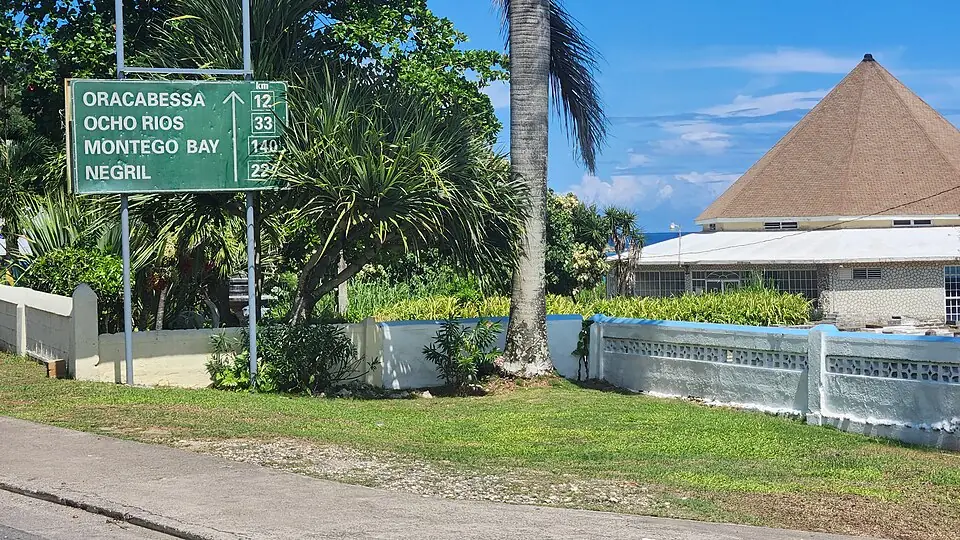
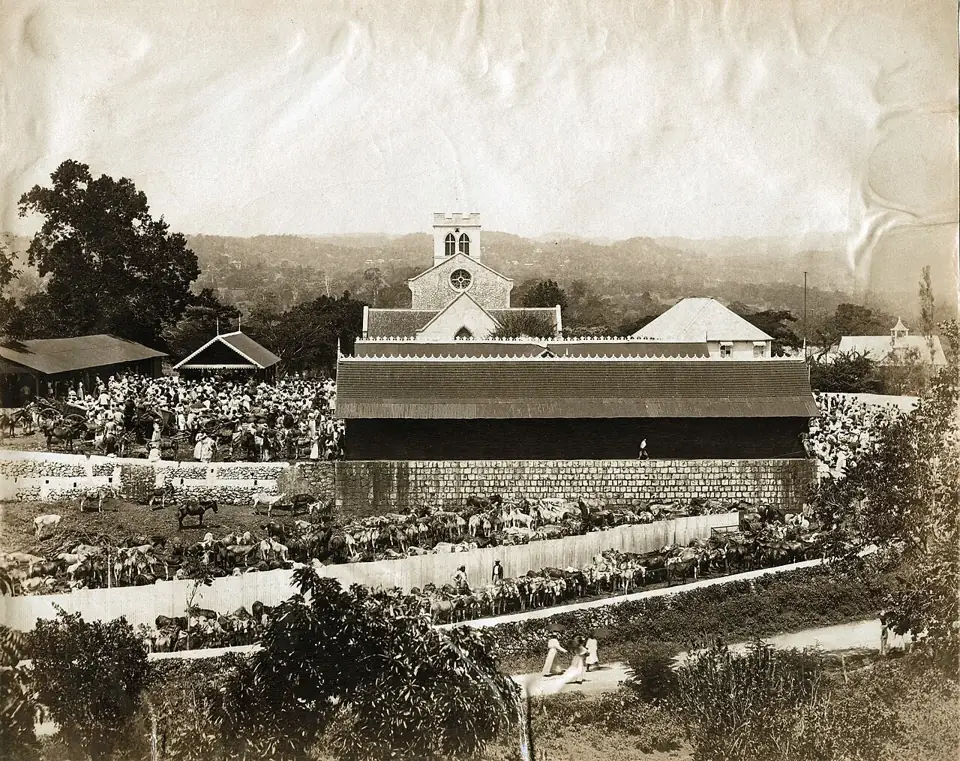
The article draws on linguistic research, UWI’s institutional studies and identified Smithsonian field material. The photographs establish places and visual contexts; they do not establish pronunciations. The six audio selections establish documented recording settings and subjects. They do not provide a balanced, present-day sample of all parishes, ages and social classes. Contemporary community conversation would strengthen that coverage; it should arrive with speaker biography and a clear account of the recording situation.
The next strong step is not a parade of people asked to “speak broad.” It is repeated, consented recording of people discussing things they know with people they normally talk to, complemented by their own account of upbringing, schooling, migration and language choices. Compare similar tasks across locations, and compare the same speaker across settings. That would allow the guide to ask which patterns belong to geography, which to social networks, and which to the situation. It is a proposed extension, not research already conducted here.
Research, recordings and source notes
- UWI Mona. Introduction to the structure and usage of Jamaican Creole (LING2810). Institutional course description: language status, structure and public uses. ↩
- Irvine-Sobers, G. A. (2018). The acrolect in Jamaica: The architecture of phonological variation. Language Science Press. Chapters 1–3 and 5; especially pp. 35–58, 109–117 and 149–159. DOI: 10.5281/zenodo.1306618. Full book consulted; CC BY 4.0. ↩
- Patrick, P. L. (1999). Urban Jamaican Creole: Variation in the mesolect. John Benjamins. Repository abstract consulted for scope; detailed findings are not attributed to an unread full text. ↩
- Mufwene, S. S. Review of Patrick’s Urban Jamaican Creole. Author’s University of Chicago text. A contrasting interpretation of the continuum and rural/urban history. ↩
- Dyer, J., & Wassink, A. B. (2002). Taakin braad and talking broad: Changing indexicality of phonetic variants in two contact situations. Texas Linguistics Forum, 44(2), 288–301. Especially the Kingston listening task, pp. 296–299. ↩
- Wassink, A. B. (2001). Theme and variation in Jamaican vowels. Language Variation and Change, 13(2), 135–159. DOI: 10.1017/S0954394501132023. Publisher abstract consulted; online posting dated 2002. ↩
- Jamaican Language Unit. (2007). The Language Competence Survey of Jamaica: Data analysis. UWI Mona. 2006 fieldwork; September 2007 report. Executive summary and methods, pp. 5–11. ↩
- Jamaican Language Unit. Background. UWI Mona. Institutional history of language discrimination, public services and the unit’s establishment. ↩
- Figueroa, E., & Patrick, P. L. (2002). The meaning of kiss-teeth. Author manuscript, University of Essex repository. Interactional meaning and evaluation. ↩
- Smithsonian National Anthropological Archives. Frederic G. Cassidy papers and sound recordings concerning Jamaican language, 1951–1991 (NAA.2008-22). Finding aid and reel inventories, especially refs. 16, 18, 26, 30, 36 and 40. XML inventory independently checked.
- Jamaican Language Unit. Surveys. UWI Mona. 2005 language-attitude survey: sampling and dates. Historical attitudes are not a current national opinion poll. ↩
- Farquharson, J. T. Jamaican. In the Survey of Pidgin and Creole Languages / APiCS Online. Sections 2–6: contact history, sociolinguistic situation, phonology, noun phrase and verb phrase. Survey consulted; CC BY 4.0. ↩
Adaptations of Farquharson’s APiCS survey and Irvine-Sobers’s open book are credited under CC BY 4.0.