Ackendown: a castle inscription and the people it leaves unnamed
A proprietor’s name survives in stone. An estate return supplies another part of the history: the people held in slavery behind the monument.
The inscription gives one man a biography
JNHT identifies Ackendown Castle’s two surviving stone towers in Westmoreland and an inscription commemorating Archibald Campbell, who died on 21 April 1833 aged 52. The inscription says he built the castle. It preserves family origin, age and authorship in a form intended to endure. Notice the allocation of detail: the named man has a memorial, while the people who sustained the estate do not appear in that short text. [1]
The owner’s inscription preserved only one side of the estate
An inscription gives a name and an enduring claim to remembrance. An estate return organises the same world differently, counting people held in slavery within the property. Read together, they expose the gap between the individual made conspicuous in stone and the many people whose work supported that standing.
The castle’s significance grows when those records remain beside it. The residence belonged to a larger system of production and coercion, not just to the proprietor’s biography. Recovering households and relationships from other documents can begin to restore the people compressed into the estate total. The ruin then becomes an entrance into a community history rather than the end of an owner’s story. [source]
Source & credit
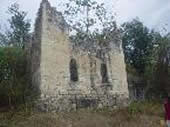
Look closely: Look at the tower’s openings and surviving masonry. Then compare the building with the inscription and almanac counts: a wall photograph cannot recover the names and experiences omitted from an estate inventory.
Add the estate return to the stone
The transcribed 1816 Jamaica Almanac’s Westmoreland list records Ackendown with 132 enslaved people and 326 livestock. Read those numbers critically: people and animals are set within an owner-centred property return. The entry documents the existence of enslavement at the estate, but does not tell us the names, household arrangements or skills of those 132 people. Nor is the printed almanac year automatically the exact date of a population count. [2]
A castle does not identify every builder
The memorial’s claim that Campbell built the castle may credit the commissioner or proprietor rather than every person who cut, moved and laid stone. The estate return establishes a slavery context, not the legal status of each mason. It would take contracts, accounts or individual records to identify the actual workforce. That distinction allows the article to connect the ruin with slavery firmly without inventing a named construction crew.
Compare returns instead of treating one total as timeless
The 1824 almanac transcription lists John G. Campbell and Ackendown with a different total: 136 enslaved people and 365 livestock. Two entries expose change and the need for careful attribution. A similarity of surname does not make John and Archibald the same person; a change of count is not, by itself, a birth or mortality calculation. Movement, ownership, reporting and property boundaries can all affect totals. [3]
The ruin has a later preservation history
JNHT records national-monument designation on 21 December 2006. That is a date for legal recognition, not construction. Its qualified description of a connecting passage does not establish an accessible underground visitor route. The source photograph shows a surviving tower long after the slavery period. [1]
Change the monument’s caption
Try describing the castle without allowing its inscription to monopolise the history. A fuller label can name Campbell, identify the recorded enslaved estate population, and acknowledge the missing individual biographies. This does not erase the named proprietor. It changes the frame from a singular achievement to an estate society with unequal power. Read Savanna-la-Mar’s history alongside it to consider how rural properties connected with the parish’s port and institutions.
Try the history yourself
Write a 60-word museum label using the inscription and one almanac entry. Include a date and a limitation. Then underline every person who is named and explain whose names the label still cannot recover.
Explore with care
Confirm current lawful access and arrange local guidance before approaching the ruins. Keep outside unstable fabric and do not search for a passage based on a qualified heritage description. Monument status does not establish staffed entry or accessible surfaces.