Accompong: read the treaty, hear the community
Location: Accompong, St. Elizabeth, Jamaica
Explore area in Google Maps ↗Map search for the named place or area. Arrange the actual entrance, guide meeting point and access with your host; this is not a confirmed tour departure.
St. Elizabeth’s Maroon history is a story of resistance, negotiated obligations, living institutions and community-specific cultural knowledge.
Name the community before describing Maroon history
Accompong is a particular community in St. Elizabeth. It should not be merged with Moore Town in Portland or treated as another name for the whole Cockpit Country. JNHT’s site record connects it with the eighteenth-century peace settlement and describes an annual January observance. The community’s own interpretation and visiting arrangements remain important alongside institutional summaries. A historical village is also a place where people live now. [1]

Source & credit
The treaty is not the festival calendar
The agreement reproduced in our Maroon article carries the date 1 March 1738–9. That is different from the January 6 annual observance described by JNHT. A commemorative day and the date on a surviving document should not be casually substituted for one another. Read the treaty’s clauses rather than relying on a celebratory phrase that implies it granted freedom without conditions. The primary text is available within the guide. [2]
Negotiation preserved freedom and imposed obligations
The reproduced agreement recognises the freedom of the named leaders and people, specifies land and farming arrangements, and sets out obligations concerning fugitives and military assistance. Those clauses complicate a simple account of resistance followed by uncomplicated victory. The community’s secured position existed beside a colonial order in which other people remained enslaved. Read the freedom and the obligations together; neither can be discarded because it makes the story less comfortable. [2]
A later historical photograph offers another scale
The mission-photography record identifies a view of Accompong after 1900, with thatched dwellings scattered across a hillside. Its precise year and photographer are unknown. This is a later representation of settlement, not evidence of the houses present when the treaty was signed. Compare the arrangement of dwellings with the modern entrance image while keeping the century between the materials visible. A mission archive’s selection also differs from a resident’s account of a household. [4]
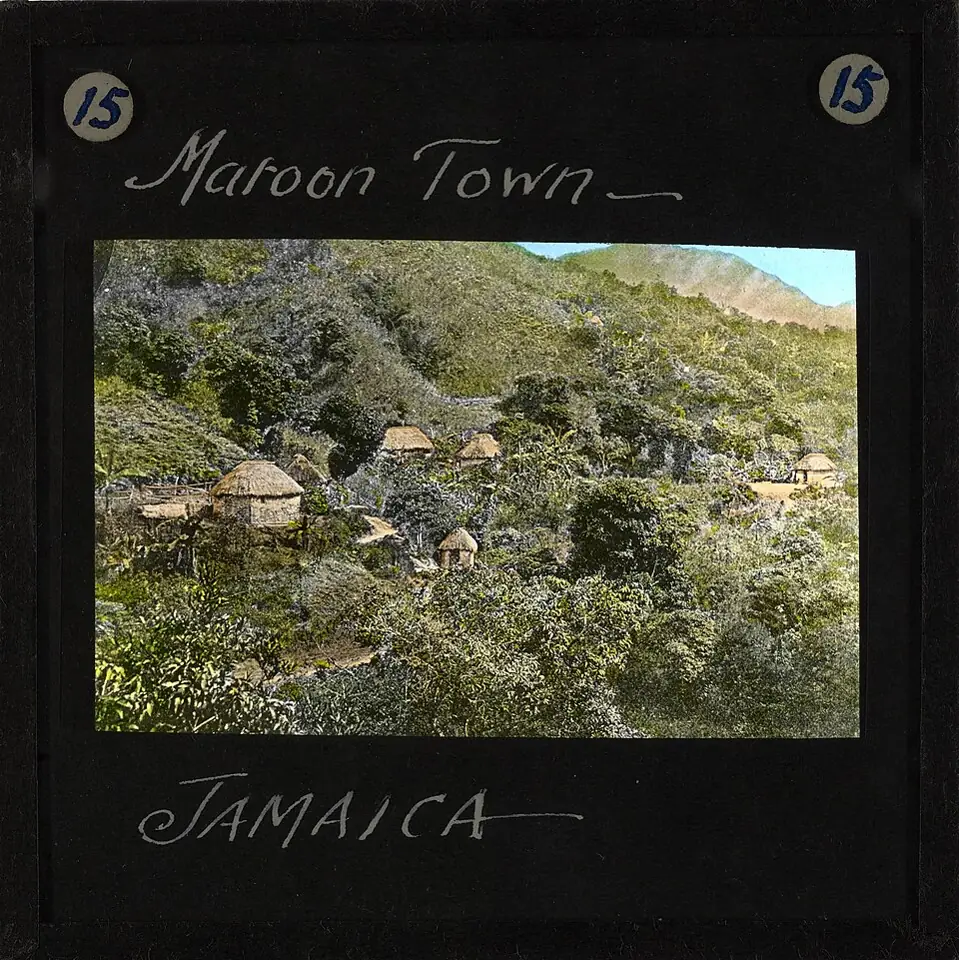
The external archive image did not load. Use its source record below to examine it.
Source & credit
Listen to an identified Accompong performance
Smithsonian Folkways identifies “Processional Music: Wah Me Gwine Do?” with a group of Accompong Maroons on Drums of Defiance, released in 1992. That release date is not automatically the field-recording date. The track lets us keep community and occasion attached to the sound. It is a musical performance, not an ordinary conversation sample or a recording of an eighteenth-century ceremony. [3]
The sound does not supply permission to reproduce the occasion
Listen for relationships between voices, percussion and repetition in the passage available to you. Then return to the title and performer identification. A commercially released selection is one documented occasion; it does not mean a visitor can record every ceremony or ask a community to repeat it. Publicly available music and access to living cultural knowledge are different matters.
A treaty-and-sound learning session
First choose one clause concerning freedom, one concerning land and one concerning an obligation. Explain what each establishes in its own historical language. Then listen to the identified performance and note what the recording can show that a written agreement cannot. Finally, list what neither source tells you about a particular household. This sequence brings law, land and culture into a shared enquiry without claiming that any one source represents the whole community.
Sources and notes
- Primary institutional or documentary account identified in the narrative. ↩
- Laws of Enslavement and Freedom, University of New Brunswick: documentary project. The treaty transcription already checked and reproduced in this guide is linked above; treaty date 1 March 1738–9. ↩
- Smithsonian Folkways: named Accompong processional recording and 1992 album release. ↩
- Accompong lantern slide, after 1900: University of Edinburgh Centre for the Study of World Christianity, digitised by USC Libraries; GB 237 CSWC47/LS12/15; photographer unknown. ↩