Marcus Garvey: from St. Ann’s Bay to a worldwide movement
Garvey connected racial dignity to institutions: newspapers, meetings, businesses and political organization. His birthplace is the beginning of a history that crosses the Atlantic, not the whole story.
A coastal town and the power of print
Marcus Mosiah Garvey was born on August 17, 1887, in St. Ann’s Bay. Jamaica National Heritage Trust identifies 32 Market Street as his birthplace. That address connects an international political figure to the everyday geography of a Jamaican town. It does not mean that a modern visitor is seeing the town exactly as it was in his childhood, or that the birthplace alone explains his later ideas. [1]
Printing gave Garvey a practical route into public life. Jamaica Information Service describes his work as a printer in Kingston, involvement in the 1907 printers’ strike and production of a newspaper called The Watchman. These activities placed him where labor, literacy and political debate met. A printing shop required technical skill; a newspaper also required a way to choose, reproduce and circulate arguments. His later reliance on publicity and organized meetings was therefore grounded in work as well as aspiration. [2]
The significance of that connection goes beyond biography. People excluded from established political institutions could still create an audience through print and association. A newspaper could carry an argument further than a local speech, while a meeting could turn readers into participants. Neither medium automatically produced agreement, but both made a movement possible beyond face-to-face acquaintance.
Travel widened the political horizon
Garvey’s years abroad exposed him to societies linked by colonial labor, migration and racial inequality. His return to Jamaica was followed by the founding of the Universal Negro Improvement Association in 1914. The organization presented African ancestry as a basis for collective pride and political action. In a colonial setting where European authority dominated education and public recognition, that was an intervention in who could describe the past and imagine the future. [3]
He went to the United States in 1916, and organizing there expanded the movement’s reach. The UNIA joined meetings and public expression to a program of Black economic independence. Rather than treating dignity as a matter of personal confidence alone, it sought institutions through which people could act together. Restaurants, shops and shipping ambitions gave economic form to that argument. [3]
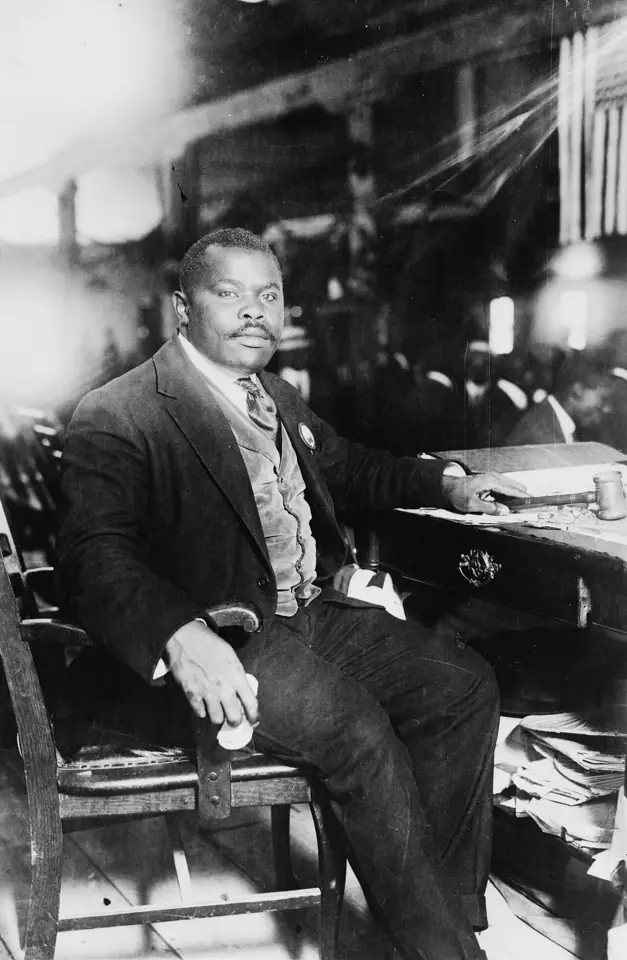
Source & credit
Economic independence became a difficult practical project
The Black Star Line represented a particularly ambitious effort to connect collective investment with ownership of transport. Shipping was integral to the Atlantic world that moved workers, goods and colonial wealth. To own a line was to challenge dependence on someone else’s routes and commercial decisions. Yet a political ambition did not eliminate the operational demands of a shipping business: vessels, finance, management and public promises had to work together.
The enterprise became central to the US prosecution of Garvey. The National Archives describes the mail-fraud proceedings in connection with promotion of a Black Star Line ship, and places them alongside federal investigation and pressure on his movement. The historical conviction should be distinguished from the subsequent clemency decisions. His remaining sentence was commuted under Calvin Coolidge, and he was deported to Jamaica in 1927. Nearly a century later, President Joe Biden granted Garvey a posthumous pardon on January 19, 2025. These are different legal events, not interchangeable descriptions of one outcome. [4] [5]
Return to Jamaica did not end the organizing
After his deportation Garvey continued political work in Jamaica. Jamaica Information Service records the formation of the People’s Political Party in 1929. This phase belongs in the story because it brought an international vision back into the practical questions of Jamaican government and representation. A movement that spoke across borders still had to encounter local institutions and the colonial distribution of political power. [3]
The contrast with Barclay’s banana organizing is useful without making the men identical. Both stories make ownership and association central to dignity and power. Barclay’s organizing concerned producers, credit and access to export markets; Garvey’s program connected racial solidarity with a broader set of businesses and political institutions. Their different projects show that Jamaican political history was also a history of the economic arrangements people tried to change.
Remembering a movement without flattening it
Garvey’s public life contained disagreement as well as inspiration. His racial separatism and particular alliances were disputed by other Black leaders. A history that records those conflicts need not dismiss the movement’s achievement in making African history and Black independence matters of mass public discussion. Equally, admiration should not replace an account of how institutions worked or why particular projects encountered difficulty.
His birthplace, Kingston organizing and overseas movement belong to one connected narrative. A visitor to St. Ann’s Bay can begin with the address, then understand why printers’ labor, colonial hierarchy, migration, investment and public speech matter to its history. The memorial place is most meaningful when the larger story is already available to the reader.
Print made a movement larger than a meeting
Garvey’s background in printing belongs to his political history because a printed message could travel beyond the people who heard a speech. A movement spread through newspapers, organisations and repeated public argument as well as through a leader’s presence. St. Ann’s Bay is therefore a starting place in a history of skills and communication, not simply a birthplace to be marked.
Economic independence gave that argument a demanding practical form. Building enterprises and organisations required resources and faced failures as well as enthusiasm. Those difficulties belong beside the scale of Garvey’s appeal. He helped make Black collective possibility an international public project, while the record of its ventures shows how hard it was to turn that possibility into durable economic power. [2] [4]
Sources and notes
- Jamaica National Heritage Trust. 32 Market Street: Garvey’s birthplace in St. Ann’s Bay. ↩
- Jamaica Information Service. Jamaica Pays Tribute to Marcus Garvey: printing work, organizing and Liberty Hall. ↩
- Jamaica Information Service. Marcus Mosiah Garvey: Jamaican organizing, UNIA and political activity. ↩
- US National Archives. Marcus Garvey: international organizing, Black Star Line, prosecution and deportation. Reviewed 2020; read alongside the 2025 pardon record. ↩
- Office of the Federal Register. Statement on Pardons and Commutations, January 19, 2025. Records Garvey’s posthumous pardon. ↩