In Search of Marianne: Quasheba’s Story
Quasheba, called Marianne in the slave registers: an African-born mother, her recorded escape, and the St. Mary family that leads to me.
Explore the companion series: Arthur’s Seat, Bogg Pen and the Kidstons →
Before the registers, there was Va
I knew my great-grandmother as Va. In the records she is Gladys Fyffe, later Gladys Fyffe Murray, but to me she was the woman I spent childhood summers with in St. Mary. Her daughter Lurlene Williams, later Lurlene Smith, was my grandmother; her daughter, Winton Murray, is my mother. My search began with these women and the family life I remembered.
Following their family backward eventually led me to Quasheba, the African-born woman called Marianne in the slave registers and identified by her African name in my family research. She was the mother of Abba, also called Jane, and the earliest African-born ancestor I have traced in this family line. The records preserve both women’s attempts to escape slavery. [F13] [F14]
Quasheba’s name connects this family story to West African traditions in which a name can mark a child’s day of birth. Comparative records associate Quasheba with Sunday. Akan naming traditions associated with present-day Ghana also help explain Abba, the Thursday name recorded for her Jamaican-born daughter. The names offer a cultural connection across the Atlantic; they do not establish Quasheba’s exact birthplace. [H6] [H17]
Following Va’s family backward brought me to her parents, Daniel Boscoe Fyffe and Albertha Peart, then to Daniel’s parents, Robert Fyffe and Matilda Kidston. We knew Matilda as Aunt Mattie. Aunt Tilly, the daughter of Va’s sister, remembered her coming to live with the family late in her life. Through that recollection, a woman born soon after emancipation remained within reach of people I knew. [F1]
At a family reunion we saw a bed that had belonged to Daniel and Albertha. Their graves are at Copper in St. Mary. The bed, the graves and the stories gave the names a physical presence long before I found them in old documents. Daniel’s brother Ivan connects another branch of our family to those same earlier generations. [F13]
The breakthrough came in the slave registers. Beyond Matilda and her father Joseph, I could follow Joseph’s mother, Abba / Jane, and Jane’s mother, Marianne / Quasheba. Beside Marianne’s name was the word that carried our family story across the Atlantic: African.
The search had reached Quasheba, an African-born woman whose life appeared under the name Marianne in an enslaver’s return. As I read across the page, I found something else: she had tried to escape.
Marianne / Quasheba and her daughter, Abba / Jane
In the 1817 St. Mary return for Mary Roche, four names appear: Edward, Marianne, Maria Davis, and Abba, also called Jane. Marianne is forty and African; Abba alias Jane is twelve and Creole, meaning born locally. The words beside Jane’s entry make the connection unmistakable: “Marianne her mother.” That short phrase joins the two women across a gap of more than two centuries. [F14]
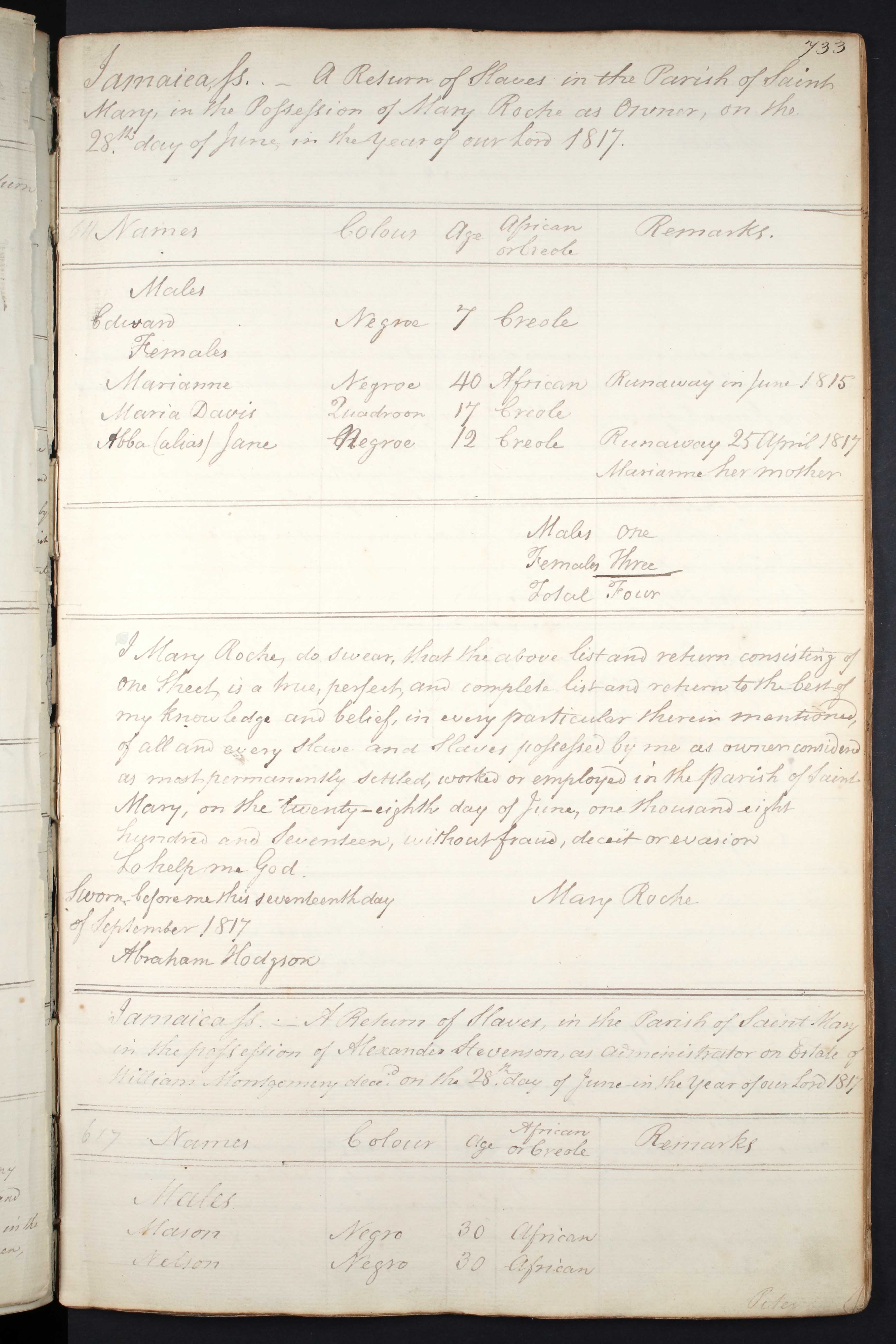
Abba and Jane are the same girl. The register gives us both names together, correcting an earlier family summary that had separated them.
The ages suggest Marianne was born around 1777 and Jane around 1805. Those are estimates, since ages in these records can vary, but they help place a mother and daughter within the history we are following.
Quasheba had been born in Africa and was enslaved in Jamaica. The clerk’s name for her was Marianne, but that was not the whole identity my family research had recovered. Behind that entry lies forced Atlantic transportation, although the page leaves her home community, language, ship and arrival date unnamed. What it preserves is her identity and her relationship to a child born on the other side of the ocean.
The entries that tell us they resisted
Quasheba’s escape, recorded under Marianne, is dated June 1815, two years before the return was compiled. Jane’s is dated 25 April 1817. At her recorded age of twelve, Jane too had attempted to leave the people claiming ownership of her. [F14]
The clerk recorded an absence from the enslaver’s control. For our family, those same words preserve an act of resistance. Neither woman’s own account survives on this page, so we cannot follow their journeys or know whether they travelled alone.
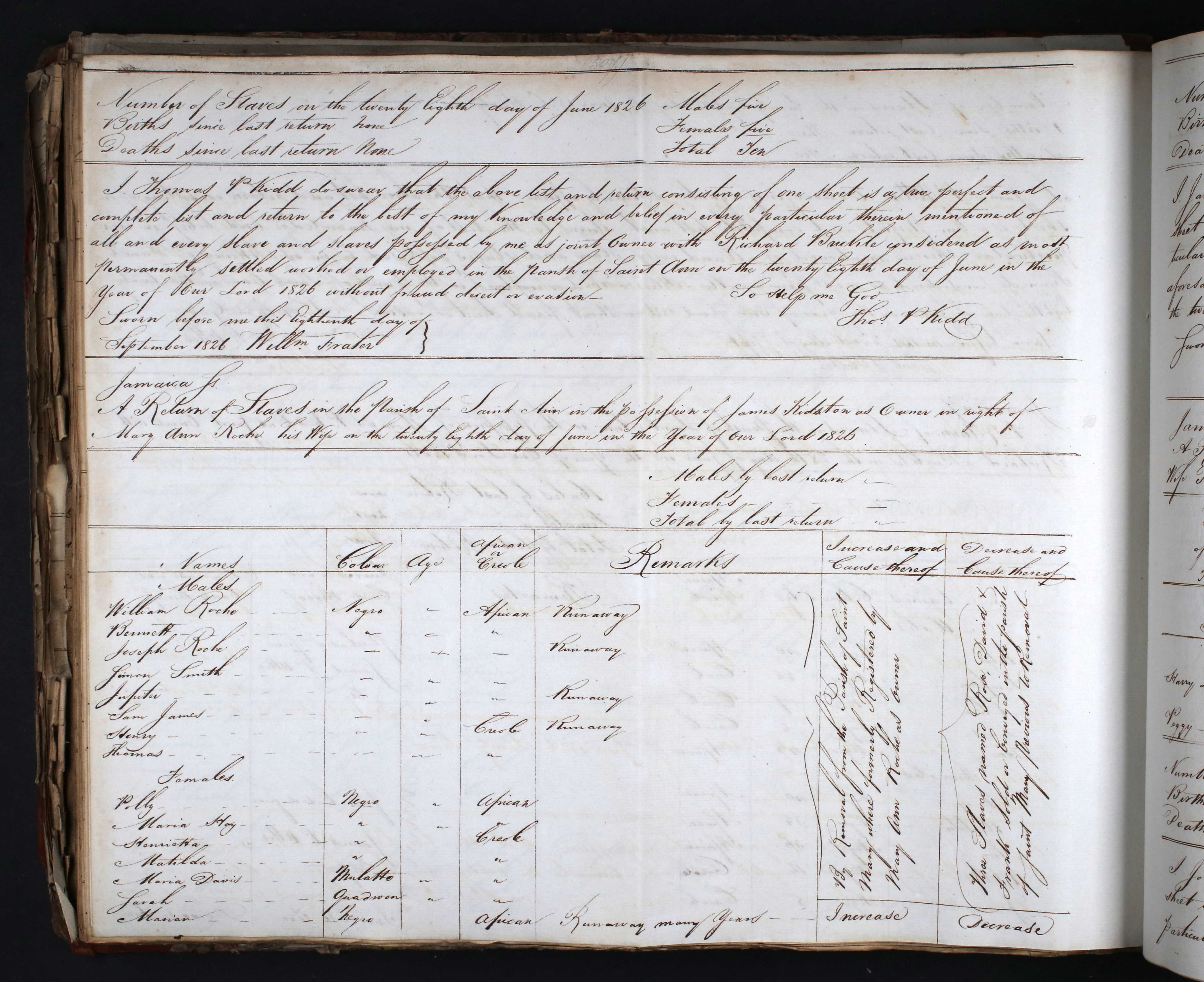
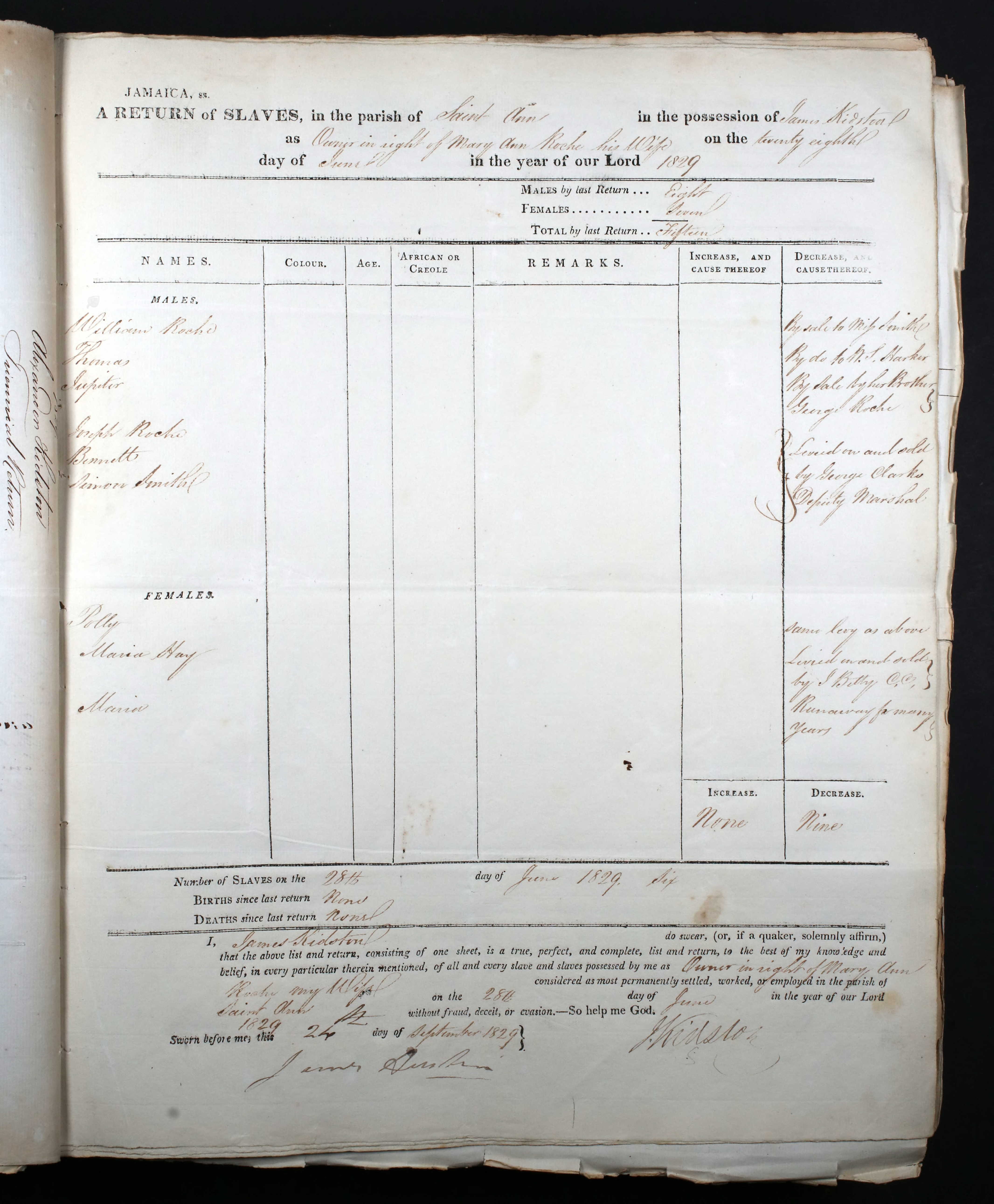
Quasheba’s absence runs through the later paperwork under the name Marianne. The 1826 return describes her as “Runaway many years”; the 1829 return repeats it. Read alongside the June 1815 date, those remarks show how long the claim to her continued after her recorded escape. [F16] [F17]
Our family remembers Quasheba / Marianne as a woman who escaped and was never caught. The surviving pages are consistent with a prolonged absence, though they do not tell us her ultimate fate. Her name remaining in a register meant the enslaver still claimed her; it does not mean she was physically on the estate.
Jane reappears in the family’s later history as Joseph’s mother. Between her escape and those later records lies a part of her life we have yet to recover: when and under what circumstances she returned to the register trail. [F13]
Escape advertisements may help fill that gap. The National Archives identifies them as an important source for researching resistance. A securely matched notice could add a description, locality or associate to either woman’s story. For now, that is a route to investigate. [H11]
A sale, a marriage and a change in registration
The next reproduced return, made in St. Mary in 1823 for Mary Ann Roche, records changes since the previous registration. Edward had died; Jane had been sold in 1822. A total of three females remained. Because this was a return of changes, it did not repeat every earlier name and age. [F15]
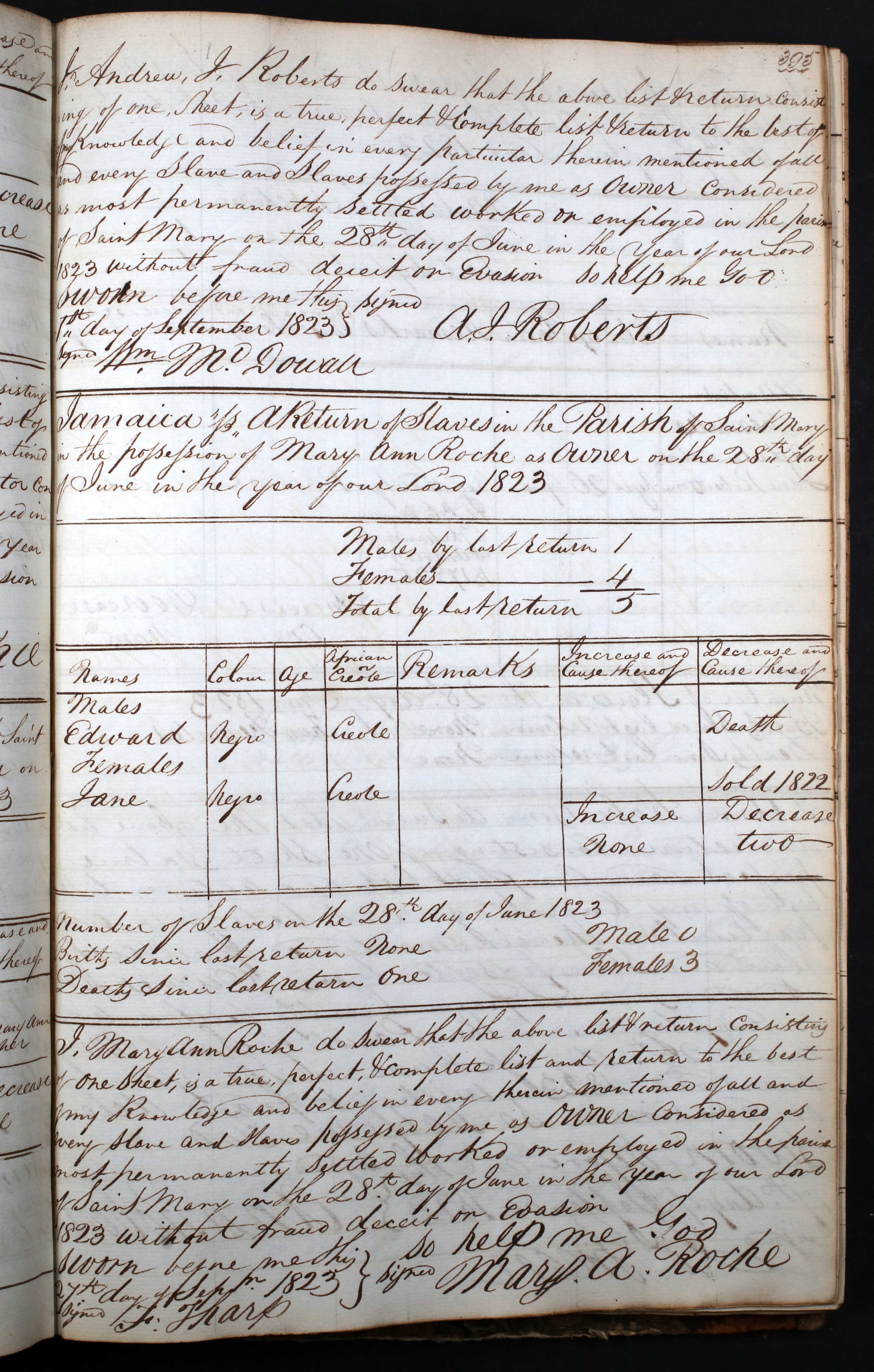
“Sold 1822” reduces a profound disruption in Jane’s life to two words. The page does not name the purchaser. Finding the receiving return would help explain where she went and how this transaction fits into the later Kidston records.
By 1826 the return was being made in St. Ann. James Kidston now appears as owner “in right of Mary Ann Roche his wife.” Their marriage had changed the legal administration of the people she held in slavery, and that change left its mark in the heading of the register. [F16]
The 1829 return again names James in that marital capacity. Quasheba is still listed as Marianne, still described as having been away for many years. Marriage and a change of parish had altered the paperwork without resolving the claim to her. [F17]
My wider register research follows the family into an Alexander Kidston connection in St. Ann and the history of Arthur’s Seat. The four pages reproduced here establish the Roche and James Kidston stages; the later Alexander entry belongs to the wider research. Distinguishing the two Alexanders, father and son, is important to tracing what followed. [F13]
By the time Joseph appears as Matilda’s father, St. Ann is firmly part of the family’s geography. The route there includes a sale, James’s registration through his wife, and the later Alexander connection. Those developments need to be traced separately: a new parish heading alone does not date a person’s physical move.
Joe becomes Joseph Kidston
Joseph’s place in the family connects the two women to the generations I can follow into freedom: he was Abba / Jane’s son and Quasheba / Marianne’s grandson. The African-born mother, her Jamaican-born daughter and the child later known as Joseph Kidston belong to the same family line. [F13]
Jane’s son first appears in my verified register research as Joe. Recorded as one year old in 1826, he was born around 1825 and later became Joseph Kidston. His individual entry is outside the supplied page reproduced above, but it is part of the wider record trail connecting Jane to Matilda’s father. [F13]
Joseph was born enslaved. Under the system then operating in Jamaica, a child inherited the mother’s enslaved status. The same administration that treated mother and child as property also preserved relationships that descendants could later recover.
Joe’s later appearance as Joseph Kidston links the child in the registers with the man in the family’s civil records. The surname belongs to the history of Roche and Kidston ownership, although the four reproduced pages do not establish when he began using it. It cannot, by itself, establish biological descent from a Kidston enslaver.
Joseph’s childhood crossed emancipation. If born around 1825, he was about nine when abolition with apprenticeship took effect on 1 August 1834, and about thirteen when full emancipation followed on 1 August 1838. His daughter Matilda would be born into legal freedom. [H3]
Matilda’s birth entry describes Joseph as a labourer and places him at Bogg Pen in St. Ann. It gives us his occupation and residence, but does not establish that he owned land. An earlier account called him a freeholder near Gayle; the cited material does not include a land record establishing that claim. [F2] [F13]
Matilda, Catherine and the birth entry
Matilda’s birth brings Joseph and Catherine Kidston together on a single page. Entry 435 records her birth on 5 April 1845 and registration on 24 May. Joseph is a labourer, with Bogg Pen appearing in his informant entry. Although our saved filename calls the image a baptism, its heading and columns identify a birth register. [F2]

Catherine is Matilda’s mother. Her name keeps the maternal side of that household visible as we follow Joseph’s line backward. Their daughter was born in St. Ann less than seven years after full emancipation.
More than a century later, Matilda’s death was registered at Farm Pen, St. Mary, on 6 May 1947. Her daughter Louise Fyffe, who had been present at the death, supplied the information. Matilda’s age was given as 103. [F5]
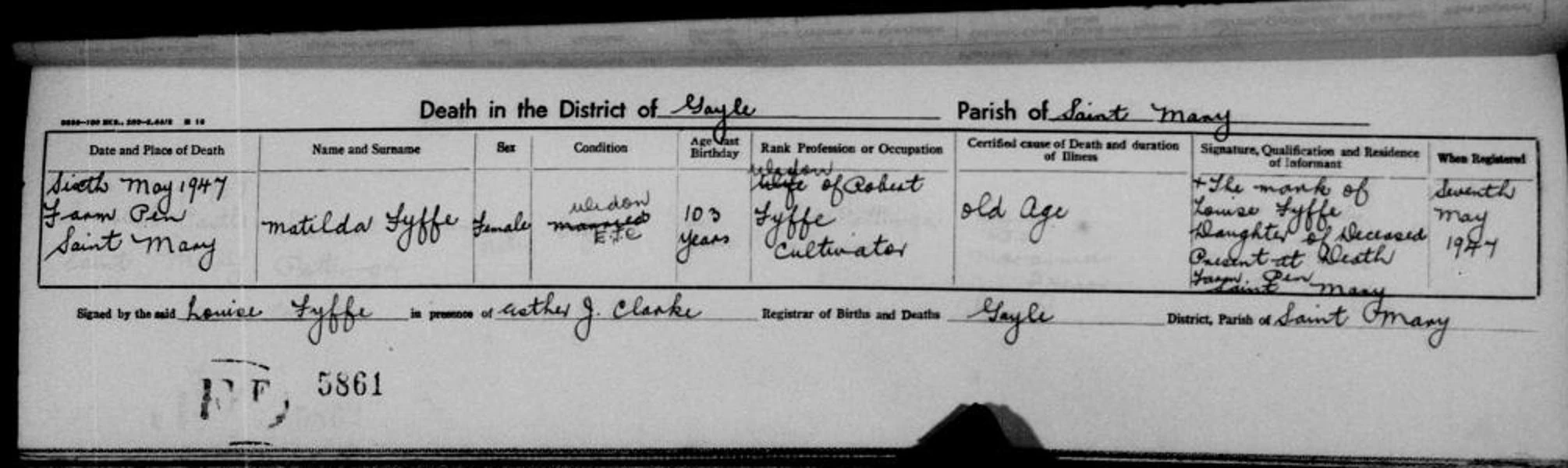
The dates do not quite agree. The birth entry gives 5 April 1845; the death entry gives an age of 103 on 6 May 1947. Calculating from the birth date gives 102 years and one month, while the reported death age points to 1843 or 1844. I use the near-birth entry for her birth date and retain the age reported at death, rather than make either document say something it does not.
Matilda’s life stretched from the early years of freedom into the twentieth century. Aunt Tilly remembered the elderly woman who carried that history into the family home. That memory gives the long span of dates a human scale.
Robert, Matilda and a shoemaker’s household
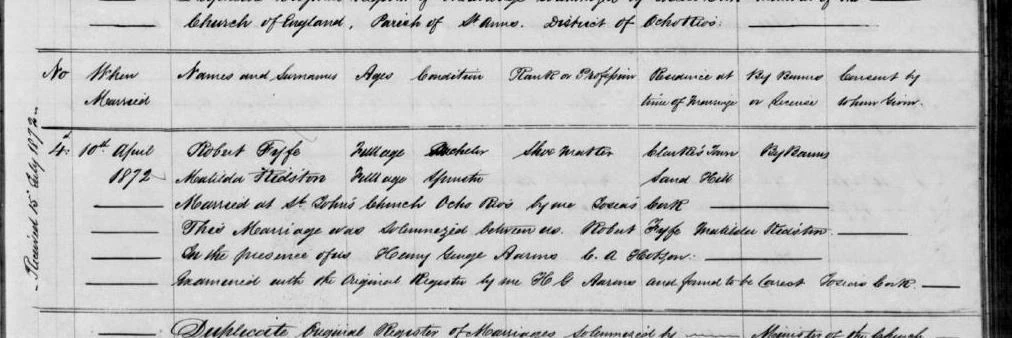
On 10 April 1872, Robert Fyffe and Matilda Kidston married at St. John’s Church, Ocho Rios. Their return, entry 4 on the right-hand page, describes Robert as a bachelor and shoemaker, Matilda as a spinster, and both as of full age. They would become the parents of Daniel Boscoe Fyffe. [F3]
St. John’s anchors their marriage in a place descendants can still recognize. This is the Ocho Rios church in St. Ann, which the diocesan directory lists separately from the St. John’s at Gayle in St. Mary. [H14]
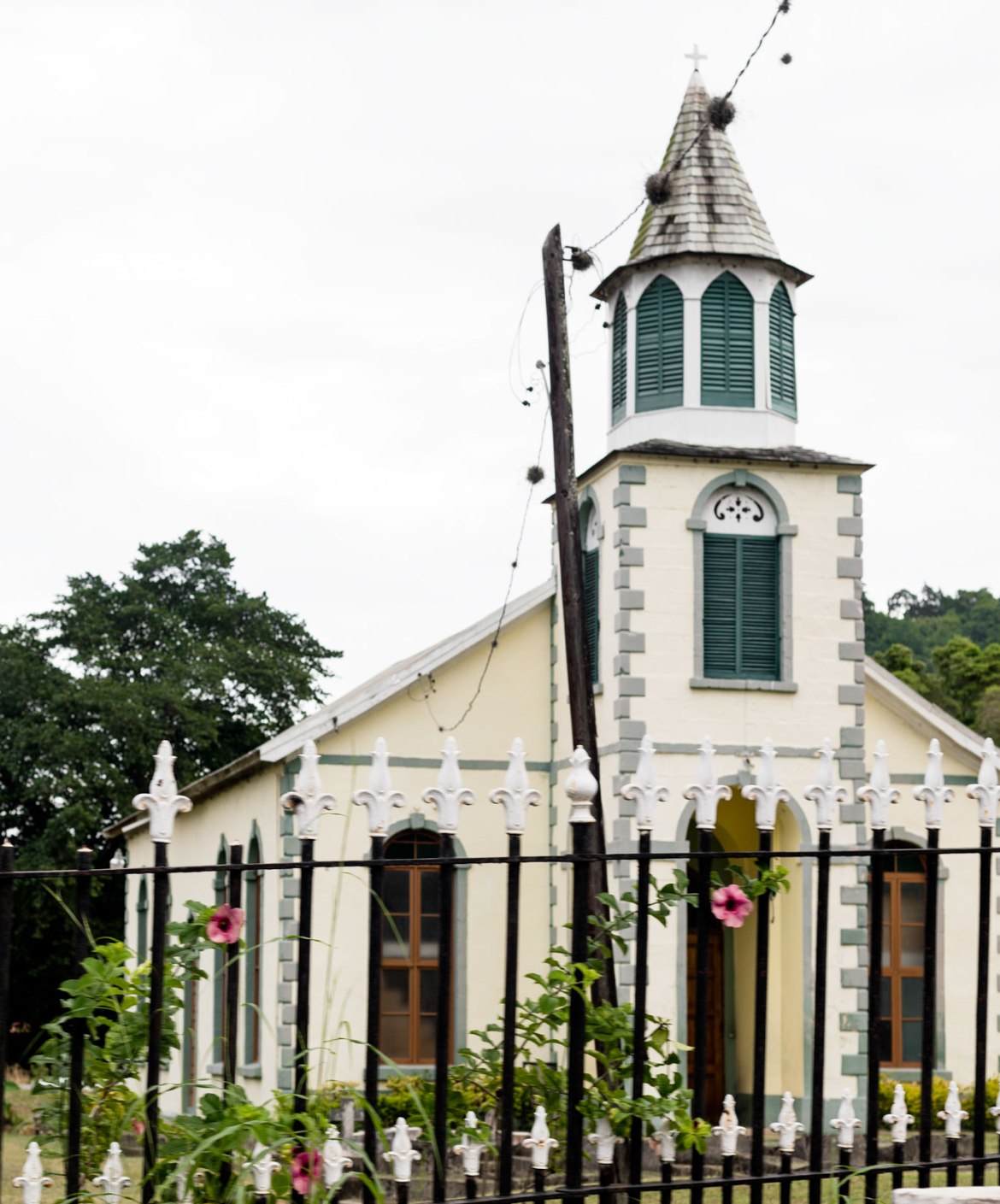
The National Library of Jamaica also preserves a dated historic photograph of the Ocho Rios church from 1931, catalogue D0009196. It can be viewed through the library’s catalogue. Reproduction requires permission, so the historical photograph is linked rather than copied into this article. [H15]
Robert and Matilda lived at Clark’s Town, as recorded in their marriage return. Robert’s work as a shoemaker appears again in the next generation’s record, placing a skilled trade within the household. A modern locality of that name survives in the Lime Hall area of St. Ann, but its precise correspondence with their nineteenth-century residence still needs confirmation.
Daniel was born at Clark’s Town on 27 February 1873 and baptized on 5 November 1873. Entry 49 on page 278 names Robert Fyffe and Matilda Kidston as his parents and identifies Robert as a shoemaker. The baptism carries the family forward from the marriage at Ocho Rios. [F4]

We use Daniel Boscoe Fyffe in the family. Buscoe appears in saved record names and research notes, just as Fyfe and Fyffe both occur in the search trail. Keeping the variants together makes it easier to recognize one person across differently written records. Daniel owned land at Farm Pen in St. Mary, an ownership supported by documentation in our family research. What remains unresolved is how it entered the family: whether Daniel purchased it himself, Robert acquired it before him, or it came through another transaction or inheritance. Ownership in Daniel’s lifetime does not establish who first bought it.
The baptism also preserves a colonial colour classification. I retain it as evidence of how the recording society categorized people, rather than turn it into a calculation of Daniel’s ancestry.
Gladys, known to us as Va
Daniel and Albertha Peart’s daughter Gladys was Va. The family identification and compiled tree connect her to both parents; her marriage record names Daniel as her father. By this point the documentary trail is reaching people whose lives overlap with my own memories. [F9] [F13]
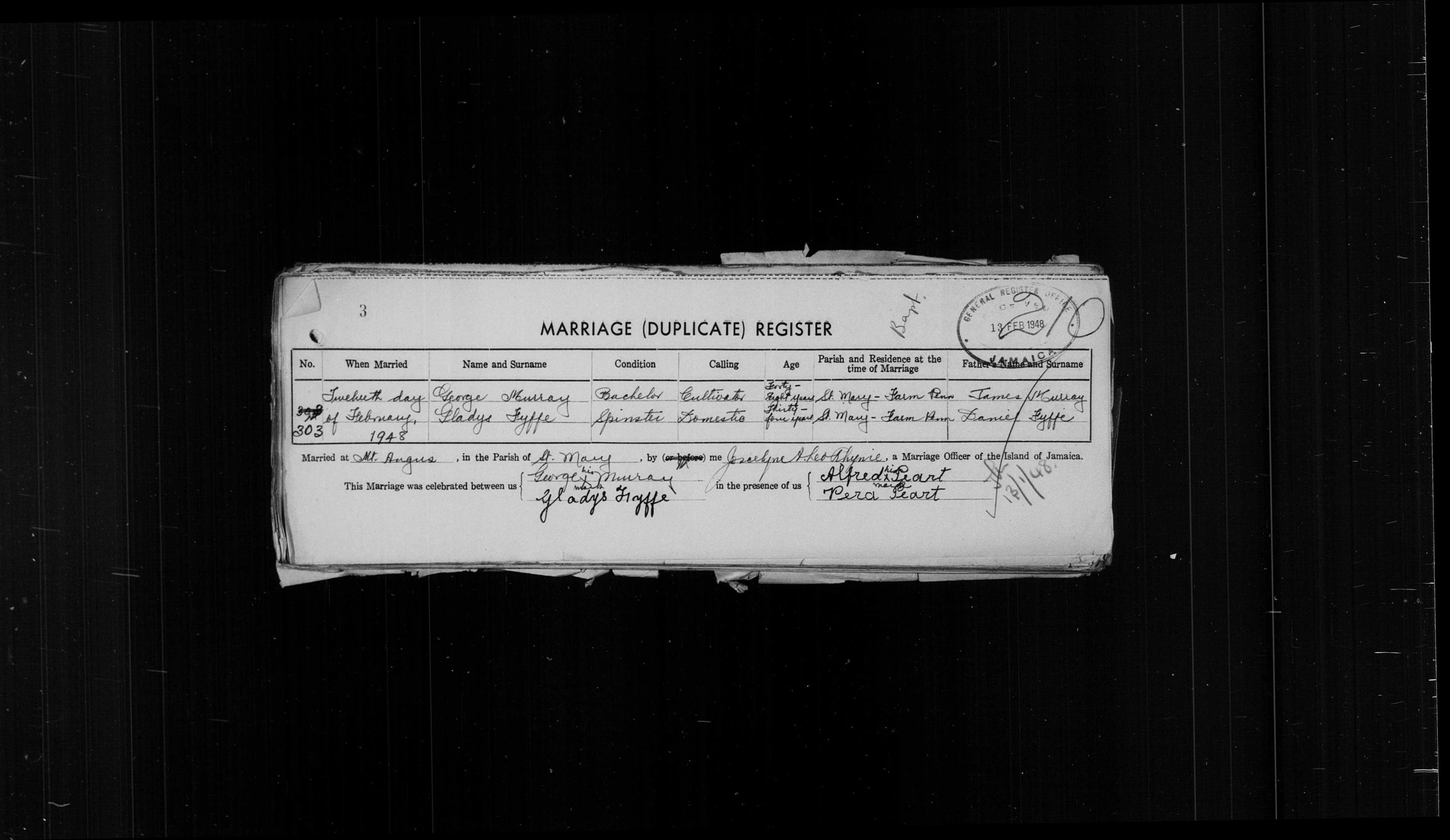
Gladys Fyffe married George Murray on 12 February 1948. The return places them at Farm Pen, St. Mary, and names Daniel Fyffe and James Murray as their respective fathers. Gladys Fyffe, Gladys Fyffe Murray and Va are the same woman, known through a maiden name, a married name and the name we used at home. [F6]
Va and Cecil Williams were the parents of my grandmother Lurlene Williams, born at Farm Pen on 15 November 1923. Her birth registration names Gladys Fyffe as her mother and records Cecil as the informant, present at the birth. It was registered on 23 November. His place in our family is clear: Cecil was Lurlene Williams’s father. [F8]
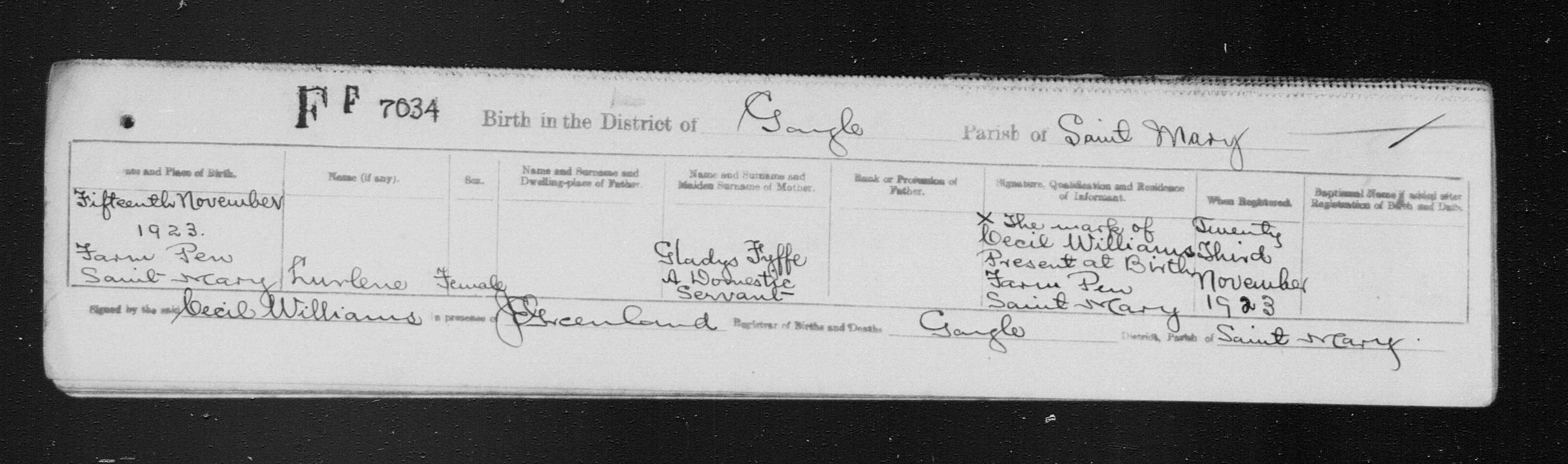
The father’s-name field on this particular form is blank. Our family knowledge supplies Cecil’s relationship to Lurlene Williams; the document records his presence and his role as informant. Read together, they give a fuller account than the form alone.
Va’s recorded work as a domestic servant belongs beside Robert’s shoemaking and Joseph’s labouring in the family story. These occupations are part of how the generations made their lives, alongside the births and marriages through which I have traced them.
Va died on 13 November 1977 at the Public Hospital in Port Maria, with Gayle recorded as her usual residence. Her reported age of seventy differs from the age of thirty-nine entered at her 1948 marriage. I keep both reported ages; neither supplies a secure exact birthday. The full death registration is available in the record notes. [F7]
From Gladys and Cecil through Lurlene Williams, then through my mother Winton Murray, the story reaches me. The oldest names in the registers now connect to the family I knew in St. Mary.
Arthur’s Seat, two Alexanders and James Kidston
Joseph’s later address was Bogg Pen, part of the merged Arthur’s Seat property in my family research. The 1878 directory names Arthur’s Seat and Bogg Pens under a common proprietor. The estate, the Kidstons and the saved photographs are now brought together in a four-part companion series.
The records carry us through Bogg Pen, Clark’s Town, Ocho Rios, Farm Pen, Gayle, Copper and Port Maria. A map helps bring these places into relation, while the documents explain what each meant in a person’s life: a home, a workplace, a church or a burial place.
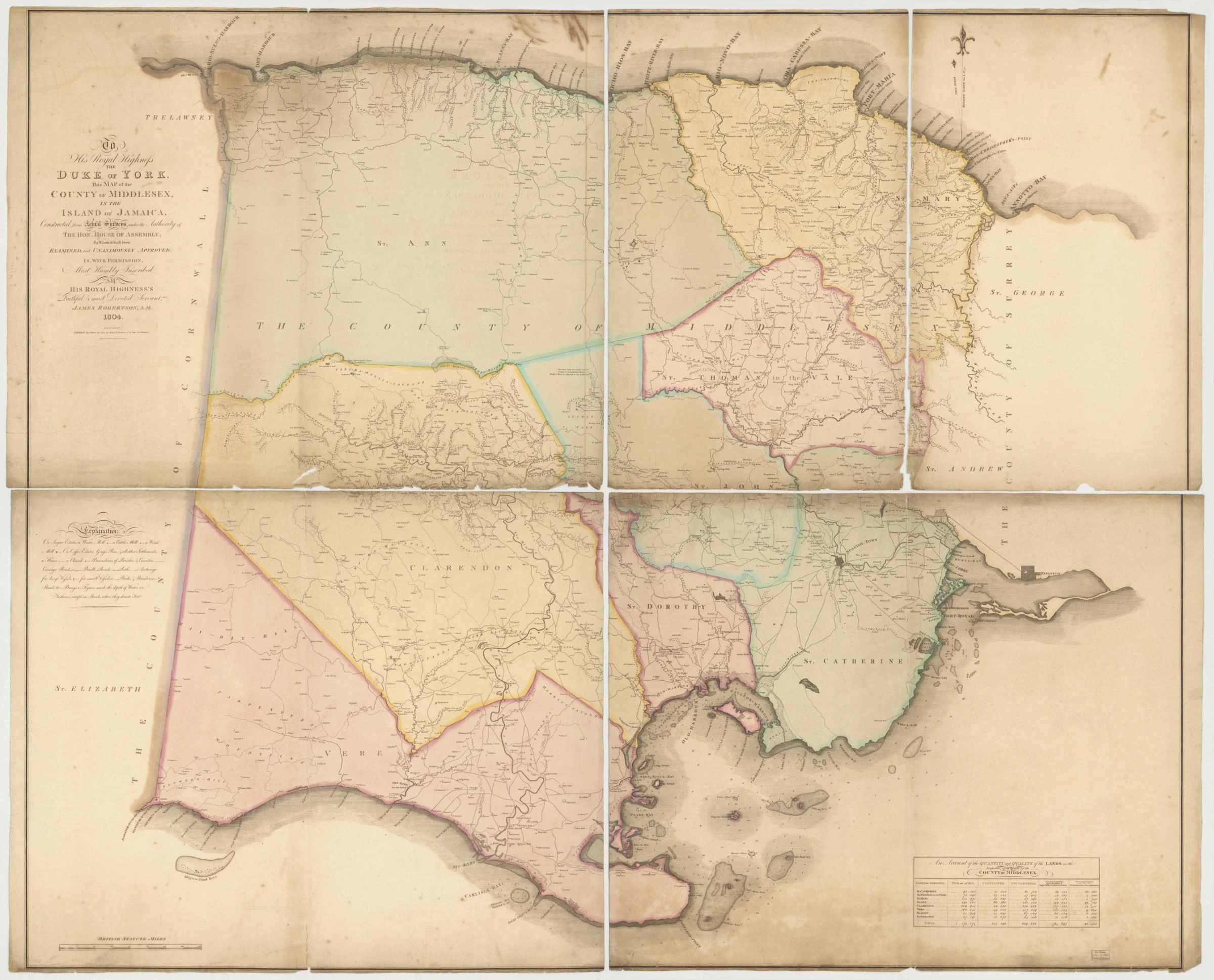
The Kidston branch needs the same care with names as the family line. My research distinguishes two Alexander Kidstons, father and son, and identifies James as a son of an Alexander. Published almanac transcriptions place the name Alexander Kidston at Arthur’s Seat in St. Ann and later at Bogg and other properties. Those estate entries help locate the family’s power, but they must not all be assigned automatically to one man. [H8] [H9] [H16]
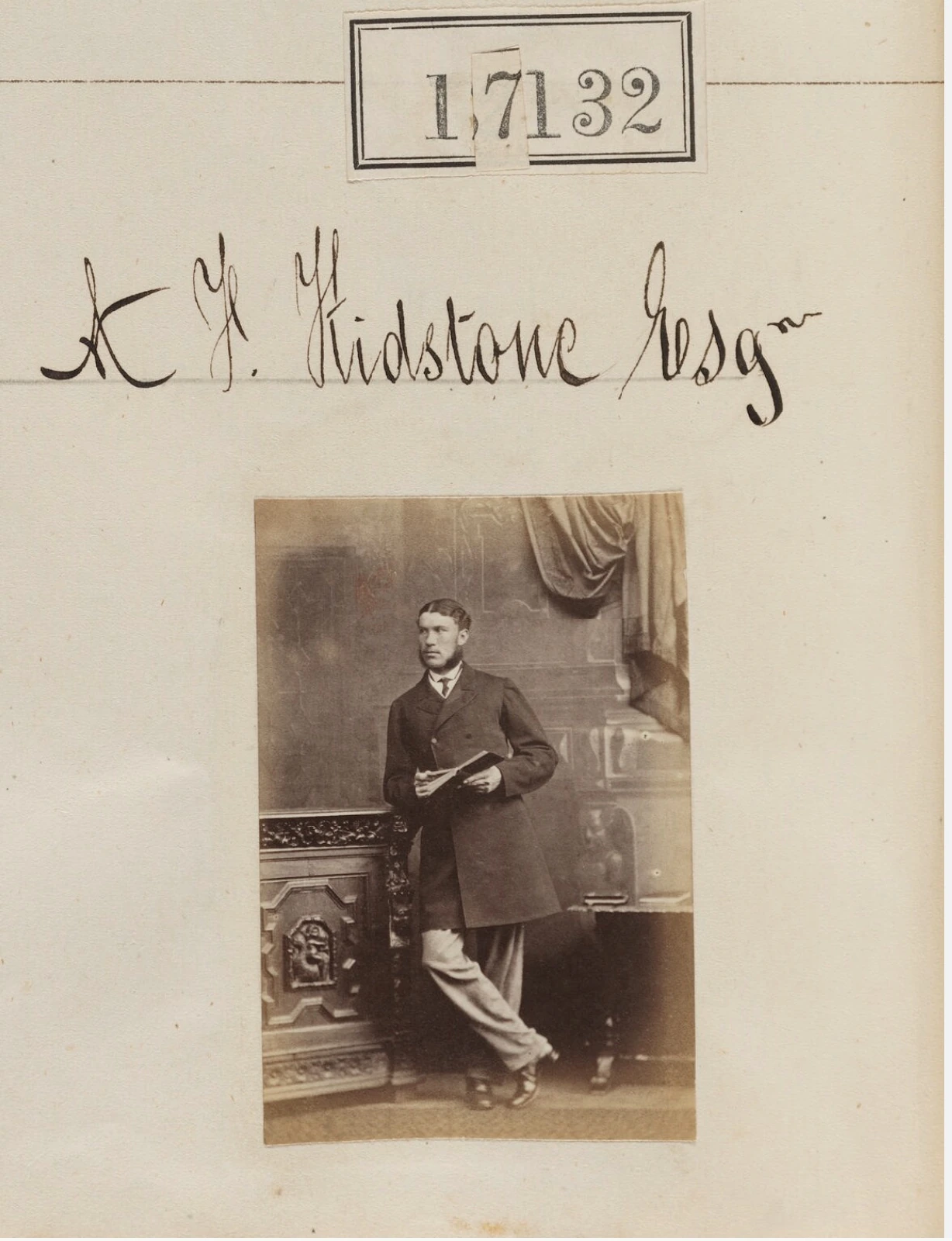
James and the younger Alexander were brothers, as established in my family research. James is described there as “mulatto,” a colonial classification consistent with mixed African and European ancestry. I suspect the brothers had different mothers, and that James’s mother was an enslaved woman. Those are separate questions from their relationship as brothers: the colour label alone does not name his mother, establish her legal status or prove that they were half-brothers.
Keeping the generations distinct resolves the family outline: the elder Alexander and his son must not be collapsed into a single person, and James belongs beside the younger Alexander as his brother. The 1829 almanac lists James and Alexander separately; a National Records of Scotland catalogue also identifies letters addressed to James and Alexander in 1812–1813. These independently located sources place the names in the historical record, while the identification of the brothers comes from my family research. Their mothers’ identities still need explicit documentation. [F13]
That uncertainty matters because James administered enslaved people through Mary Ann Roche, while Alexanders appear elsewhere in the estate record. African ancestry and participation in slave ownership could exist within the same colonial family. Tracing those relationships helps explain the system surrounding Marianne and Jane without displacing them from the centre of this story.
Quasheba and Abba: the African names within our Jamaican story
Alongside the European names in the records, our family has kept Marianne’s day name, Quasheba, and Jane’s, Abba. They connect the story to Akan naming traditions associated with present-day Ghana, where names can carry the day of a child’s birth. Forms vary across communities and the diaspora; Kofi Agyekum’s University of Ghana study identifies Aba as the Fante female Thursday name. [H17]
The 1817 clerk wrote Abba as Jane’s alias, preserving that name in the document itself. Aba and related forms are associated with Thursday in West African day-name traditions; Quasheba is associated with Sunday in diaspora evidence discussed by historian Nic Butler. These connections offer a direction for research into the African world behind our family’s Jamaican history. [H6]
Marianne’s identification as Quasheba comes from my wider family research; the name is not visible on the four register pages reproduced here. Keeping the day name beside Marianne preserves that research connection while making its source clear. [F13]
Ghana is therefore an important lead, not a birthplace proved by the names alone. Naming traditions travelled, survived and changed across the Atlantic. To move from that cultural connection to a specific community or place, we need further evidence about Marianne herself.
The next records to seek are concrete ones: the receiving return for Jane’s 1822 sale, Joe’s full 1826 entry, the later Alexander registration, the conveyance or inheritance records for Daniel’s Farm Pen land, and any securely matched escape advertisement. An explicit record naming the brothers’ mothers could test the proposed half-brother relationship.
The family’s movement into freedom belongs within Jamaica’s wider history of apprenticeship, land and labour. The National Library of Jamaica describes the coercive apprenticeship system, and the Jamaica National Heritage Trust explains the continuing importance of land and housing after emancipation. Against that background, Joseph’s recorded labour, Robert’s shoemaking and Daniel’s documented ownership of land at Farm Pen belong to successive generations building lives after enslavement. The documents reproduced here do not establish who originally acquired the Farm Pen property. [H3] [H5]
The trail now reaches an African-born woman and her daughter, their recorded attempts to escape, a son born enslaved, and the households their descendants formed in freedom. Quasheba’s own voice is absent from the return. We cannot recover her language or birthplace from its columns. But we can keep her African name beside Marianne, follow her daughter Abba / Jane and her descendants, and recognize the resistance the register records. The story that leads to Va and to me begins with a woman who had a life in Africa before she appeared in Jamaica’s paperwork.
The chronology and the family line
| Date | Event | Evidence |
|---|---|---|
| About 1777 | Estimated birth of Marianne / Quasheba. | Age forty in the 1817 return; approximate [F14]. |
| About 1805 | Estimated birth of Abba alias Jane. | Age twelve in 1817; approximate [F14]. |
| June 1815 | Quasheba’s escape recorded under the name Marianne. | Retrospective remark in the 1817 return [F14]. |
| 25 April 1817 | Jane’s escape recorded. | Remark in the 1817 return [F14]. |
| 1822 / 1823 | Jane’s sale in 1822 reported in the 1823 return. | Receiving purchaser not named on this page [F15]. |
| About 1825 | Birth of Joe, later Joseph Kidston. | Family-verified reading of age one in 1826; entry not in the supplied page [F13]. |
| 1826 / 1829 | James Kidston registers in St. Ann in right of Mary Ann Roche, his wife. | Headings reproduced; Marianne recorded as long absent [F16–F17]. |
| 1834 / 1838 | Abolition with apprenticeship, followed by full emancipation. | Historical context; Joseph’s approximate ages nine and thirteen [H3]. |
| 5 April 1845 | Matilda born to Joseph and Catherine Kidston. | St. Ann birth entry 435 [F2]. |
| 10 April 1872 | Robert Fyffe and Matilda Kidston marry. | St. John’s, Ocho Rios; entry 4 [F3]. |
| 27 February / 5 November 1873 | Daniel’s birth and baptism. | Robert and Matilda named; baptism entry 49 [F4]. |
| 15 November 1923 | Lurlene Williams born at Farm Pen. | Gladys Fyffe named as mother [F8]. |
| 6 May 1947 | Matilda dies at Farm Pen. | Age reported as 103; differs from age calculated from the 1845 entry [F5]. |
| 12 February 1948 | Gladys Fyffe, Va, marries George Murray. | Daniel Fyffe named as her father [F6]. |
| 13 November 1977 | Va dies at Port Maria; usual residence Gayle. | Death registration [F7]. |
Nine people, eight parent–child links
- Quasheba / MarianneAfrican-born; Quasheba is her day name in the family research; mother of Abba / Jane.
- Abba / JaneAbba is her day name; daughter of Marianne / Quasheba and mother of Joseph.
- Joseph Kidston / JoeBorn about 1825; father of Matilda with Catherine Kidston.
- Matilda Kidston FyffeDaughter of Joseph and Catherine; wife of Robert Fyffe.
- Daniel Boscoe / Buscoe FyffeSon of Robert and Matilda; father of Gladys with Albertha Peart in the family research.
- Gladys Fyffe Murray, “Va”My great-grandmother; mother of Lurlene Williams.
- Lurlene Williams, later Lurlene SmithMy grandmother; daughter of Gladys (Va) and Cecil Williams, and mother of Winton.
- Winton MurrayMy mother; daughter of Lurlene Williams.
- Anthony DePassNarrator and descendant.
In this sequence, Quasheba / Marianne is my sixth-great-grandmother. Va is Gladys, not another person or generation. Catherine, Robert, Albertha and Cecil are also essential ancestors, although this selected line follows the branch that leads back to Marianne.
Begin with someone you knew
Jamaicans at home and in the diaspora can begin in the same place I did: with someone they knew. Gather the names, nicknames, places and approximate dates, and ask who remembers each part of the story. A recollection can open the way to a document; a document can send you back to the family with a better question.
- Link people through events. Work backward through births, marriages, baptisms and deaths. Compare parents, occupations, residences and informants. A matching name alone is not a complete identification.
- Save the whole page. Preserve its heading, neighbouring entries, page number and archive reference. The oath above a return may belong to someone else. A filename may call a birth entry a baptism. Read the form before interpreting a row.
- Keep aliases together. Abba alias Jane is one person on the 1817 page. Search variants such as Joe and Joseph, Buscoe and Boscoe, Fyfe and Fyffe. Record exactly where each spelling appears.
- Follow transactions in both directions. A sale in an outgoing return should prompt a search for the receiving return. Transcribe the remarks and the legal capacity of the registering person, not just the names.
- Separate place, status and date. Registration in St. Ann is not automatically evidence of a move on the date of the return. A marriage date does not establish when a surname began. A person still claimed on a return might be recorded as absent.
- Preserve disagreements. Matilda’s 1845 birth entry and reported death age belong side by side. Mark estimates as estimates. Keep an unresolved question in the notes rather than silently rewriting the evidence.
The Library of Congress Jamaica genealogy guide connects researchers with parish records, enslavement registers, wills and manumission material. The National Archives guide explains the T 71 route. Some digitised collections require a free account or browsing unindexed pages. Free access does not always mean access without a login. [H1] [H12]
For historical places, compare the 1804 Middlesex map with parish records and Jamaican Family Search almanac transcriptions. Ask churches and archives about appointments before travelling. Ask permission before entering private land or photographing people and graves, and confirm accessibility arrangements directly.
Names establish the connections, but the larger task is to recover lives: who raised a child, made a living, cared for an elderly relative or attempted to escape. Records created to administer other people’s power can still help us tell our own history.
Family records and research sources
Family archive
- F1 · Supplied family narrative
- From Marianne to Anthony: Eight Generations, an AI-written research summary supplied 18 October 2026, incorporating family recollections. It is not an archival transcript or independent corroboration. The summary provides no identified vestry or tax record establishing Joseph’s landownership. Source for childhood summers and Aunt Tilly’s recollection. Early-lineage confirmation, register chronology, Va’s identification as Gladys, family recollections of Daniel and Albertha, and the later Alexander connection supplied by Anthony DePass; see F13. Anthony DePass identifies his mother as Winton Murray. The illustrated 1845 entry is used for Matilda’s birth date, with the different reported age at death retained.
- F2 · Matilda Kidston birth entry, 1845
- 1845 St. Ann birth register, entry 435: Matilda, born 5 April; parents Joseph and Catherine Kidston; Joseph, labourer, Bogg Pen. Registered 24 May. Family archive: Mother / Daniel Matilda / “Matilda kidston Baptism.jpg.”
- F3 · Robert Fyffe and Matilda Kidston marriage, 1872
- 10 April 1872, St. John’s Church, Ocho Rios; right-hand page 211, entry 4. Robert Fyffe, bachelor and shoemaker; Matilda Kidston, spinster; both of full age. Residence recorded as Clark’s Town for both; married by banns. Family archive: Mother / Robert Fyffe. This form has no father-of-bride field.
- F4 · Daniel’s baptism, 1873
- Birth 27 February 1873, Clark’s Town; baptism 5 November, page 278, entry 49. Parents Robert Fyffe and Matilda Kidston; father a shoemaker. Family archive: Mother / Daniel Matilda. Buscoe/Boscoe spelling retained as a research variant.
- F5 · Matilda Fyffe death, 1947
- 6 May 1947, Farm Pen, Gayle district, St. Mary. Matilda’s reported age is 103; Louise Fyffe, daughter, is the informant. Family archive: Mother / Robert Fyffe. The death age differs from the illustrated 1845 birth entry.
- F6 · Gladys Fyffe and George Murray marriage, 1948
- 12 February 1948: Gladys Fyffe and George Murray, residing at Farm Pen, St. Mary. Fathers Daniel Fyffe and James Murray. Family archive: Mother / Va. Gladys’s reported age appears as thirty-nine.
- F7 · Gladys Murray death, 1977
- 13 November 1977, Port Maria, St. Mary; Gladys Murray, usual residence Gayle, reported age 70. Family archive: Mother / Va. Medical details are not discussed in the narrative.
View the full death-registration image
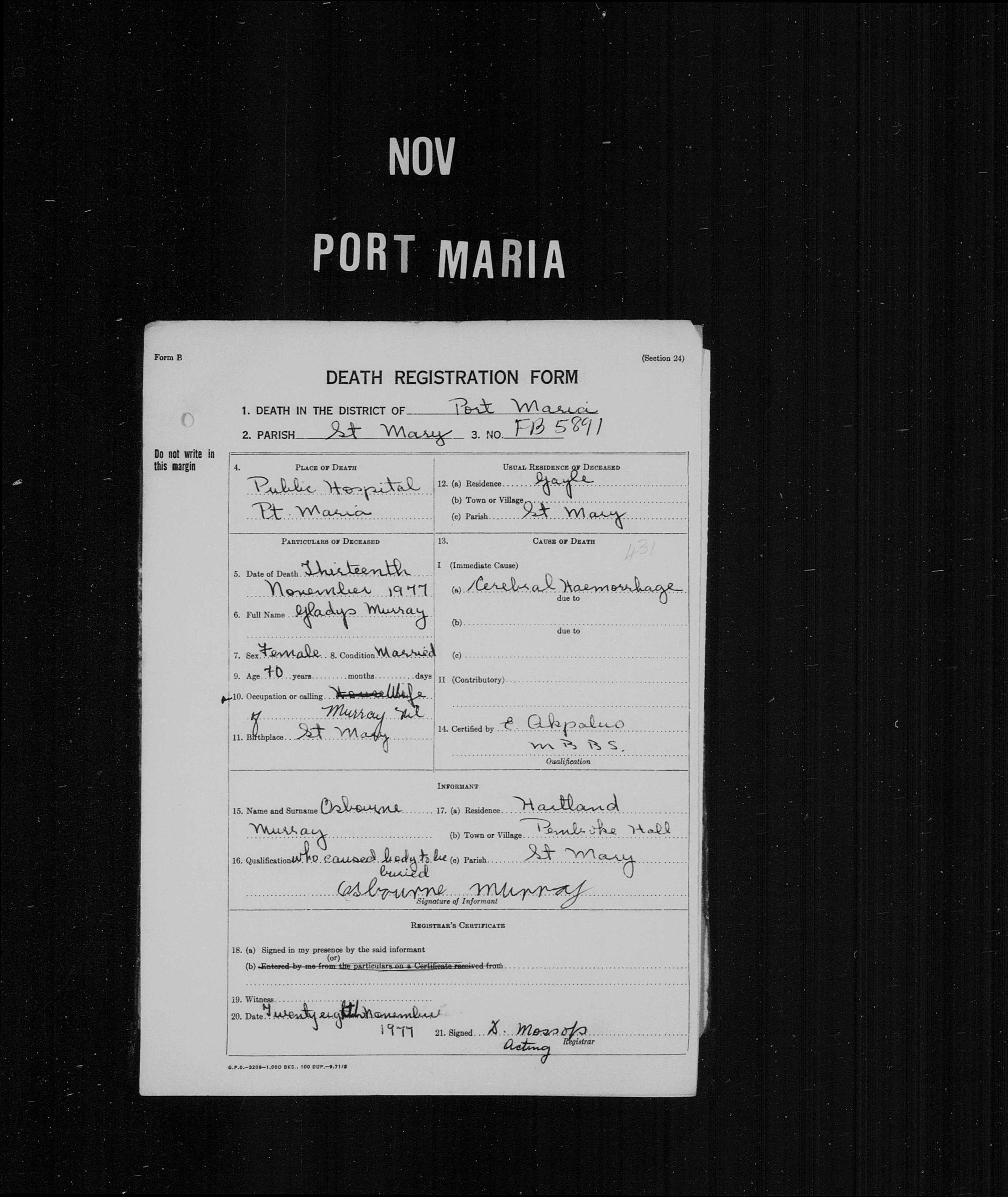
Location: Jamaica; see the locality recorded in the reproduced entry. Location: Jamaica; specific locality is identified in the record below. Full family-archive image [F7]. Historical death registration from the family archive. - F8 · Lurlene Williams birth, 1923
- 15 November 1923, Farm Pen, St. Mary: Lurlene Williams’s birth, mother Gladys Fyffe, informant Cecil Williams, present at birth. Registered 23 November. Anthony DePass confirms Cecil as Lurlene Williams’s father; the form’s father field is blank. Family archive: Mother / Va.
- F9 · Compiled family tree, June 2024
- Family Tree / “Faily tree 6_2024.jpg.” The screenshot links Daniel Buscoe Fyfe and Albertha Peart, Robert Fyfe and Matilda Kidston, and Joseph and Catherine Kidston. A compiled guide to relationships, not independent verification. Its Matilda dates conflict with the 1845 birth entry.
View the earlier compiled tree
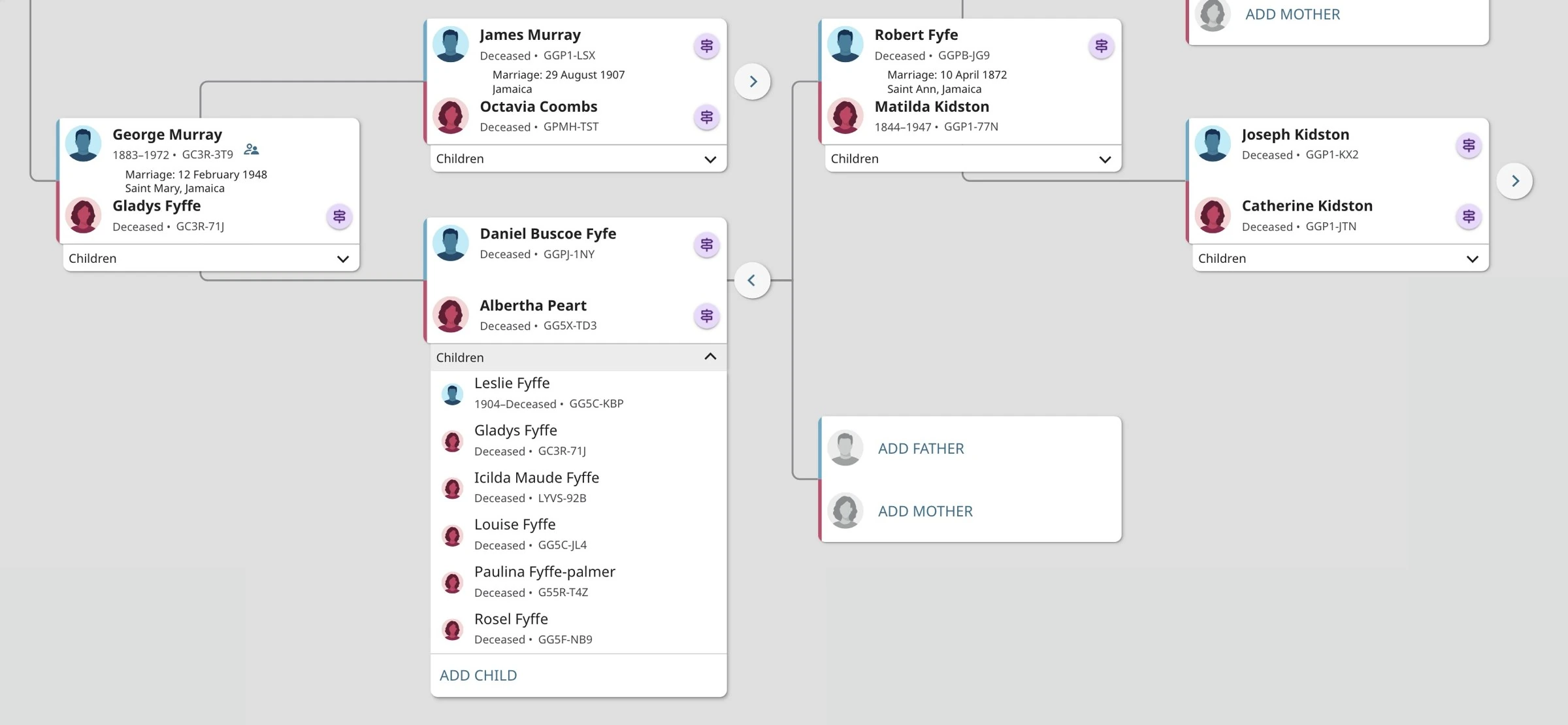
Location: Family relationships across Jamaica; this compiled tree is not a geographic map. Location: Jamaica; specific locality is identified in the record below. The earlier family tree is a research compilation. Its dates and connections must be compared with originals [F9]. - F10 · Family research and interview notes
- Family research notes, “Robert Fyffe and Matilda Kidston.docx,” and informal notes of a January 2024 conversation with Claudette. Used as attributed research and oral testimony alongside the illustrated life-event records.
- F11 · Port Royal enslavement-register image
- Family Tree / Slavery / “CSUK1817_133624-00706.jpg.” Visible T 71/119; Port Royal, 1817; return involving Jacob DePass as guardian. Examined, but not used to prove the maternal Marianne–Jane–Joe sequence. Pursue separately for the DePass branch.
- F12 · St. Ann baptism page, 1818
- Family Tree / Mother / “kidstons 1818.jpg.” Kidston children on the left-hand page are described as free children of colour. Examined as contextual evidence; no relationship to Joseph is asserted.
View the baptism page
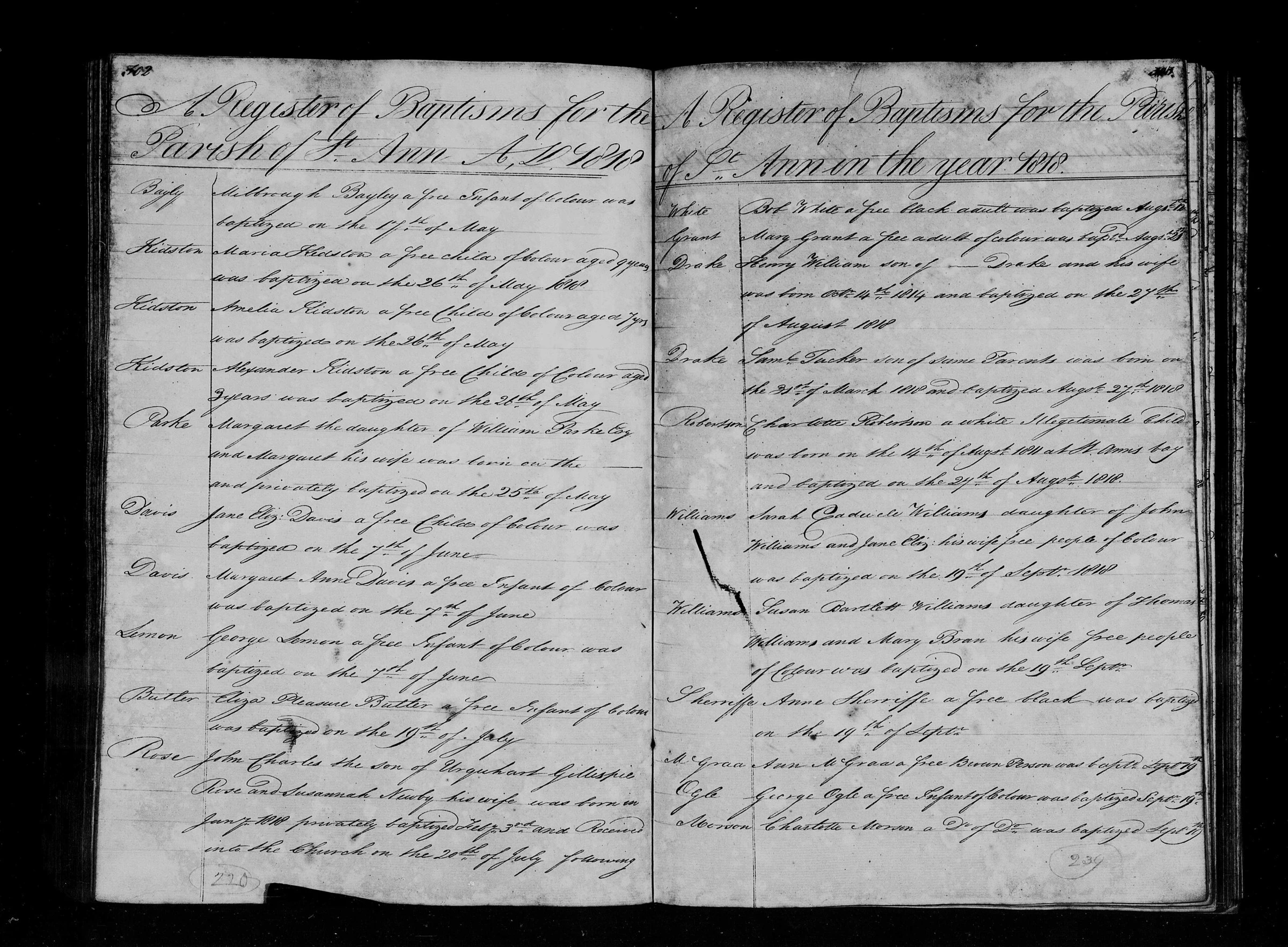
Location: St. Ann, Jamaica; 1818 baptism registration. Location: Jamaica; specific locality is identified in the record below. The St. Ann 1818 baptism page contains Kidston entries described as free children of colour. Their relationship to Joseph is not established [F12]. - F13 · Verified family lineage and archival summary
- Archival Transcription: British Colonial Slave Registers (TNA T 71), an AI-written research summary supplied 18 October 2026, considered separately from Anthony DePass’s confirmation that he verified the lineage links and Joseph’s consistent appearances in the relevant returns after his birth around 1825. The summary is not a literal archival transcription. Matilda’s parentage is documented by the 1845 birth entry; the 1872 marriage form has no father-of-bride field. The cited material does not establish Joseph’s later landownership. These family research findings are attributed to him; four original register pages are reproduced here, while Joe’s individual entry and the later Alexander return are not among those supplied images. Individual register images provide more precise evidence than the summary’s broad reference ranges. The 1817 page records Abba alias Jane as one person. Quasheba is attributed to the wider research; that name is not visible on the four supplied pages. Anthony DePass’s clarification of 18 October 2026 identifies Cecil Williams as Lurlene Williams’s father, distinguishes two Alexander Kidstons as father and son, and confirms James and the younger Alexander as brothers, with James described as “mulatto” in his research. The cited material does not include the underlying James parentage and classification record; the proposed half-brother relationship and his mother’s enslaved status remain hypotheses. Anthony’s clarification of 19 October 2026 confirms that documentation supports Daniel Boscoe Fyffe’s ownership of land at Farm Pen. The cited material contains no conveyance or probate record identifying the original purchaser. It does not establish landownership by Joseph or a purchase by Robert. Anthony DePass’s clarification of 15 November 2026 supplies her surname as Williams and her later married name as Lurlene Smith.
- F14 · Mary Roche’s St. Mary return, 1817
- Return dated 28 June 1817, manuscript page 733. Marianne: forty, African; Abba alias Jane: twelve, Creole; explicit remark “Marianne her mother.” Escape remarks: June 1815 for Marianne, 25 April 1817 for Jane. Family Tree / Slavery / 62711_73022001091_1665-00794.jpg. Original register image. A precise T 71 volume reference is not visible in this image.
- F15 · Mary Ann Roche’s St. Mary return, 1823
- Return dated 28 June 1823, manuscript page 395. Changes: Edward’s death; Jane sold in 1822. The page does not name the purchaser. Family Tree / Slavery / 62711_314054001181_0644-00454.jpg. Original supplied image inspected. The preceding Andrew J. Roberts oath is not Roche’s return.
- F16 · James Kidston’s St. Ann return, 1826
- Lower return dated 28 June 1826. Heading names James Kidston as owner in right of Mary Ann Roche his wife. Marianne’s row records a prolonged absence. Family Tree / Slavery / 62711_314054001181_0640-00535.jpg. Original supplied image inspected. Joe’s entry is not visible in this image. The upper oath belongs to a different return.
- F17 · James Kidston’s St. Ann return, 1829
- Return dated 28 June 1829, again in right of Mary Ann Roche his wife. Marianne appears with “Runaway many years.” Family Tree / Slavery / 62711_314054001181_0646-00078.jpg. Original supplied image inspected. It does not establish her ultimate fate.
- F18 · Kidston portrait
- Family Tree / Kidston.jpg. Identified by Anthony DePass as Alexander Kidston; mount labelled “A. J. Kidstone Esq.” Date, photographer and precise identification relative to the early nineteenth-century estate holder remain unestablished. Reproduced as a family-archive image, not proof of the enslaver’s appearance.
Historical context and research routes
- H1. The National Archives. Enslaved people and slave owners. Guide to registers, fields and T 71.
- H2. The National Archives. Spotlight on slavery registers: transcript. Explains register construction, changes and offensive historical terminology.
- H3. National Library of Jamaica. History Notes, emancipation section. Dates and broad apprenticeship context.
- H4. Williams, James. A Narrative of Events, since the First of August, 1834, by James Williams, an Apprenticed Labourer in Jamaica. Diana Paton, editor. Duke University Press, 2001. Publisher’s description consulted; this research did not examine the full edition.
- H5. Jamaica National Heritage Trust. Free Villages. Land, housing and labour after emancipation.
- H6. Butler, Nic. Charleston County Public Library. Recall Their Names: The Personal Identity of Enslaved South Carolinians. Comparative Atlantic naming context, not direct evidence about this Jamaican family.
- H7. 1825 Jamaica Almanac, St. Mary, returns for March quarter 1824. Jamaican Family Search transcription. Original almanac scan not inspected.
- H8. 1827 Jamaica Almanac, St. Ann, returns for March quarter 1826. Jamaican Family Search transcription. Original almanac scan not inspected.
- H9. 1829 Jamaica Almanac, St. Ann. Jamaican Family Search transcription. Original almanac scan not inspected.
- H10. Jamaica Information Service. Parish Profile: St. Mary. Search-index excerpt of the institutional parish profile.
- H11. The National Archives. Slavery and the British transatlantic slave trade. Rebellion and resistance context; no family participation established.
- H12. Library of Congress. Jamaica: Genealogy Resource Guide, Archival Records. Collections, unindexed records and access conditions.
- H13. Robertson, James, cartographer and publisher; Samuel John Neele, engraver. This map of the county of Middlesex, in the island of Jamaica. London, 1804. Library of Congress digital image; call number G4963.M5G46 1804 .R6. Catalogue metadata and image retrieved directly. Historical map used for regional context; no ancestral home is plotted.
- H14. Diocese of Jamaica and the Cayman Islands: Churches by Deanery. Identifies St. John’s, Ocho Rios.
- H15. National Library of Jamaica, Church, Ocho Rios, D0009196. 1931 photograph; reproduction requires permission.
- H16. National Records of Scotland, CS228/B/15/52, catalogue description of a Court of Session process, identifying copies of letters to James and Alexander Kidston, 1812–1813. Catalogue descriptions of the letters. Also the 1817 Jamaica Almanac transcription, placing Alexander at Arthur’s Seat in St. Ann. Neither source proves the proposed family relationship.
- H17. Agyekum, Kofi. (2006). The Sociolinguistic of Akan Personal Names. Nordic Journal of African Studies, 15(2), 206–235. University of Ghana researcher; see birthday names, pp. 213–214, including Fante Aba for Thursday. Open-access article.