Falmouth after Melissa: history includes what a town must rebuild
Follow the hospital, emergency care and displaced infirmary residents through dated reports, with photographs that distinguish visible damage from confirmed recovery.
A damaged town is still somebody’s home
A photograph of a church without its roof can explain a loss immediately. It cannot tell us whether a nurse has a usable ward, an infirmary resident has returned home, or a family can afford repairs. Falmouth’s Melissa story needs those questions alongside its familiar historic buildings.
This account follows dated reports from the storm through October 2026. The photographs have their own dates. Read them as evidence of particular places at particular moments, not as a verdict that the whole town remains closed or has completely recovered.
Source & credit
October 2025: the storm and the first losses
Melissa crossed Jamaica on 28 October 2025. The National Hurricane Center’s post-season report documents catastrophic impacts in western Jamaica. That island-scale account is the starting point, but the condition of an individual Falmouth building needs more local evidence. [1]
In his statement to Parliament on 4 November, posted online on 6 November, Prime Minister Andrew Holness reported that Falmouth Hospital had lost most of its roof and experienced extensive flooding. Electrical systems and diagnostic and clinical equipment were affected. This was damage to the means of delivering care, not merely to a building’s appearance. [2]
The practical problem continued after the wind passed. People needed treatment while damaged spaces and equipment were being dealt with. A hospital reconstruction story therefore has to include the services supplied during the interruption, as well as the repairs themselves.
November: care while the hospital was being repaired
A Foreign Affairs Ministry release dated 22 November 2025 described a Spanish-supported Type 2 field hospital operating in Falmouth. It reported emergency and surgical care, maternity and paediatric services, with specialists supporting the work. The ministry described about 80 healthcare workers at the site and capacity for up to 200 patients daily. The figure describes capacity, rather than a count of patients treated. [3]
These arrangements put people back into an account that can otherwise become a list of damaged roofs. A temporary theatre, maternity service or paediatric consultation mattered because treatment could not wait for every permanent building to be restored. The release records what was reported in November; it does not establish that the same field hospital is operating today. [3]
December: the infirmary and a school sharing the burden
The Trelawny Infirmary faced a different displacement problem. A Local Government Ministry report dated 2 December 2025 said approximately 60 residents and 40 staff remained displaced. Residents were being housed at Hague Primary School. A school had become part of the care response, showing how damage to one institution could put pressure on another. [4]
The minister announced a temporary facility using prefabricated containers, with spaces for residents, bathrooms, dining and recreation. Relocation by the end of December was the stated hope. An announced plan is not proof that the move happened on schedule; this account has not established its actual completion date. [4]
January photographs: what can we see?
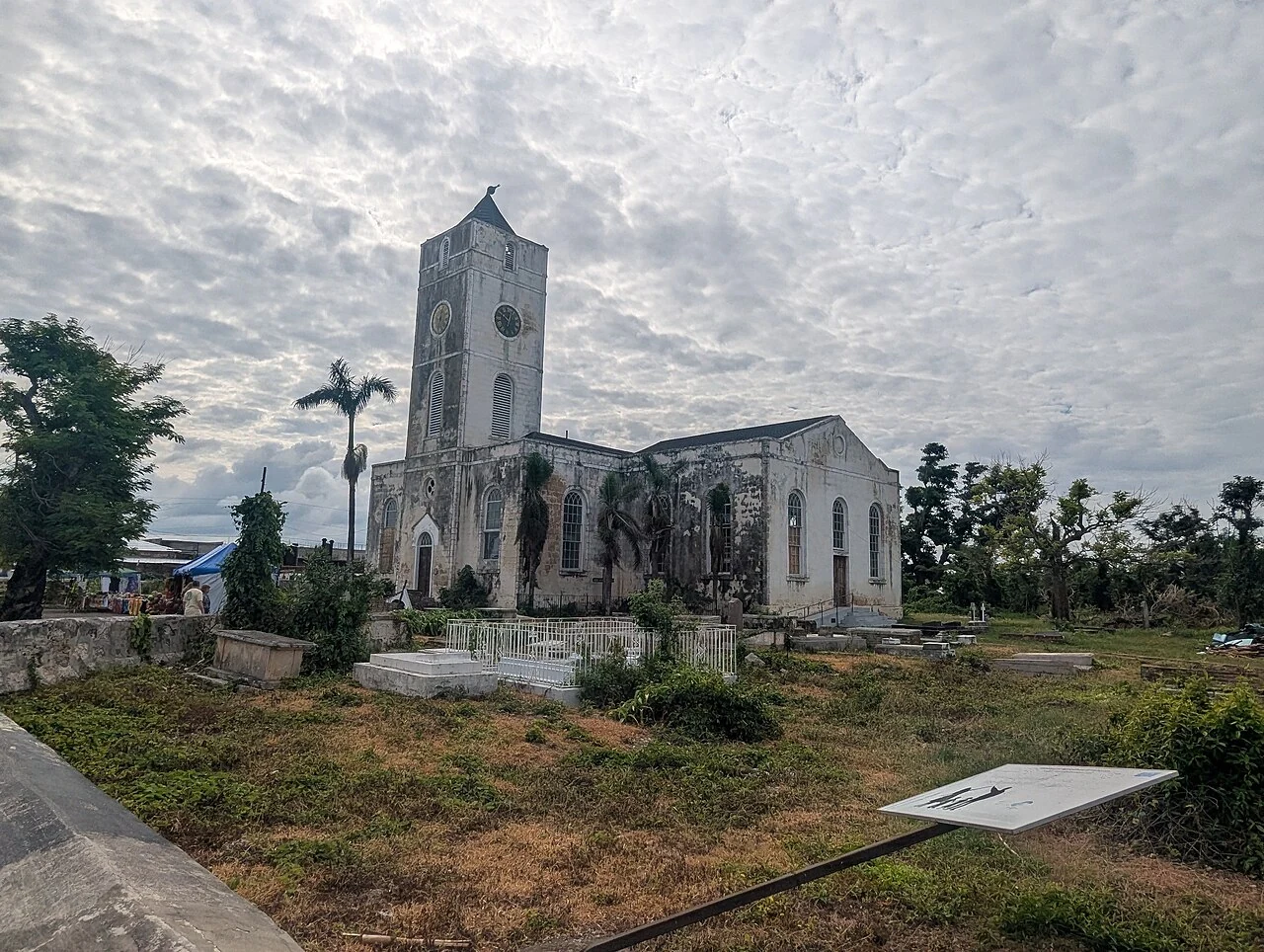
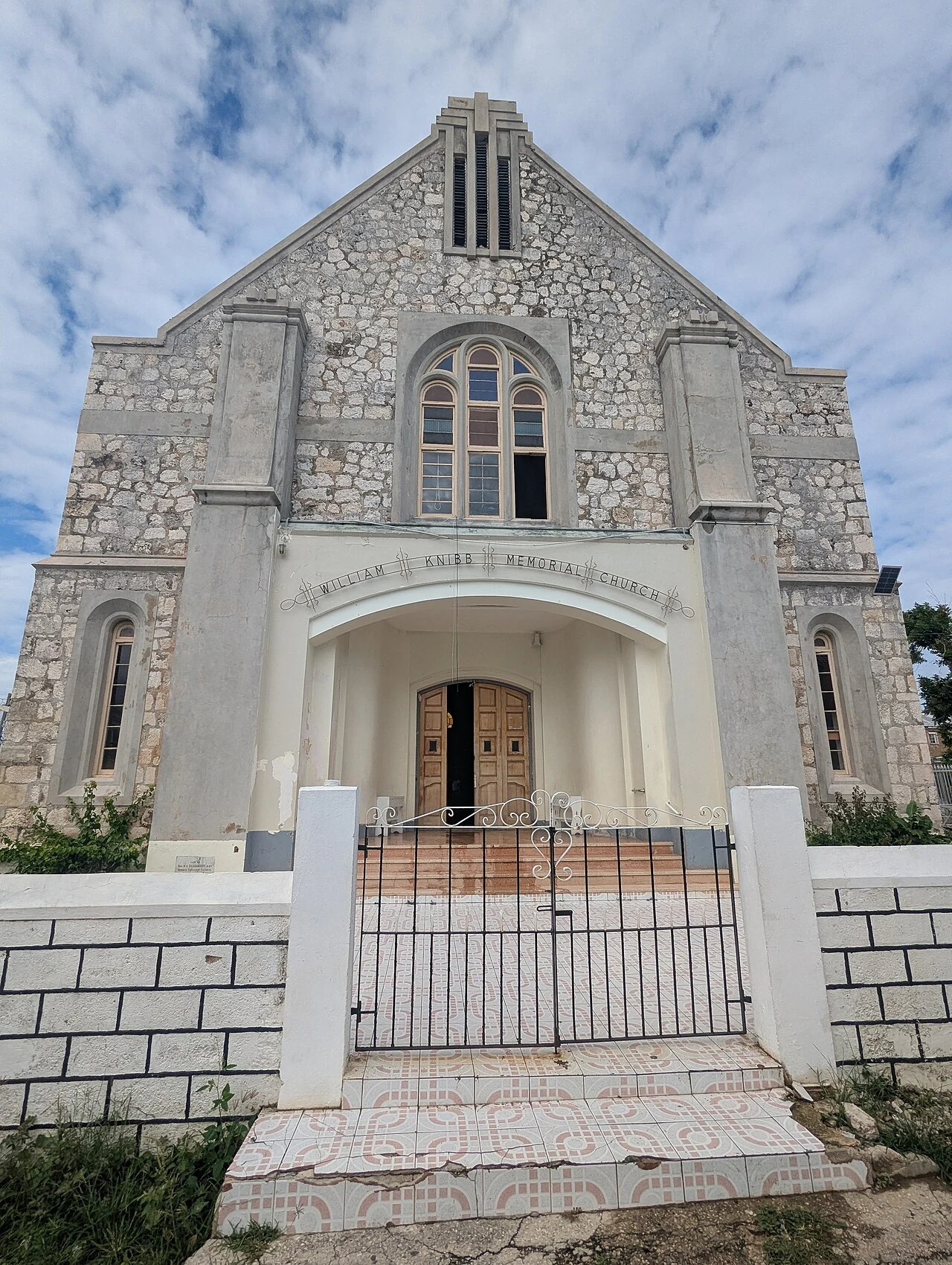
The 27 January 2026 photographs give us a dated look at individual Falmouth landmarks. At St Peter’s, roof loss is visible. At the William Knibb Memorial Church, the photographed frontage presents a different view. Neither photograph supplies an engineer’s assessment, an interior survey or the complete story of its congregation’s recovery.
Source & credit
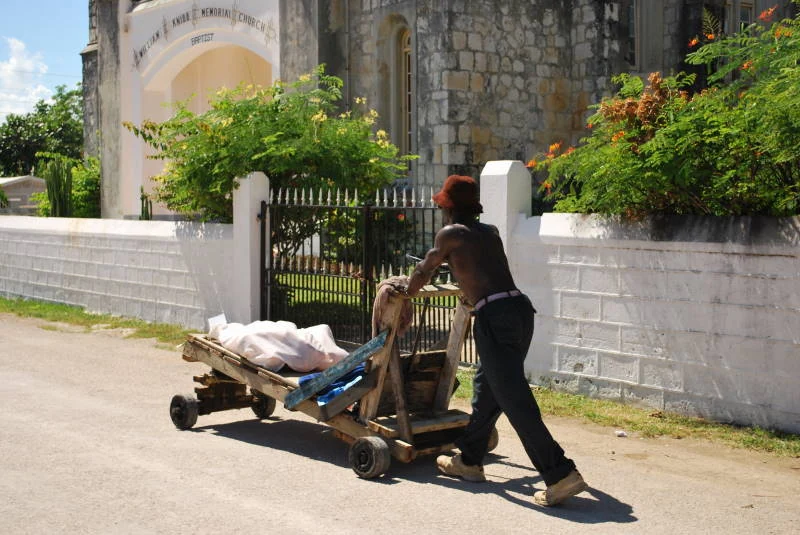
For comparison, Diego Tirira’s 2010 photograph below shows a person moving a handcart beside a church frontage in Falmouth. It is valuable as a pre-storm street scene. The angle differs from the later images, so it is not presented as a precisely matched before-and-after pair.
Source & credit
October 2026: a substantial update, with work still forecast
A JIS hospital update published on 8 October 2026 reported Health Minister Christopher Tufton’s briefing the previous day. He said the main ward of Falmouth’s Accident and Emergency Department was about 90 per cent complete, with air conditioning among the remaining work. The expected finish was late October or early November. Work had also begun on paediatric and dietary areas. [5]
That gives a more useful picture than repeating the immediate aftermath indefinitely. It also requires restraint: the forecast does not establish completion by 26 October, and a percentage for one part of the hospital is not a percentage for the whole town. The minister also acknowledged healthcare workers continuing to serve while dealing with the hurricane’s effects in their own lives. [5]
Falmouth has rebuilt before
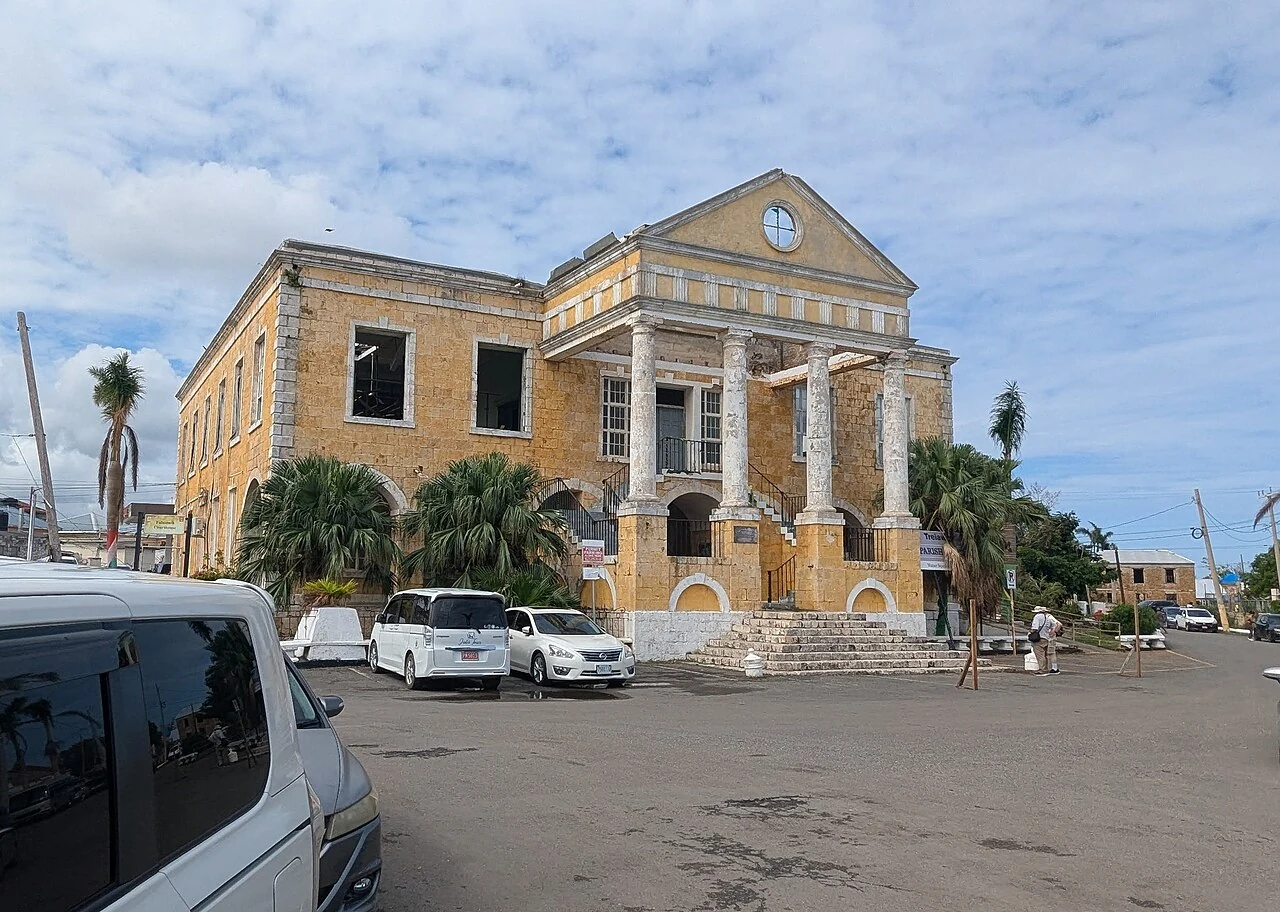
The courthouse offers a longer perspective. Fire damaged it in 1926 and it was rebuilt. Its history already includes disruption and reconstruction; architectural survival need not mean that every material has remained untouched. [6]
Source & credit
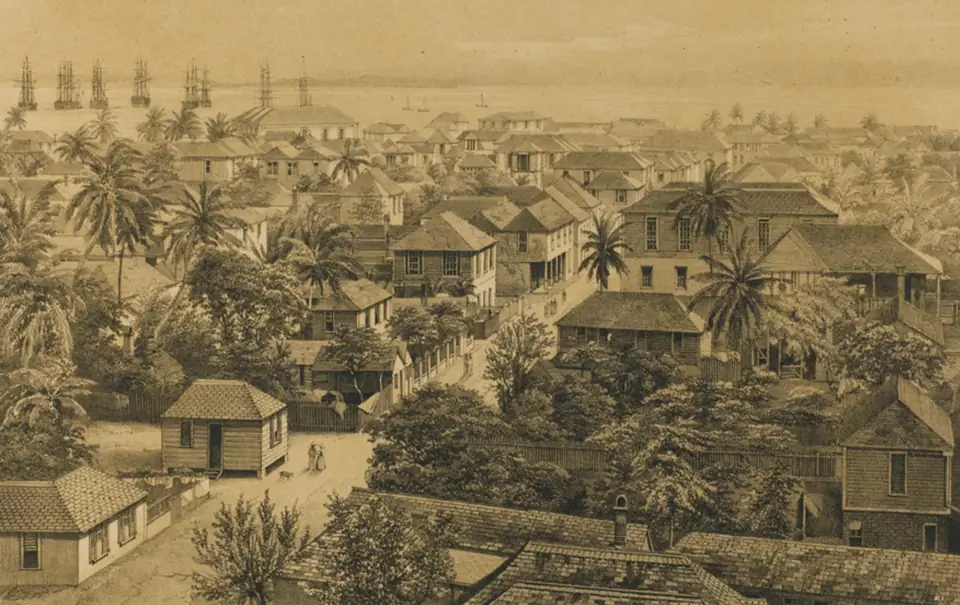
The older church-tower panorama below records another Falmouth altogether. It helps place the town between the harbour and its streets. It cannot stand in for a photograph of the hospital before Melissa. Historical views are most useful when they answer a specific question rather than merely supplying an atmosphere.
Source & credit
Read recovery through services as well as buildings
The hospital, field facility, infirmary and school tell related but distinct stories. The hospital report concerns clinical space and equipment; the infirmary report concerns residents needing somewhere to live and receive care. Photographs of churches document visible fabric. The June 2026 assessment hosted by the United Nations provides a broader account of the hurricane’s effects and recovery needs. These sources operate at different scales and dates. [7]
For a visit, confirm the named business, guide, building and route you actually intend to use. Arrange the return pickup, ask about steps and uneven surfaces, and respect barriers around work sites. A photograph from January cannot settle whether an entrance is usable in October.
Tony’s Call: Give Falmouth your time and business where it is welcome. Learn its history and listen to the people doing the rebuilding. Ask permission before photographing a damaged home, and keep a household’s privacy ahead of your wish for a dramatic picture.
Falmouth’s people, port and buildings → · Current conditions desk →
Sources and notes
- NOAA National Hurricane Center, Hurricane Melissa tropical cyclone report: the October 2025 event.
- Office of the Prime Minister, statement delivered 4 November 2025 and posted 6 November: Falmouth Hospital roof, flooding and equipment damage.
- Ministry of Foreign Affairs and Foreign Trade, media release dated 22 November 2025: Spanish-supported field hospital and clinical services.
- Ministry of Local Government, report dated 2 December 2025 (page also shows 10 February 2026): displaced infirmary residents and proposed temporary facility. Announced targets are not treated as completed relocations.
- Jamaica Information Service, Garfield L. Angus, 8 October 2026: Falmouth Hospital reconstruction update from the 7 October briefing. The A&E completion date is a forecast, not verified completion.
- Jamaica National Heritage Trust, Falmouth Court House: the 1926 fire and rebuilding.
- United Nations-hosted assessment, June 2026: effects and impacts of Hurricane Melissa in Jamaica. Historical assessment, not a live building-access report.