Daddy Rock, Woodside: bringing enslaved ancestors back into view
A community’s place of remembrance connects a plantation register with family names, gathering and the work of emancipation memory.
Begin where the community remembers
Daddy Rock is a cavern-like formation in Woodside, St. Mary. JNHT describes it as a place held in reverence, associated in community memory with enslaved Africans meeting, worshipping and discussing their circumstances. Its account links the site with Emancipation observances and ancestral plaques. The survival is therefore not only rock: it is the community’s use of place to keep people and relationships in view. The historical meetings are reported traditions, not surviving verbatim minutes. [1]
Remembrance changed who the landscape was about
A plantation register was created to organise people under an owner’s control. Community remembrance can use that same document for a different purpose, bringing names back into a landscape as ancestors rather than assets. Daddy Rock’s significance lies in that change of relationship between a record and the people it describes.
Gathering and family knowledge add something a register could not set out to preserve: how later generations understand belonging to the place. Documentary entries and community memory need not be forced into one kind of proof. Together they can make the estate landscape speak about descendants and continuity, while each uncertain family link remains a question to investigate. [source]
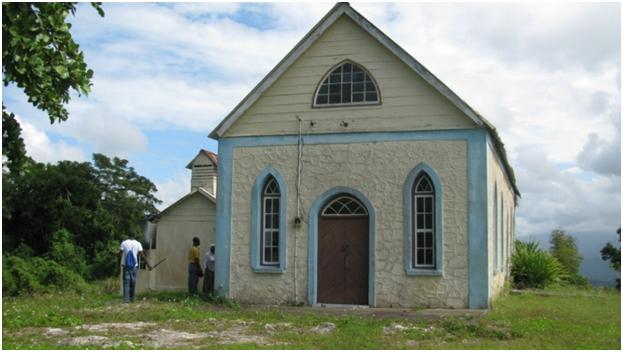
Source & credit
Look closely: Place the church within its landscape, then return to the ancestral plaques in the text. This is the church associated with the former plantation house, not a photograph of Daddy Rock.
A register becomes a name again
JNHT reports that families placed ancestral names on plaques using the 1817 slave returns. The register originally served an administration that counted people as enslaved property. A plaque can use that same record for another purpose: naming an ancestor whom a family wishes to remember. Those uses are morally and historically different. A register entry may begin research, but a matching name alone does not prove a complete family line. Dates, ages, kinship references and neighbouring records have to be compared. [1]
Erna Brodber and local historical work
The JNHT account draws on Woodside scholar Erna Brodber’s research. Brodber’s Woodside, Pear Tree Grove P.O. treats the community through plantation and later records rather than presenting the village as an anonymous rural setting. A 2012 account of the community observance describes residents gathering to remember enslaved ancestors and share discussion and song. It is a record of an observance at that time, not confirmation of this year’s programme. [2][3]
One landscape holds different pasts
Woodside also has Taíno rock art and a church associated with a former plantation house. They must not be merged into one “slave site.” The JNHT photo shown here is St. Gabriel’s Anglican Church, not Daddy Rock and not the Taíno carving. Each object asks a different question: settlement before Europeans, plantation ownership, later religious use, or collective remembrance. Keeping their identities clear allows the community’s layered history to remain intelligible. [1]
Remembering is an action
A gathering at Daddy Rock can turn a place once associated with constraint into a place for speaking about freedom. That is an interpretation of remembrance, not proof that the rock’s function was identical in every generation. The community, rather than an outside guide, should explain what its observance means. Ask which names are spoken, how the register was read, and what residents want young people to learn. Those questions allow continuity to include present choices.
Read absence without inventing a life
An ancestral name is powerful precisely because so many accounts leave the enslaved as a total. Still, a plaque does not tell us everything: a person’s own words, ambitions or experience may remain missing. A good family-history note states what the record establishes, what the family recalls and what needs another source. It can honour an ancestor without constructing a scene that the archive cannot support. Woodside offers a practical model for connecting record-based research with local memory.
Try the history yourself
Compare the purposes of an 1817 administrative return and an ancestral plaque. Write one statement each can support and one it cannot. If researching family, keep the exact source and uncertainty beside any proposed relationship.
Explore with care
Contact local organisers before visiting Daddy Rock or asking about an Emancipation gathering. Confirm access and surfaces; the cave-like setting is not a verified accessible visitor route. Ask before photographing plaques or participating in an observance.