Two family histories inside the estate record: Kidston, land and the people held in slavery
A proprietor’s name can survive in print while the people sustaining the property appear only as a total. Reading the records together changes whose history is visible.
Begin with what the table actually says
The 1817 Jamaica Almanac prints returns supplied to parish vestries for the March 1816 quarter. In St. Mary it lists Alexander Kidston at Boscobell with 32 enslaved people and 184 livestock. In St. Ann it lists the same name at Arthur’s Seat with 107 enslaved people and 361 livestock. The columns are people held in slavery and stock—not people and acres. Together, the two entries record 139 enslaved people under the named proprietor’s returns. [1]
That total belongs to those particular entries and that reporting period. It must not be substituted for a later return or treated as an unchanging population. Births, deaths, sales, transfers and administrative changes could alter a later figure. Published almanacs also lagged behind the date of the information they printed. The date of a volume and the date represented by a return need to remain visible together.
The 1826 almanac reports the March 1825 quarter and lists Alexander Kidston at Bogg with 149 enslaved people and 465 livestock. It separately lists Mary Ann Roche with 14 enslaved people. These entries identify documented ownership associations in St. Ann; they do not, on their own, prove the later family relationships being investigated. The figure 149 belongs to Bogg in that later return, not to the combined 1816 Boscobell and Arthur’s Seat entries. [3]
The proprietor was named; the population was counted
The form of the record exposes an inequality. Kidston’s name and the property names are printed. The 139 people in these two returns are not individually identified there. A proprietor therefore becomes easier to place in a conventional biography, while the lives claimed as property require other documents before names and relationships can be recovered. The absence of names is a feature of the source’s purpose, not an indication that those people had no families or histories.
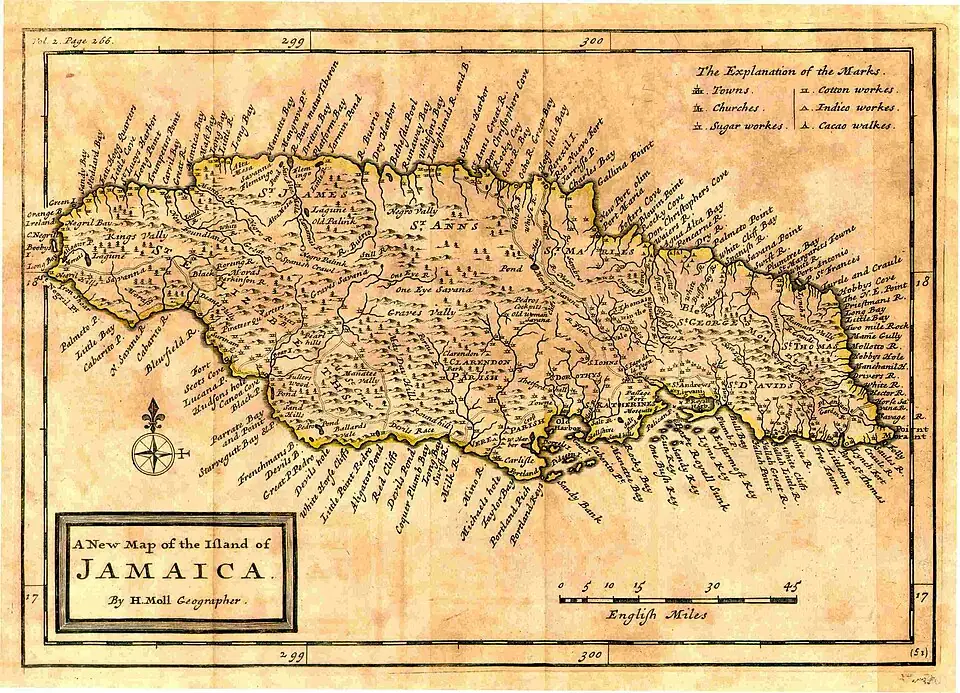
The table also places estates and pens inside a wider parish network. In St. Mary, the same volume lists the large holdings at Brimmer Hall, Trinity and other properties; in St. Ann, it names Drax Hall, Orange Valley and many smaller holdings. The coastline was not a collection of isolated great houses. It was a landscape of agricultural work, residence, markets and public administration whose records made ownership more visible than the workers sustaining it. [1]
Look for the work at the edge of the picture
Source & credit
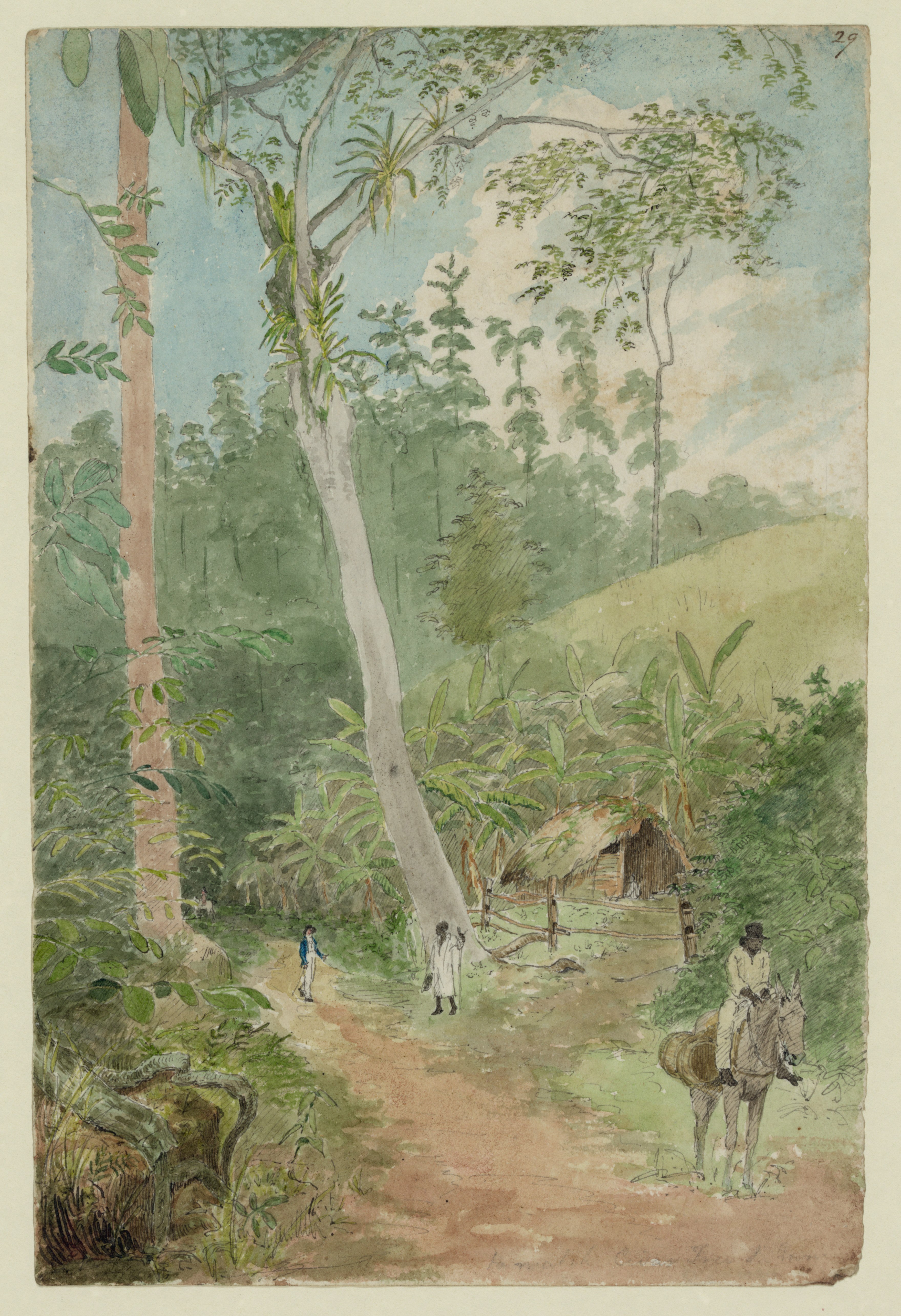
Berryman’s Jamaican drawing puts a small hut and people on a path beneath towering vegetation. The catalogued title names a bookkeeper, a watchman and water-carrying. It is an image of a place organised through work. The people are small within the landscape, but the scene becomes difficult to understand if we stop looking at them.
The same is true of an estate return. A reader can notice the proprietor and move on, or pause over the number of people claimed beneath his name. In the 1816 Arthur’s Seat and Boscobell entries, that number is 139. The figure describes the scale of an ownership claim; it also points towards 139 lives whose family relationships the table did not record.
Three records do three different jobs
An almanac return gives a proprietor, a property and a count. Registration records of enslaved people can supply individual names, ages, reported birthplaces and changes between returns. A parish or civil record can establish a later baptism, marriage, death or family relationship. These are complementary records. A total in an almanac cannot by itself prove that a particular named ancestor lived on the estate; a shared surname cannot prove biological descent from its owner. [2]
This is the distinction between the two family histories. One follows people who controlled property, including inheritance, marriage and administration. The other follows the people whose lives those arrangements constrained. They intersect through ownership and estate association even where kinship has not been established. That intersection is consequential history in its own right, without inventing a biological connection to make it dramatic.
Source & credit
From enslavement to a recorded family
The family history on this site follows Marianne / Quasheba, Abba alias Jane, Joseph Kidston, Matilda Kidston and Daniel Boscoe Fyffe. Original registers now reproduced in the family narrative name Marianne as Jane’s mother, Joseph and Catherine as Matilda’s parents, and Robert Fyffe and Matilda Kidston as Daniel’s parents. The 1872 marriage at St. John’s, Ocho Rios, records Robert and Matilda’s union. The Arthur’s Seat companion series connects those households with Bogg Pen and the wider Kidston history.
The historical context explains why that bridge matters. Emancipation changed legal status, but it did not make the archive equally complete. A person can appear in earlier records through an owner and in later ones through family, residence or occupation. Spelling and the use of surnames may change. Continuity has to be supported by converging attributes and relationships rather than by forcing identical forms across records created for different purposes.
A mother, a father and a child replace an aggregate

Source & credit
Matilda’s entry gives the abstract distinction between records a human form. Joseph and Catherine appear as parents. Bogg Pen appears as an address. Joseph’s labourer occupation and his role as informant sit beside the child’s birth. The property landscape remains present, but the reason for recording the people has changed.
Following Matilda into her 1872 marriage to Robert Fyffe, and then Daniel’s 1873 baptism, carries the story forward through the relationships the family formed. These are the bridges through which an estate history becomes a family history. They also keep Catherine and Matilda visible in a documentary world where a proprietor’s biography is usually easier to assemble.
Race labels were administrative judgments
Colonial descriptions of color or ancestry belong to the racial hierarchy of their own period. They are not genetic measurements and should not be assigned to living descendants as fixed identities. Their relevance is that officials used them to describe and classify people in an unequal system. A historical transcription may need to preserve a term to explain a source, while the article must make clear whose language it was.
The same principle governs an estate name. It can indicate a place of work or residence, a proprietor’s association or the route through which a document was filed. It is not a complete account of a person’s identity. Families existed beyond the categories owners and officials used, even when recovering those relationships now requires several kinds of evidence.
The estate belongs inside the family story
The printed 1816 returns establish a named proprietor associated with two properties and the counts above. The family’s original registers add named relationships, while Matilda’s 1845 entry places Joseph at Bogg Pen. Reading them together changes whose history becomes visible. A biography that celebrates a landowner while omitting the people in those columns has left out the human basis of the property.
For descendants and visitors alike, the stronger account keeps both sides in view. It tells the documented facts of property and administration, restores named lives when the records support them, and states an unresolved connection once rather than substituting a long series of research instructions for a finished narrative. The people held in slavery belong in the history even before every genealogical link can be settled.
Continue through the connected stories
The Arthur’s Seat series follows the land and the Kidstons; Joseph’s chapter follows the household; and the St. Ann court story brings named people into the institutions surrounding that landscape. In Search of Marianne / Quasheba carries the ancestral narrative to the later family.
The surname is where the search begins
An estate record could count people without preserving the relationships that mattered most to them. A later marriage or birth entry might name a parent, partner or child. Connecting those different records changes the subject from an owner’s property to a family’s continuity.
This is why the Kidston and Fyffe material matters beyond a surname search. Recorded names and racial labels were produced within unequal institutions; families lived through events and relationships larger than those categories. A responsible reconstruction follows dated links while preserving uncertainty. For a descendant, the result can be both personal and historically important: people once entered as possessions become identifiable members of a family whose story continues. [1]
Sources and notes
- Jamaica Almanac (1817). Returns given to vestries for March 1816: St. Mary and St. Ann. Transcription at Jamaican Family Search. ↩
- Library of Congress. Jamaica local history and genealogy: archival records and record types. ↩
- Jamaica Almanac (1826). St. Ann property returns. Transcription at Jamaican Family Search. ↩
- William Berryman, Plantain Walk — Bookkeeper — Watchman and Hut — man with casks of water / greattoe in stirrup. Library of Congress, ppmsca.13410, DRWG 1 — Berryman, no. 13. Catalogue date: between 1808 and 1816. Original drawing in watercolour, black ink and pencil; Commons scan of the Library image. Public domain / no known restrictions on publication. The Library’s date range takes precedence over the Commons page’s single 1808 date.