Church, colony and congregation: who held religious power in Jamaica?
Church history changes when public finance, slavery, Black religious leadership and family records are told together. Institutions and worshippers did not always give the same meaning to Christianity.
An established church was part of government
After the English conquest, Anglican institutions developed within the colony’s public order. J. B. Ellis’s 1913 diocesan history records an act in 1681 authorizing parish magistrates to levy taxes for ministers and church buildings. In 1683 clergy became members of parish vestries. These arrangements made a church more than a place people chose to worship: its maintenance and officeholders were linked to local taxation and authority. [1]
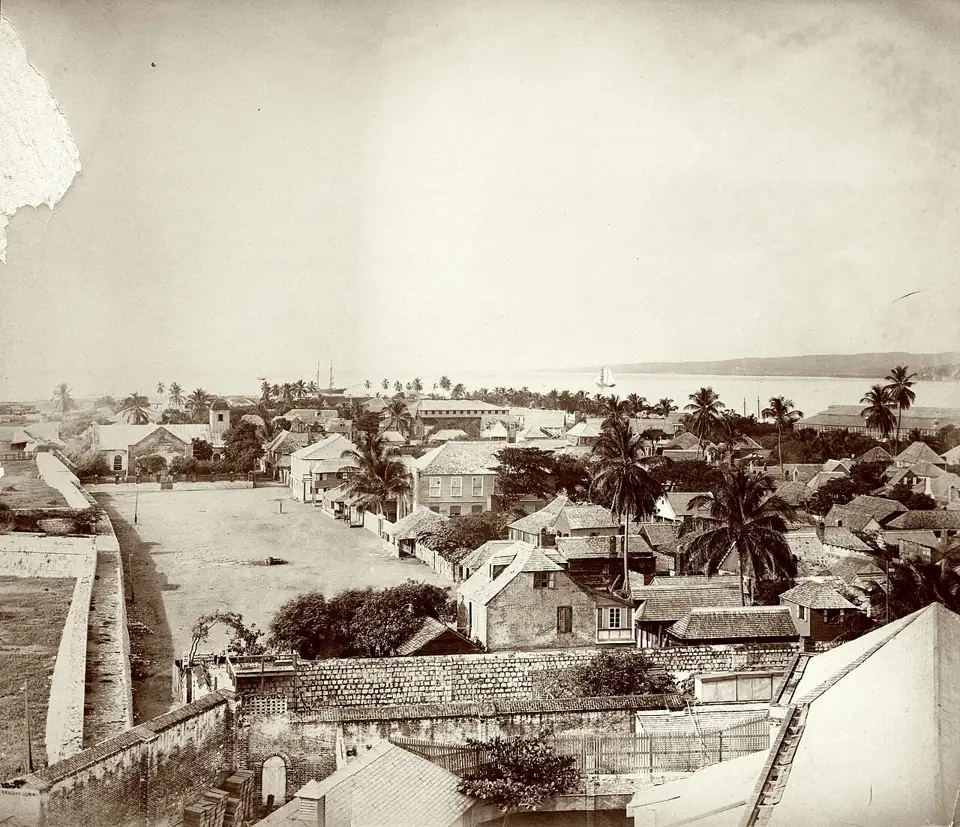
Source & credit
Look closely: Locate the church within the town rather than viewing it as a detached monument. The photographer’s scene does not establish the beliefs of the people who lived around it.

Source & credit
The church’s place in a port community gives the institutional story another setting.
Unknown author · Public domain · Image record ↗Ellis wrote as a church historian with a denominational viewpoint, but his account is unusually candid about the relationship to enslavement. His eighteenth-century chapter describes an assembly dominated by slaveholders or sympathizers and an established church serving the social world of settlers, planters and officials. It also records a baptism fee fixed by law in 1706 that he regarded as prohibitory for enslaved people. Religious recognition could be priced and administered inside the very society that denied those people freedom. [2]
In 1748, the financing changed: clergy salaries were to be paid from island funds rather than depending partly on vestry decisions, while local obligations for rectories or rent continued. This altered the channel of support without removing the church from colonial government. Public money, religious office and plantation authority remained intertwined. A memorial to a rector can therefore be read as part of an institutional history as well as a record of personal ministry. [2]
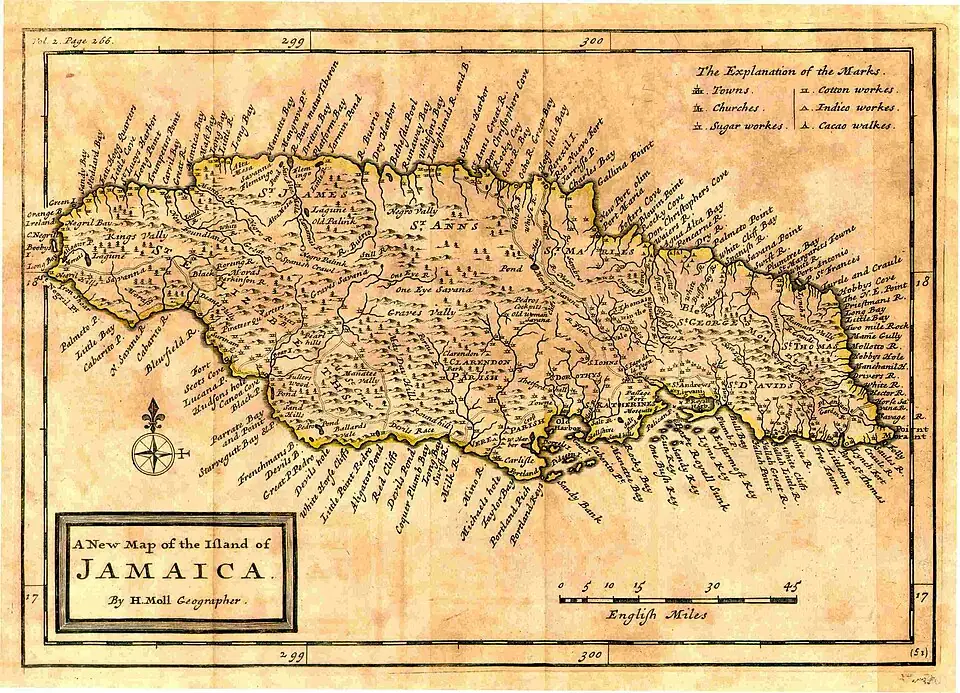
Source & credit
Christianity was also interpreted from below
Enslaved and free African Jamaicans did not encounter missionary practice as people without their own knowledge. Katharine Gerbner’s study of the first Moravian mission describes Zacharias George Caries arriving in 1754 and being called “obea” by people at the Bogue estate within months. Her interpretation is that obeah was a framework through which African Jamaicans could understand European healing and religion, not merely an object missionaries tried to replace. [3]
The episode reverses the familiar direction of the conversion story. A missionary brought an account of Christian transformation; the people he met classified his conduct through their own understanding of spiritual and medical power. The encounter involved interpretation on both sides. It cannot be summarized as Europeans importing belief into an empty cultural space. Nor does this particular episode establish the position of every Moravian congregation or every Anglican parish on slavery.
An enslaved Baptist leader made freedom the issue
Samuel Sharpe’s organising shows another relationship between congregation and colonial power. JIS identifies him as an enslaved Baptist leader whose plan for refusal to work developed into the uprising of 1831–32. The congregation supplied relationships through which enslaved people could communicate and act. Religious authority here belonged to an enslaved man, and became part of a struggle to end the system within which other churches held property and office. [4] [4]
After emancipation, church-associated activity could also shape independent settlement. Sturge Town’s 1839 land purchase and the school, chapel and resident minister established by 1840 joined religious organization to housing and education. Purchasers paid for their holdings; they were not merely beneficiaries in a missionary biography. The church could provide a network and an institution while residents pursued a material independence of their own. [5]
The register recognized a relationship, not an entire life
Baptism, marriage and burial registers now help descendants reconstruct families. Their importance lies in the names, dates, residences, occupations, witnesses and relationships they record. They also represent an institution’s categories and practices. A wedding entry establishes that a marriage was recorded on a particular date. It does not mean the couple’s relationship began that day, or describe every earlier household arrangement. Religious participation alone did not determine a person’s legal status. [6]
That distinction matters in the Fyffe–Kidston inquiry. The family archive’s illustrated 1872 return identifies Robert Fyffe and Matilda Kidston’s marriage at St. John’s, Ocho Rios. Ocho Rios’s St. John’s and Gayle’s St. John’s are different churches in different parishes. A shared dedication cannot decide which register contains a marriage. The National Library’s Ocho Rios photographs show an identified building at particular dates; they do not prove who married there.

Source & credit
A substantial church building recorded in the missionary photograph collection.
Unknown author · Public domain · Image record ↗
Source & credit
Compare the approach, setting and building scale.
Unknown author · Public domain · Image record ↗Living worship did not follow a single imported script
The Revival recordings below belong to African Jamaican religious life, in which voiced prayer, chorus, rhythm and bodily participation have their own histories. Folkways identifies the performers and the recorded forms; those descriptions differ from the language of an eighteenth-century vestry or a church historian’s evaluation. Hearing the performances after reading the institutional chronology makes the distinction tangible: official authority and the practices of worshippers are connected, but not identical. [7]
The historical judgment is therefore specific. The Anglican establishment was materially entangled with the slave colony. Missionaries operated within that unequal world. Black Jamaicans also interpreted, led, organized and transformed religious life. A denomination cannot receive one verdict that substitutes for all those histories. Following money, law, leadership and the congregation produces a fuller account than either automatic praise or blanket condemnation.
Sources and notes
- J. B. Ellis (1913). The Diocese of Jamaica, chapter III: parish government, taxation and clergy. Historical denominational account. ↩
- J. B. Ellis (1913). The Diocese of Jamaica, chapter IV: clergy support, fees and enslavement. ↩
- Katharine Gerbner (2015). “They call me Obea.” Atlantic Studies, 12(2), 160–178. University of Minnesota publication record and abstract. ↩
- Jamaica Information Service. Samuel Sharpe: Baptist leadership and the 1831 uprising. ↩
- Jamaica National Heritage Trust. Sturge Town: purchase, settlement, school and chapel. ↩
- Library of Congress. Jamaica local history and genealogy: archival records and record types. ↩
- Smithsonian Folkways. Folk Music of Jamaica (1956), FW04453: identified Kumina, work, ring-play and Revival recordings. ↩