St. Ann’s slave court: the plantation economy on trial, through the colony’s own pen
A surviving court book brings pimento, livestock, escape and testimony into the history of St. Ann. It shows how everyday disputes entered a legal system controlled by people with power over the accused.
Jacky, William and the things inside a home
On 9 April 1811, Jacky was accused of entering William’s home and taking clothing and coins. Historian Michael John Becker discusses the case from the St. Ann court book: both men were recorded as enslaved by Alexander Kidston, yet the possessions were recognised as William’s. Becker cites The King v. Jacky to Dr. Kidston, MS 273, folio 373.
The case makes a contradiction tangible: a person legally held as property could also have possessions recognised in a criminal proceeding. The passage does not give the verdict. It brings the Kidston name into a dispute involving two named men and a home. The possible identity link with the Jacky named in an 1816 workhouse list remains open.
[B]The Kidston family chapter follows ownership and parish office. Here, the point of entry is a household’s belongings. Clothes and money make the everyday stakes visible before the story returns to the institutions that recorded them.
A valuable crop became an accusation
The National Library of Jamaica identifies a case concerning pimento taken from Mount Pleasant Plantation in a court book whose first entry is dated April 9, 1787, and whose last is April 12, 1814. Pimento is a useful starting point because it connects the familiar parish landscape to labor, ownership and law. A crop could be represented as plantation income in one account and alleged theft in another. The criminal charge did not stand apart from the economic system; it helped enforce that system’s claims. [1]
The catalogue also identifies proceedings involving the killing of hogs, murder and escape from enslavement. These are different alleged acts, and their meanings cannot be reduced to one motive. What unites them in this collection is the institutional setting: the people accused were judged in a slave society. An act of flight challenged an owner’s claim over a person. A dispute over food or animals implicated the resources through which an estate and its residents lived. [1]
The parish connected property to public authority
The court was presided over by white justices of the peace, including merchants and planters. The Library describes severe sentences and records of rulings as well as affidavits and proceedings. People linked to the commercial and agricultural order participated in judging people subordinated within it. This was not an equal dispute between independent citizens whose only difference was the particular charge. [1]
Other records make that connection visible. The 1817 almanac’s St. Ann returns list proprietors, properties, enslaved people and livestock, and state that the information was supplied to parish vestries for the March 1816 quarter. Property administration and local government overlapped. Those tables do not identify the outcome of the Mount Pleasant case, but they describe the administrative world surrounding the court: owners and holdings were visible, while the people held in slavery could be reduced to a count. [2]
The testimony is important because the record is unequal
The court book preserves testimony attributed to enslaved people. That is its human importance. Someone who appears only as a number in a property return can become a speaker, witness or accused person in a proceeding. Yet the written words were selected and recorded by others. Questioning, translation, summary and the expectations of officials shaped what reached the page. The Library explicitly identifies this tension between the voices preserved and the biases of those preserving them. [1]
That does not make the source worthless. It changes how we read it. A deposition can establish what a clerk recorded someone as saying without demonstrating that the record contains every word, every circumstance or an entirely voluntary statement. A judgment can show what the court decided without making its account a neutral explanation of the event. The record gives access to both a fragment of a person’s experience and the institution that framed it.
The surviving book has its own history
St. Ann’s Parochial Board presented the book to the Institute of Jamaica in 1922. The National Library microfilmed it in 1985. Its catalogue records 383 microfilm pages, pale text, water damage and at least six missing pages. The original’s condition has restricted ordinary handling. These physical details explain why silence in the surviving record is not proof that an event or a person never existed. [1]
The catalogue establishes the range and survival of the court book. Becker’s study supplies the separately cited Jacky and William case. Together they allow the article to move between the institution and named lives recorded within it; the pimento case remains described at catalogue level.
The law entered the working day
Source & credit
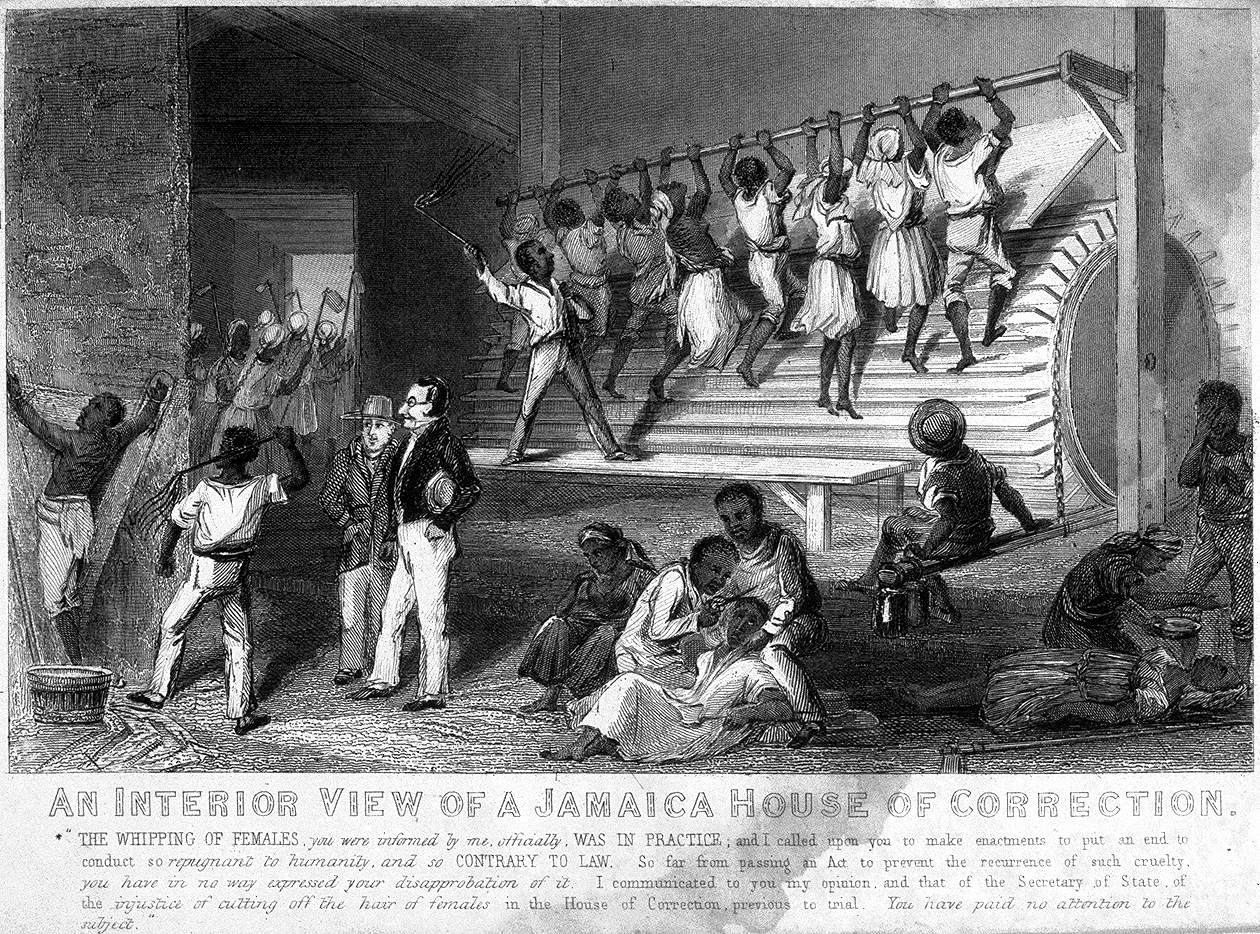
The house-of-correction engraving makes institutional power physical. Bodies are held above a moving treadmill; other figures administer punishments or endure them. Its printed complaint makes the treatment of women part of the challenge to the system. This is a later image from the apprenticeship period, extending the account beyond the court book’s closing date in 1814.
Read alongside the family series, the dates matter. The 1811 case belongs to slavery. The 1837 Bogg return belongs to apprenticeship. Matilda’s 1845 birth belongs to full emancipation. Joseph’s life crossed those changes. The institutions surrounding work and movement belong in the story because a change in the category on a return did not instantly settle the conditions of daily life.
From a resort parish to a parish of ordinary lives
The fishing-boat photograph identifies St. Ann’s Bay in 2023. It is regional context rather than a view of Mount Pleasant or the court. It reminds a visitor that the parish contains working communities, institutions and histories extending beyond attractions. The court book belongs beside the story of free villages and the family records: one exposes coercive legal authority, another describes efforts to secure land after emancipation, and a third recovers people obscured by property administration.
The result is a different account of heritage. Great houses document an owner’s position; legal and household records reveal the lives required to sustain that position. St. Ann’s history is richer when a crop, an accusation and an attributed voice are allowed to stand beside the monumental building.
Follow the person beyond the court’s category
The next step is to connect this court history with names, households and later records. A court classified someone as an accused person or witness; a family record might identify a parent, partner or child. Those relationships help recover a life larger than the institution’s reason for recording it. Continue with names and family evidence → [1]
Sources and notes
- National Library of Jamaica. Record Book of the Court of St. Ann, 1787–1814, MS 273. Catalogue description, not a transcription of a named trial. ↩
- Jamaica Almanac (1817). Returns given to vestries for March 1816: St. Mary and St. Ann. Transcription at Jamaican Family Search. ↩
- Michael John Becker, The Rule of the Lash and the Rule of Law (Duke, 2021), pp. 58–59, note 30. Scholarly account of MS 273, folio 373; original folio not reproduced here.
- An Interior View of a Jamaica House of Correction, abolitionist engraving associated with 1837; version reproduced in James Mursell Phillippo, Jamaica: Its Past and Present State (1843), facing p. 172. Public-domain scan, Wikimedia Commons. Slavery Images SI-OB-436 documents its 1837 circulation and subsequent versions.