After emancipation: how land made freedom more usable
The end of slavery did not transfer estates to the people who had worked them. In St. Ann, free villages connected legal freedom to plots, households, schools and a new bargaining position.
1834 was not the end of compulsory labor
Britain’s emancipation process separated a change in legal status from an immediate end to plantation control. Slavery formally ended in 1834, but apprenticeship kept formerly enslaved people subject to compulsory labor arrangements. Full emancipation followed in 1838. Those dates are not interchangeable. They mark the difference between being told that slavery had ended and being able to withdraw labor without remaining inside the apprenticeship system. [1]
Even after 1838, estates retained resources that families needed: land, housing and employment. Freedom did not itself provide a home independent of an employer or enough ground to cultivate food. That was the material problem the free-village movement addressed. Its settlements were not simply commemorative places named after abolitionists. They were attempts to reorganize everyday dependence.
A movement already taking shape
Sligoville, in St. Catherine, began in 1835 under Baptist minister James Phillippo, before apprenticeship ended. The Heritage Trust identifies it as Jamaica’s first free village. Its early establishment shows that independent settlement was not merely a reaction after the final legal date; people were working toward another way of life while the transition remained contested. [2]
Sturge Town followed in St. Ann in 1839. Reverend John Clark helped establish the settlement, which took the name of Joseph Sturge, the Quaker campaigner against apprenticeship. A narrative centered only on Clark or Sturge would miss the people who bought land and built households. The founders helped organize the opportunity. The residents had to make it work. [3]
The purchasers belonged in the foreground
The Heritage Trust describes approximately 120 acres near Brown’s Town, with land purchase, conveyancing and surveying costing about £700. Eighty or ninety people paid more than £400 initially; installments and additional purchasers covered the remainder. These are historical amounts, not present-day equivalents. They matter because they show collective financing and a continuing obligation, rather than a village simply bestowed on grateful recipients. [3]
Land could change a household’s relationship to an estate. A family with a separate home and food-producing ground had a different basis for negotiating work than one whose employer also controlled its residence. That did not eliminate debt, poor markets or unequal power. It did make the possibility of refusing a particular labor arrangement less wholly dependent on the proprietor’s permission. Independence was being built through property and community as well as declared through law.
A village was a set of institutions
By 1840, Sturge Town had a chapel, a church-run school and a resident minister, Samuel Hodges. The Trust also describes house plots associated with provision cultivation and pimento trees, with sugar cane on some holdings. These connected uses are more revealing than a photograph of the chapel alone: a home supplied shelter, a plot supported food or income, a school prepared children for a different future, and a congregation helped organize social life. [3]
A church-founded village could open opportunities while also carrying a missionary vision of respectability, marriage and household order. That is why neither “missionaries liberated the people” nor “churches only controlled them” is an adequate explanation. Residents invested their money and labor and pursued their own family interests within institutions that had religious leadership. Their agency and those institutions’ authority coexisted.
The freedom bargain moved from law to livelihood
The village did not stand outside the parish economy. Produce had to reach markets; money had to cover purchases and obligations; families still faced changing demand and environmental conditions. The settlement’s significance is not that it ended every difficulty. It offered a way to reduce the concentration of housing, work and land in the same hands. A small plot could support a much larger claim: a household’s life should not be entirely organized by an estate.
Read this history alongside Barclay’s later organizing in St. Mary. The free villages concern access to land and independent residence. The producers’ movement concerns control over credit, marketing and the value of a crop. They belong to a longer sequence in which Jamaicans sought to make legal freedom effective in daily economic life. The same question persists across the two periods: what resources allow a person to bargain, rather than merely accept the available terms?
What the place means now
Sturge Town is a living community, not a complete nineteenth-century scene preserved for visitors. Its heritage includes descendants, changing households and institutions that continued beyond their founding moment. The St. Ann’s Bay image here provides parish context; it is not a photograph of the village. A visit is most useful when the story of purchasers, plots and education remains visible alongside the named abolitionist and missionary.
The achievement was considerable precisely because it required more than a declaration. Families assembled money, accepted obligations and built spaces in which they could live with greater independence. The legal end of slavery is essential to the account. The labor of making freedom usable is the next chapter.
Manchester: Maidstone turns a plantation purchase into households
Source & credit
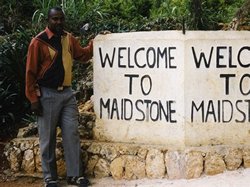
JNHT describes Maidstone’s foundation in 1840 under Moravian direction, through purchase of a former coffee estate near Nazareth in Manchester. Its 341 acres were divided into 98 lots ranging from one to fifteen acres. Some purchasers completed their payments by 1850. The account makes buying and paying part of the freedom story rather than treating a village as a gift without household effort.
Rocky, uneven ground prevented a regular grid, but residents built a village and a schoolhouse that also served as a chapel. The layout was shaped by terrain and use. Compare it with the estate village at Seville: both accounts concern homes and space, while the land transaction and the conditions of freedom differ.
Maidstone is therefore a useful Manchester connection for this St. Ann-focused article. Follow land, payment, building and education in sequence. The founding record establishes the settlement history; it does not establish which surviving dwelling dates from the original lots.
Ownership could make refusal less costly
The freedom to choose an employer means more when losing a job does not also mean losing a home. Free-village land purchases addressed that practical imbalance. A plot could support residence and cultivation while a church or school helped sustain collective life beyond the estate’s immediate control.
This was an achievement built through money, organisation and continued work. It did not make every purchaser prosperous or remove the need for wages. Its significance lay in altering the options available to a household. A village was therefore part of Jamaica’s economic and political history as well as its settlement history: people were building a place from which to negotiate the terms of life after slavery. [1] [2] [4]
Sources and notes
- National Library of Jamaica. Emancipation exhibition: slavery, apprenticeship and free villages. ↩
- Jamaica National Heritage Trust. Sligoville: the first free village. ↩
- Jamaica National Heritage Trust. Sturge Town: purchase, settlement, school and chapel. ↩
- JNHT, Maidstone: estate purchase, lot sizes, payments, terrain and the school-chapel. Checked 12 October 2026. ↩