A. A. Barclay: the land, the bank and the banana ships
A minister in St. Mary saw that growing a crop was only the beginning. His campaign joined land settlement, cooperative credit and producers’ bargaining power—and outlived him.
The man behind the name
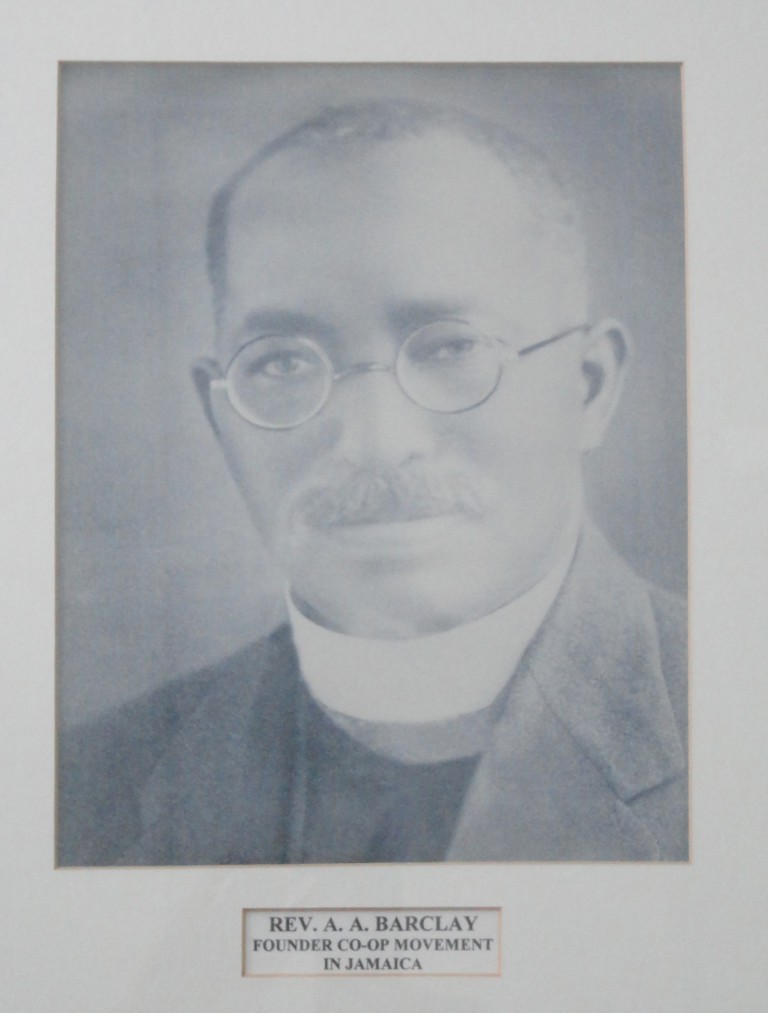
Look at the collar and round spectacles in this portrait. The label beneath the face calls Reverend A. A. Barclay the founder of Jamaica’s cooperative movement. That was a considerable claim for a Presbyterian minister working from Goshen and Lucky Hill in St. Mary. His congregation lived in a parish where a successful crop did not automatically produce a secure household. A grower needed land to cultivate, money to keep going between harvests, and a buyer with access to the ships. Barclay worked on all three. [1]
Source & credit
Before the banana contract came the land
A hurricane could destroy bananas long before a debt disappeared. Historian Edmund Davis connects the destruction of 1912 to the development of government-funded cooperative loan banks. Satchell dates the Western St. Mary Co-operative Loan Bank at Gayle to 1914 and identifies Barclay as its organizing secretary. Credit could keep a household cultivating; collective land purchase could change the household’s position more fundamentally. [2]
The bank bought Bagnolds in 1919 for settlement. Davis reports six properties, 4,417 acres and 450 purchasers, with lots ranging from five to fifty acres. He then describes the bank’s 1922 report of increased cultivation and new houses. Those figures give the movement a physical scale. Its work reached beyond a meeting room into plots, paths, planted land and places to live. These figures reach us through Davis’s account, not a modern survey of every purchaser’s later fortunes. [3]
For a person who had depended on rented or insecure ground, a settlement scheme offered a different starting point. Yet ownership alone could not guarantee a dependable market. A farmer might gain land and still sell into a system whose strongest commercial decisions were made elsewhere. This is the connection between Barclay’s loan-bank work and his later producers’ organization.
Who held the power? Follow the fruit.
The banana was perishable. It had to move from a hillside to a buying point, then to a ship and an overseas market before its value vanished. A grower’s crop and a shipping company’s timetable were therefore bound together. Large companies could exercise influence through purchasing arrangements, estates and access to transport; a small producer could not casually build an alternative overseas distribution system.
United Fruit Company is the foreign competitor explicitly identified in Satchell’s account of the producers’ struggle. The Jamaican challenge was to organize enough growers to bargain and market together. Atlantic Fruit also appears in the parish history as a substantial St. Mary landowner, but the sources used here do not establish a separate personal confrontation between Barclay and that company. The distinction matters: ownership in the parish, commercial competition and a documented dispute are different relationships. [4]
Source & credit
From one farmer’s bargain to a producers’ organization
Jamaica Producers Group’s institutional history dates Barclay’s proposal for a growers’ cooperative to 1924. The Jamaica Producers Association formed in 1925 with F. H. Robertson, public figures and farmers. It sought to organize export contracts rather than leave each producer isolated at the buying point. In the same year Barclay became St. Mary’s elected Legislative Council representative, connecting an economic campaign to political representation. [5]
This was an attempt to move bargaining power along the whole chain. Land settlement addressed the ground beneath the crop. Cooperative credit addressed the gap between expenditure and sale. Producers’ organization addressed the sale itself. Legislative representation supplied another arena in which that structure could be challenged.
Barclay died in November 1926. He did not personally launch the refrigerated ships or negotiate all the later company agreements. His death is the hinge of this story: the man disappears, but the economic machinery he helped set in motion keeps developing. [6]
The companies—and the struggle—after Barclay
The Jamaica Banana Producers Association formed under the JPA on 1 April 1929. Robertson investigated the British market in 1931; a Jamaican-owned steamship subsidiary and refrigerated fleet followed. Shipping supplied another part of the chain that growers alone could not control. [7]
Jamaica Producers records a United Fruit–JBPA agreement in 1936, after a public campaign and inquiry. The organization became a joint-stock company. Collective bargaining therefore developed through negotiation and changing legal structures; it did not remove every uncertainty facing an individual farmer.
Elders & Fyffes appears in the corporate chronology’s 1947 price and shipping negotiations with JBPA and the All Island Banana Growers Association. This was twenty-one years after Barclay’s death: part of the institutional legacy, not his personal negotiations. [8]
Barclay Town: put the community back on the map
Barclay Town is a real St. Mary community near Lucky Hill. The Electoral Commission’s 2025 polling-station list locates Barclay Town Basic School at Barclay Town, Lucky Hill P.O. It belongs beside Goshen, Gayle and the land-settlement story when following this inland geography. [9]
The reported connection between the town’s name and Reverend Barclay needs a naming record, parish resolution, deed or securely attributed community history. The sources checked for this edition establish the community and his work in the area, but do not settle the naming origin. A shared surname alone does not establish the naming origin. The deeper question is worth pursuing: how did the collective purchase of estates become the communities, smallholdings and family homes people know today?
What the archive photograph lets us see
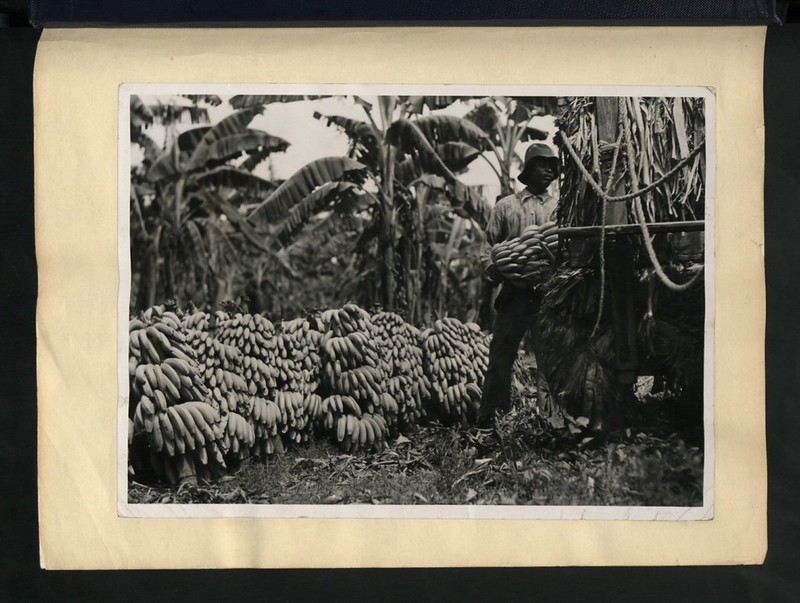
Return to the 1940 photograph above. One man, whose name the archive does not give, stands by a suspended bunch. Other harvested bunches lie in rows beneath the plants. The image records handling and volume: the work between growing fruit and getting it away. It does not reveal the man’s pay, employer, ownership or parish. Read beside the bank report and shipping chronology, it helps restore the material life behind the word “export.” [10]
Barclay’s achievement was to recognize that the household, the field, the bank, the buying contract and the ship were parts of one problem. His story becomes more revealing when those connections remain visible—and when the people working the fruit are kept in the picture.
The household was the reason the chain mattered
Land settlement, credit and shipping meet at the household trying to live from its crop. Keep that household in view when the company names take over the chronology. Barclay’s campaign is easier to understand when a buyer’s terms and a ship’s departure are connected to the ground and home at the beginning of the chain. [2] [5] [7]
Sources and notes
- Jamaica Producers Group, Our History. Identified portrait and institutional chronology; corporate account. ↩
- Veront M. Satchell, St. Mary History, PDF pp. 140, 143, 145: Gayle bank, Bagnolds, Barclay and politics. ↩
- Edmund Davis (1998), The History of Theological Education in Jamaica: The United Theological College of the West Indies and Its Four Antecedent Colleges (1841–1966), doctoral dissertation, Utrecht University, chapter 4, printed pp. 76–77. On p. 77, note 9 cites Annual Report, Western St. Mary Loan Bank (1922), p. 7, and Synod Journal (1923), p. 12. Figures apply to six properties, as reported by Davis; the original bank report and Synod Journal have not been independently examined for this edition. ↩
- Satchell, commerce and local politics: United Fruit as competitor; Atlantic Fruit as parish landowner. No separate personal dispute is inferred. ↩
- Jamaica Producers, 1924 proposal and 1925 JPA. Satchell, PDF p. 145, supports Barclay’s 1925 election. ↩
- Satchell, PDF pp. 143, 145: death in November 1926. Later corporate actions must be distinguished from Barclay’s own life. ↩
- Jamaica Producers: formal JBPA foundation in 1929, British-market investigation in 1931 and subsequent shipping. A contradictory 1927 Pringle claim in the parish history is not followed. ↩
- Jamaica Producers: 1936 United Fruit–JBPA agreement and 1947 Elders & Fyffes negotiations. Institutional legacy, after Barclay’s death. ↩
- Electoral Commission of Jamaica, 2025 polling stations: Barclay Town Basic School, Barclay Town, Lucky Hill P.O. Establishes locality, not naming origin. ↩
- The National Archives UK, CO 1069/372(1), Jamaican banana agriculture, 1940. Locality and worker identity unspecified; no known copyright restrictions. ↩