The people who grew and moved Jamaica’s bananas
Five historical photographs, a Jamaican poem and growers’ testimony reveal the skill, physical work and bargaining behind an export crop.
The first photograph brings us to a doorway rather than a ship. Several people sit beside thatched buildings, with washing on a line, a child and dogs. The commercial title supplied by A. Duperly & Sons is After a Day’s Work on a Banana Plantation. That title frames the scene through labour, but the surviving record does not give the people’s names, their relationships, their employment terms or a precise Jamaican locality. Their anonymity is a limit of the record, not a reason to leave the history with the exporting companies. [1]

Source & credit
Look first at the people. The original commercial caption identifies an activity but gives no individual names or working terms.
Adolphe Duperly & Sons · Public domain · Image record ↗The plantation was not the whole banana economy
Historian John Soluri’s research puts smallholders back into Jamaica’s early export story. Growing bananas for overseas sale was not confined to large estates. Cultivators could have ambitions and enterprises of their own, while depending on traders and shipping systems they did not control. That finding broadens the setting of the photograph without identifying these particular people as independent growers or wage workers. [2]
The group’s position outside buildings also brings home and work into the same view. Clothing, shelter and time outside the field belong to people’s lives, even when a commercial caption reduces the scene to an agricultural subject. We can describe what the image preserves while leaving its missing personal history open. A more complete account would need records made for different purposes: names, household connections, contracts, wages or people’s own recollections.
Handling was visible work, not an invisible link
Source & credit
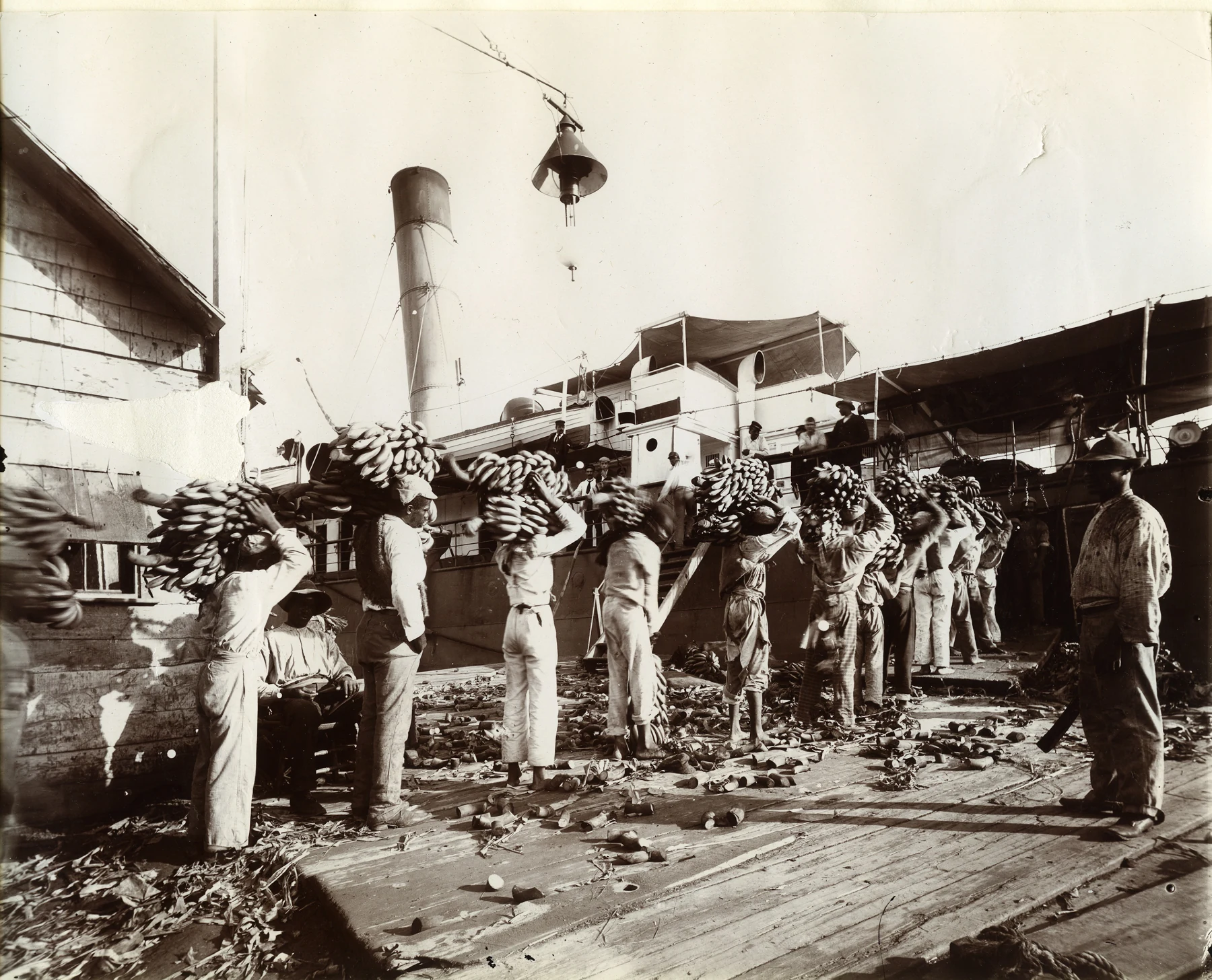
At Port Antonio, the camera shows a different part of the work. Whole bunches sit above people’s heads as they move along the wharf beside a vessel. More fruit lies within reach of the loading route. A banana export was not simply a crop transferred from a ledger to a ship. Human bodies carried it through a succession of spaces, with the bunches still exposed to handling and damage. [3]
The image also preserves a sequence of tasks: carrying, receiving and moving fruit towards the ship. It cannot tell us the wage attached to each task or whether the person taking a brief rest had completed a shift. Those unknowns should not prevent us from seeing the amount of handling involved. They prevent us from turning visible positions into invented job descriptions or life stories.
A journey to sell could end without a buyer
Soluri describes growers receiving only two or three days’ notice to harvest and bring fruit to traders. Buyers could discount or reject bunches according to size, maturity or damage; rejection could also reflect an oversupplied market. In 1897 Thomas Smickle described St. Thomas growers unable to find buyers. In 1905 the Rev. E. Arnett reported fruit abandoned in St. Ann after long journeys because exhausted mules could not haul it home. Soluri’s research provides these accounts from the commission records. [2]
Once someone had cut and carried a crop, much of the cost had already been paid in effort, time and transport. A buyer’s refusal could leave that investment without a return. The distinction between producing fruit and having power over its sale is therefore central to the story. The wharf was a place of movement, and also a place where the terms of an income were decided.
Source & credit
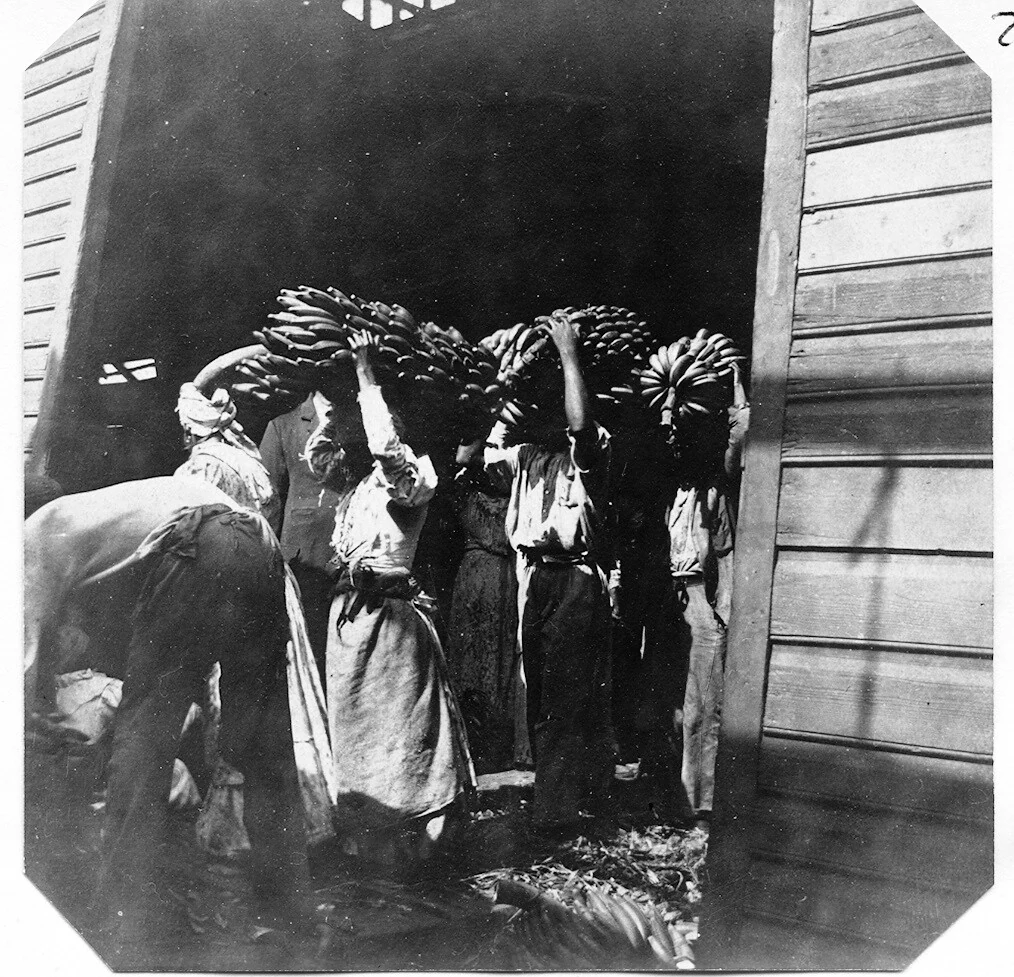
Hannah Philbrook Adams photographed this Kingston handling scene during a 1905 cruise. The bunches, the doorway and the people moving through it make the physical transfer visible from another angle. Her journey produced a visitor’s image of work. It did not produce an interview with those pictured. Keeping that difference clear lets the photograph contribute evidence without making the visitor’s perspective stand for the workers’ own account. [4]
McKay wrote about the skill inside the crop
Claude McKay’s King Banana, published in Songs of Jamaica in 1912, supplies a Jamaican literary voice. Its speaker moves through clearing and preparing ground, cutting fruit, wrapping it in dried leaves and packing a dray so the bunches do not crush one another. The poem’s agricultural confidence is specific: it presents people who know how to cultivate, handle and judge their crop. [5]
That knowledge is part of the poem’s argument. The crop supports food, income and pride in work. Money can come home after sale, or be spent on rum. McKay gives the speaker choices and an opinion about what skilled cultivation deserves. This is a constructed poetic voice, not a transcript of the Duperly group’s speech or proof of what happened on the day they were photographed. [5]
Read the poem alongside the loading pictures. A camera makes carrying visible; the poem explains and argues through words. The two forms give agricultural people more presence than a story organised entirely around the names of shipping companies. Neither tells us everything, but together they make practical expertise harder to overlook.
Producers tried to reach further down the chain
Jamaica Producers’ institutional history dates the Rev. A. A. Barclay’s cooperative idea at Lucky Hill to 1924 and the Jamaica Producers Association’s formation to 1925. The Jamaica Banana Producers Association followed in 1929. The problem, in the company’s account, was how small farmers could negotiate export arrangements with influence comparable to larger planters. [6]
Its 1931 section describes F. H. Robertson investigating the British market and the subsequent creation of a shipping subsidiary with refrigerated vessels. The ambition went beyond growing more fruit: producers wanted a role in transporting and marketing it. The later 1936 account describes a public meeting at Kingston’s Ward Theatre, a petition and a commission leading to an agreement with United Fruit. [6]
Source & credit
This chronology records an organisation’s explanation of its development. It is not evidence that every farmer received the same benefit, or that small producers controlled every decision once an association existed. The useful change in perspective is the goal itself: cultivators sought leverage in parts of the business that determined what their work would earn. [6]
The port connected the work to another world
Source & credit
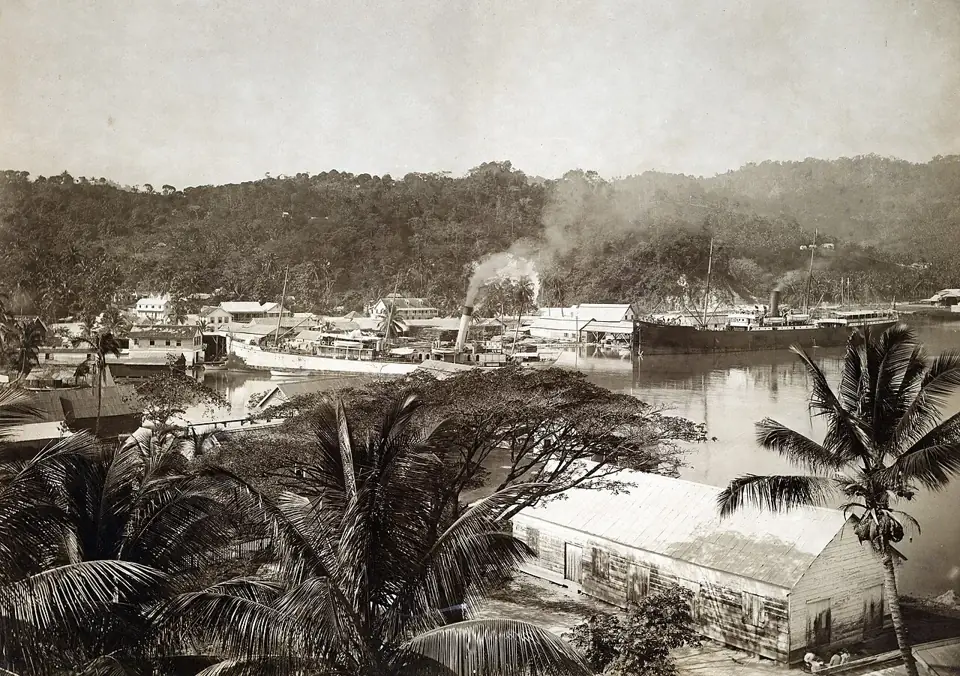
Look closely: Compare the docks with the banana-work photograph. This view supplies a port setting; it does not establish the date or workers in the other image.
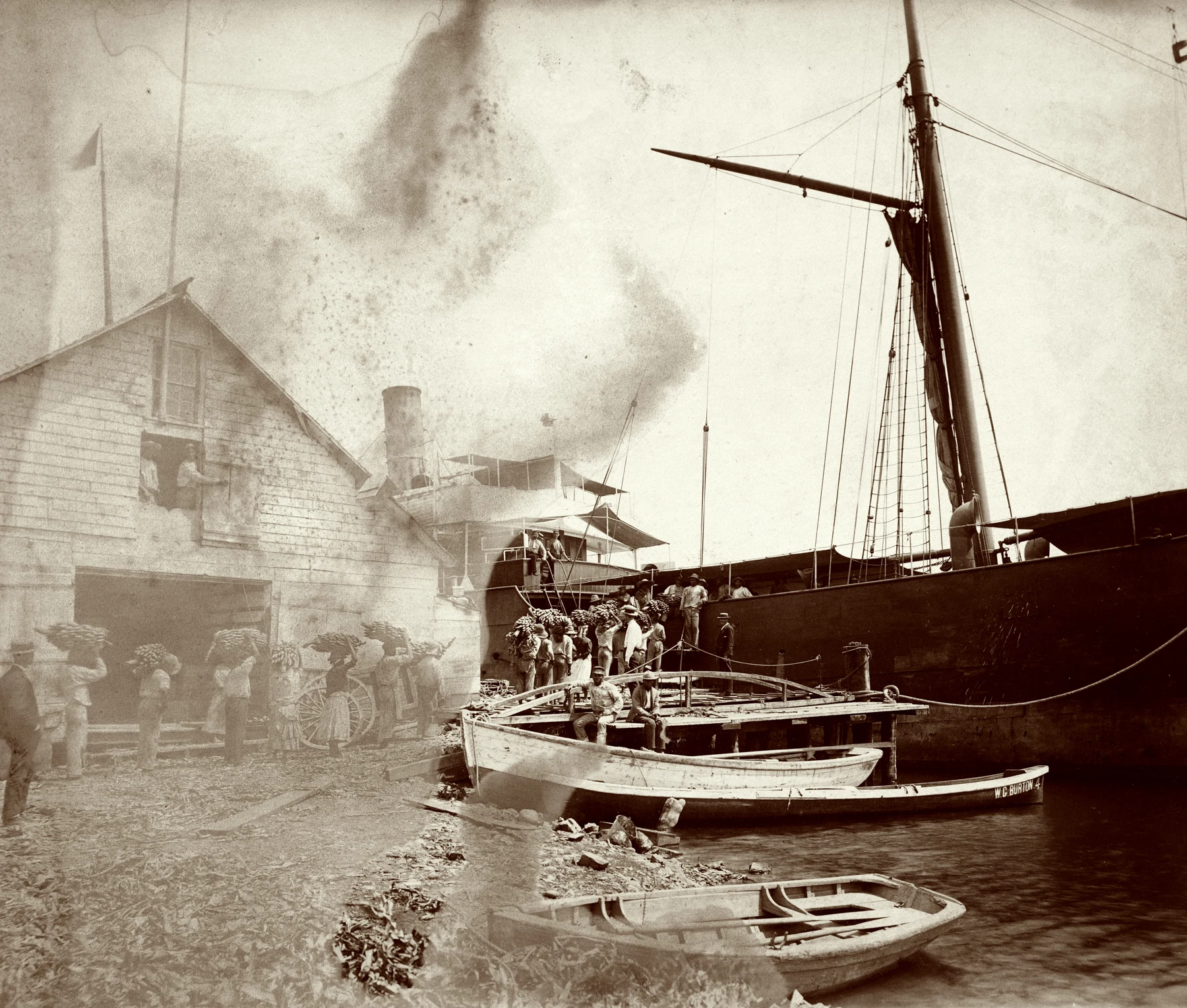
Johnston’s dock views place this work inside Port Antonio’s waterfront. In the loading picture the catalogue even supplies an overseas destination, Boston. That destination does not identify the farms that supplied the particular cargo. It does show why a local harvest depended on arrangements extending well beyond Jamaica: a ship, a schedule and a buyer elsewhere were part of the crop’s commercial life. [7]
Risk did not end with the early photographs
A later FAO study of the world banana economy describes Jamaican farmers facing poor weather and falling real farm-gate prices during 1995–2000. It notes the difficulty of recovering from uninsured storm losses and paying for replanting. This is a dated comparison, not a report on current conditions. It shows that producing a perishable crop could remain vulnerable to forces outside a household’s control long after the pictured export era. [8]
The people by the doorway remain unnamed. The growers in historical testimony, McKay’s poetic speaker, the handlers on the wharves and later producer organisers do not fill those names in. They give the picture a better setting: a history of knowledge, effort, bargaining and risk in which Jamaican people were participants, not background scenery.
Sources and notes
- A. Duperly & Sons, After a Day’s Work on a Banana Plantation: public-domain commercial image record, before 1922; precise locality and individual identities not supplied.
- John Soluri (2006), Bananas Before Plantations: Smallholders, Shippers, and Colonial Policy in Jamaica, 1870–1910, Iberoamericana VI(23), 143–159, especially pp. 146–150. Original scholarly research; Smickle and Arnett accounts consulted through this article.
- A. Duperly & Sons, Loading Bananas, Port Antonio: public-domain photograph, before 1922; carrying and shipboard setting.
- Hannah Philbrook Adams, Loading Bananas, Kingston: February 1905; public-domain photograph, taken on the photographer’s cruise.
- Claude McKay, King Banana, Songs of Jamaica (1912), primary poem in Toronto Metropolitan University Libraries’ public-domain edition. The poem describes cultivation, leaf wrapping, dray packing and sale; it does not narrate a rail or port journey.
- Jamaica Producers Group, Our History: company account of 1924–25 organising, 1929 association, 1931 market investigation and subsequent shipping, and 1936 negotiations. Institutional account, not an independent evaluation of outcomes.
- Dr. James Johnston, Loading S.S. Banan with bananas for Boston, Port Antonio: catalogue identification, before December 1921. Dock comparison image has its separate source credit.
- FAO, The World Banana Economy, 1985–2002, chapter 2 Jamaica discussion: dated 1995–2000 weather, farm-gate prices, storm losses and replanting costs; no current production or insurance claim.
Historical sources, image identities and reproduction records reviewed 26 October 2026. Capture, publication and digitisation dates are distinguished where known.