ARTHUR’S SEAT & THE KIDSTONS · 3 OF 4 · ST. ANN & ST. MARY
Joseph Kidston of Bogg Pen: a family through slavery and freedom
In 1845 Joseph Kidston registered his daughter Matilda’s birth and gave Bogg Pen as his address. That small entry joins a history of enslavement to a family’s life in freedom, and leads through the Fyffes to Anthony DePass.
Joseph Kidston registered Matilda’s birth on 24 May 1845, giving his occupation as labourer and his address as Bogg Pen. The entry names Catherine Kidston as Matilda’s mother and records the birth on 5 April.
[1]
Source & credit
Joseph is my ancestor. My register research follows him earlier as Joe, born about 1825, the son of Abba / Jane and grandson of Marianne. The father registering a daughter in freedom had himself been born into slavery.
[2]Catherine belongs at the beginning
The entry gives Catherine a place beside Joseph at the beginning of Matilda’s life. He was the informant; both parents are named. Its occupation and address fields describe Joseph, while Catherine’s own working life remains outside this brief entry.
Matilda was born less than seven years after full emancipation. Her generation began life in freedom; Joseph’s childhood had crossed slavery and apprenticeship.
Marianne and Abba / Jane
The earliest original page reproduced here is a St. Mary return dated 28 June 1817, under Mary Roche. It names Marianne, aged forty, as African, and Abba alias Jane, aged twelve, as Creole. The remark “Marianne her mother” joins the two women directly. “Abba alias Jane” is one person recorded under two names.
[3]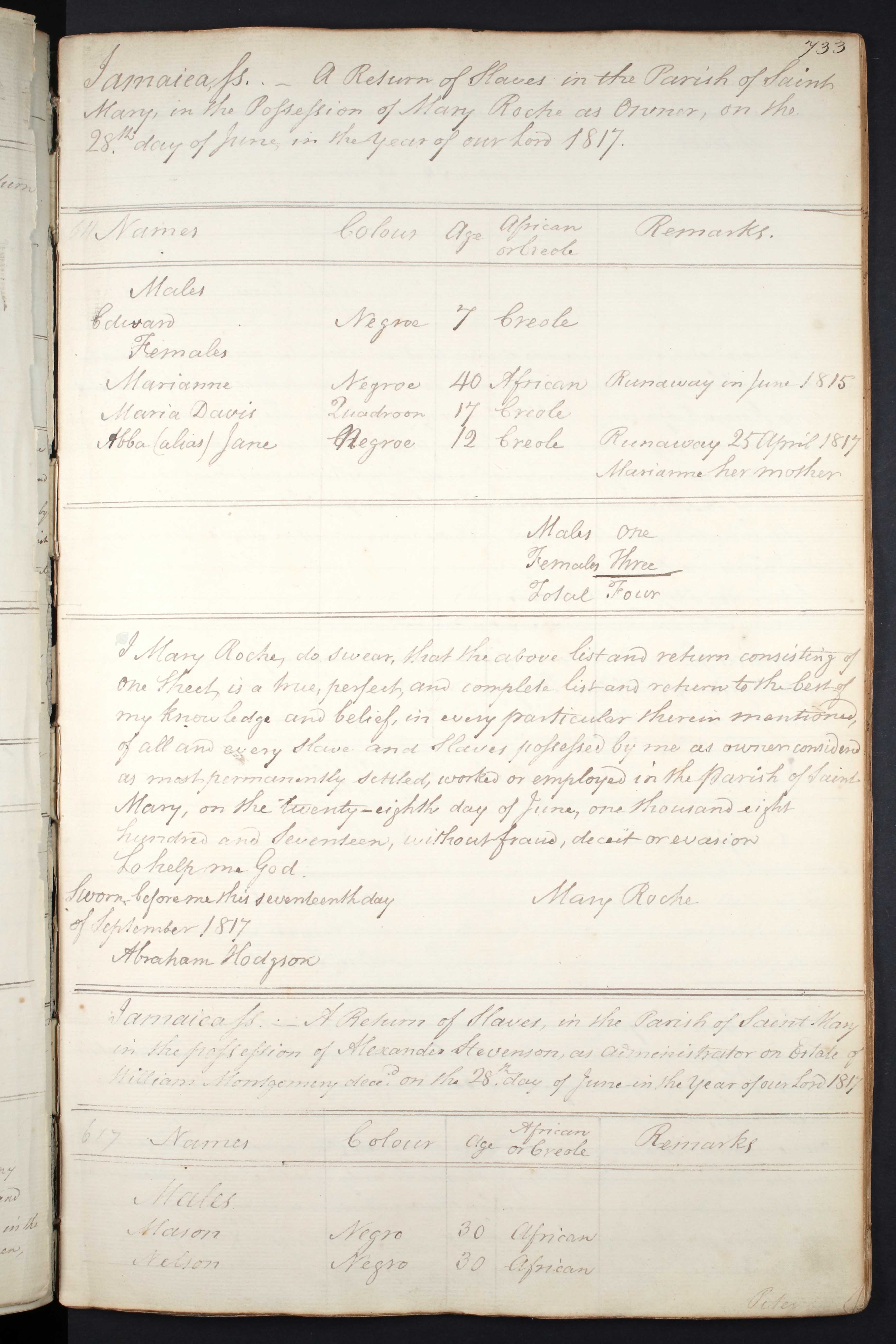
Source & credit
The same return records Marianne’s escape in June 1815 and Jane’s on 25 April 1817. These remarks preserve their acts of resistance within the owner’s accounting.
Jane’s entry in the 1823 return records a sale in 1822. The purchaser is not named on that page; the later Kidston stages follow the continuing register research.
[4]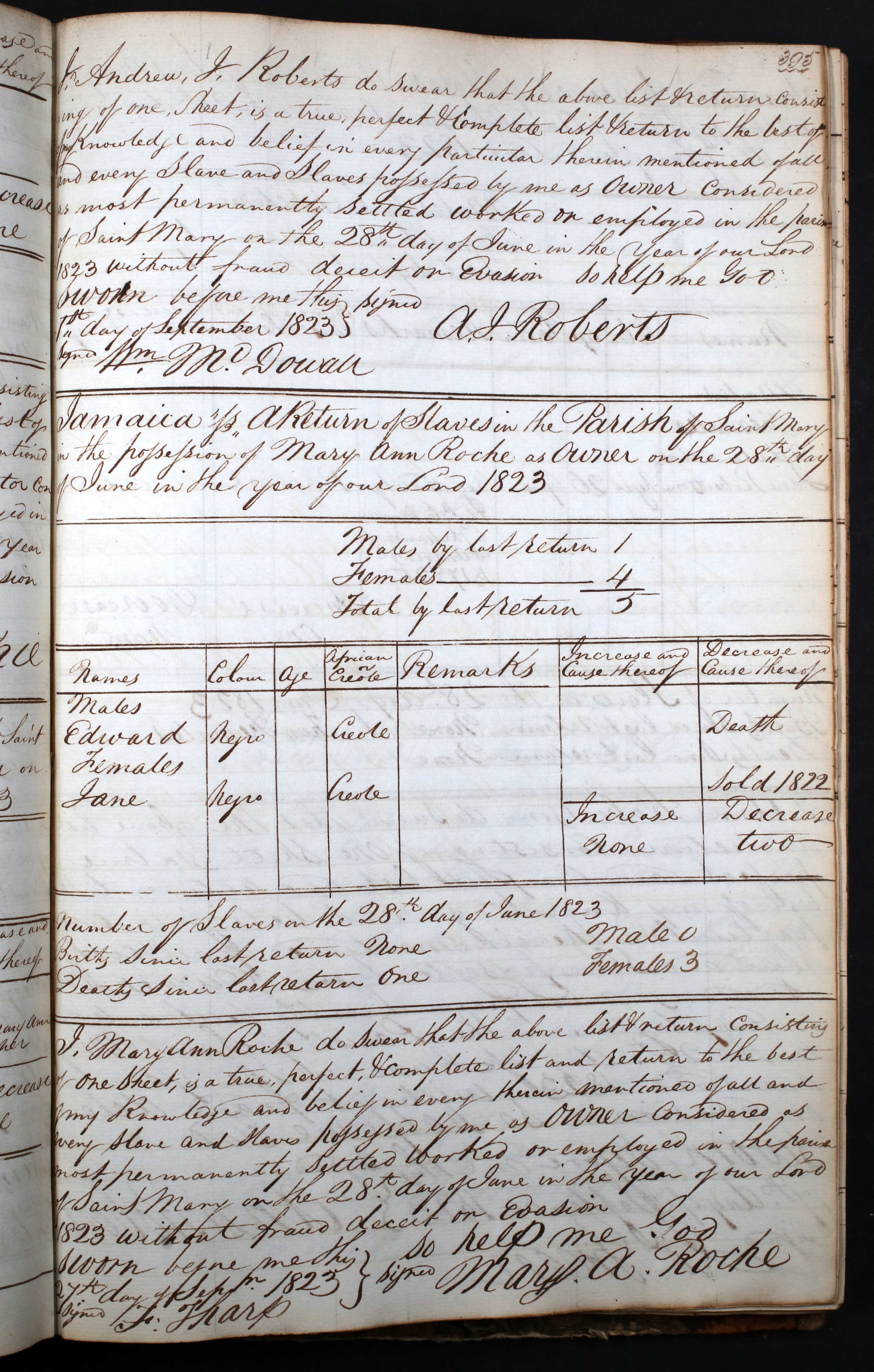
Source & credit
James Kidston’s return and Marianne’s continued absence
By 28 June 1826, James Kidston registered as owner in right of his wife, Mary Ann Roche. Marianne remained listed despite the return’s description of her long absence.
[5]The 1829 return still describes Marianne as “Runaway many years.” The repeated entry preserves an ownership claim alongside her continuing recorded absence.
[6]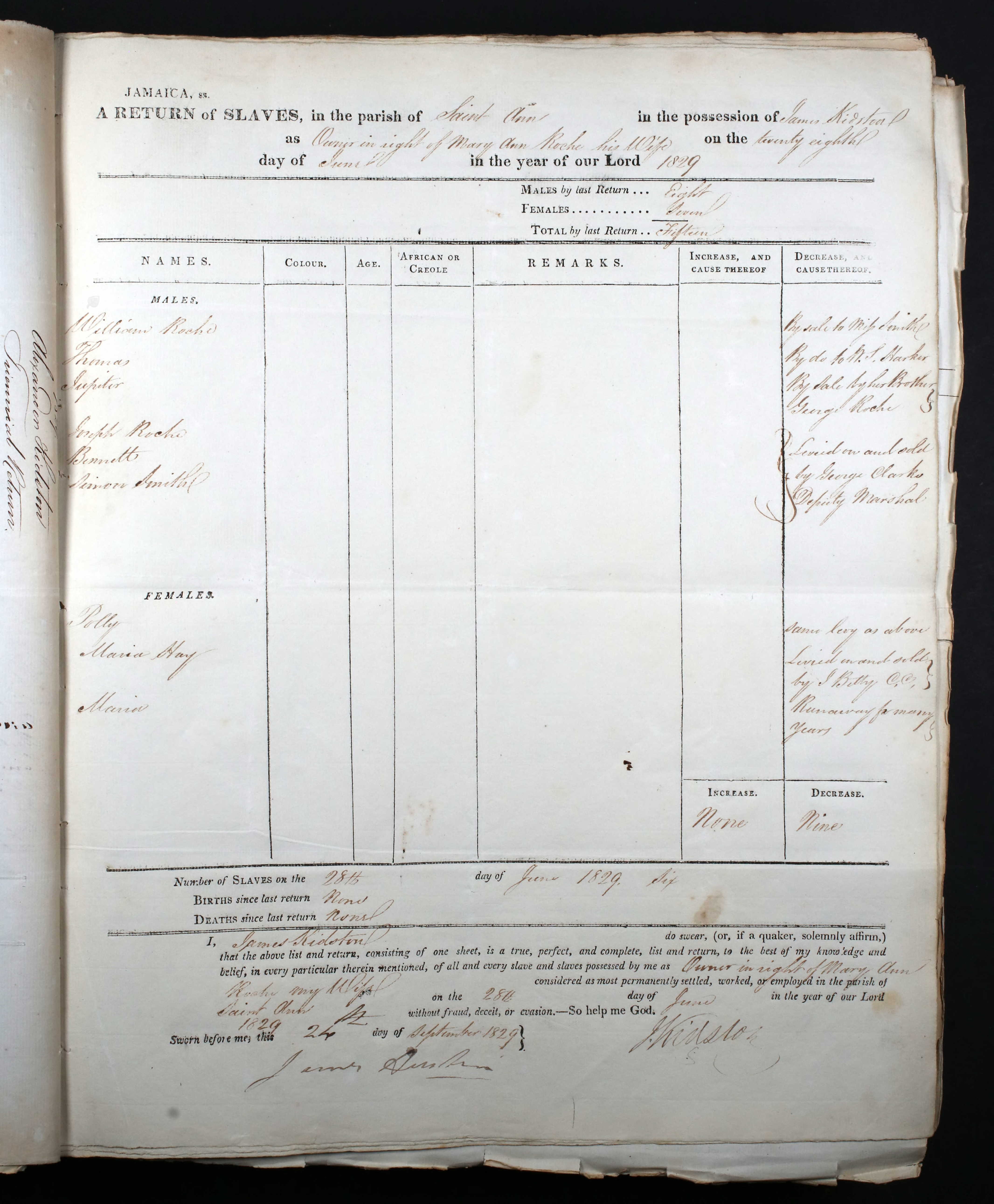
Source & credit
Joe becomes Joseph in the later family record
Joe’s approximate 1825 birth places him at about nine when abolition with apprenticeship began in 1834, and thirteen when full emancipation followed in 1838.
[2][7]Bogg’s return for 28 March 1837 lists 117 apprentices under Alexander Kidston. It supplies the property’s labour context during Joseph’s childhood; his individual chronology comes from the family register research.
[8]A young St. Ann apprentice describes the working day
At Penshurst, another St. Ann property, James Williams’s 1837 account describes milking cows, checking sheep and other stock, repairing walls, cutting fodder and keeping watch.
Williams also describes punishment at the St. Ann’s Bay workhouse and its treadmill. His separately documented experience gives regional context for the compulsory labour system through which Joseph’s childhood passed.
[W]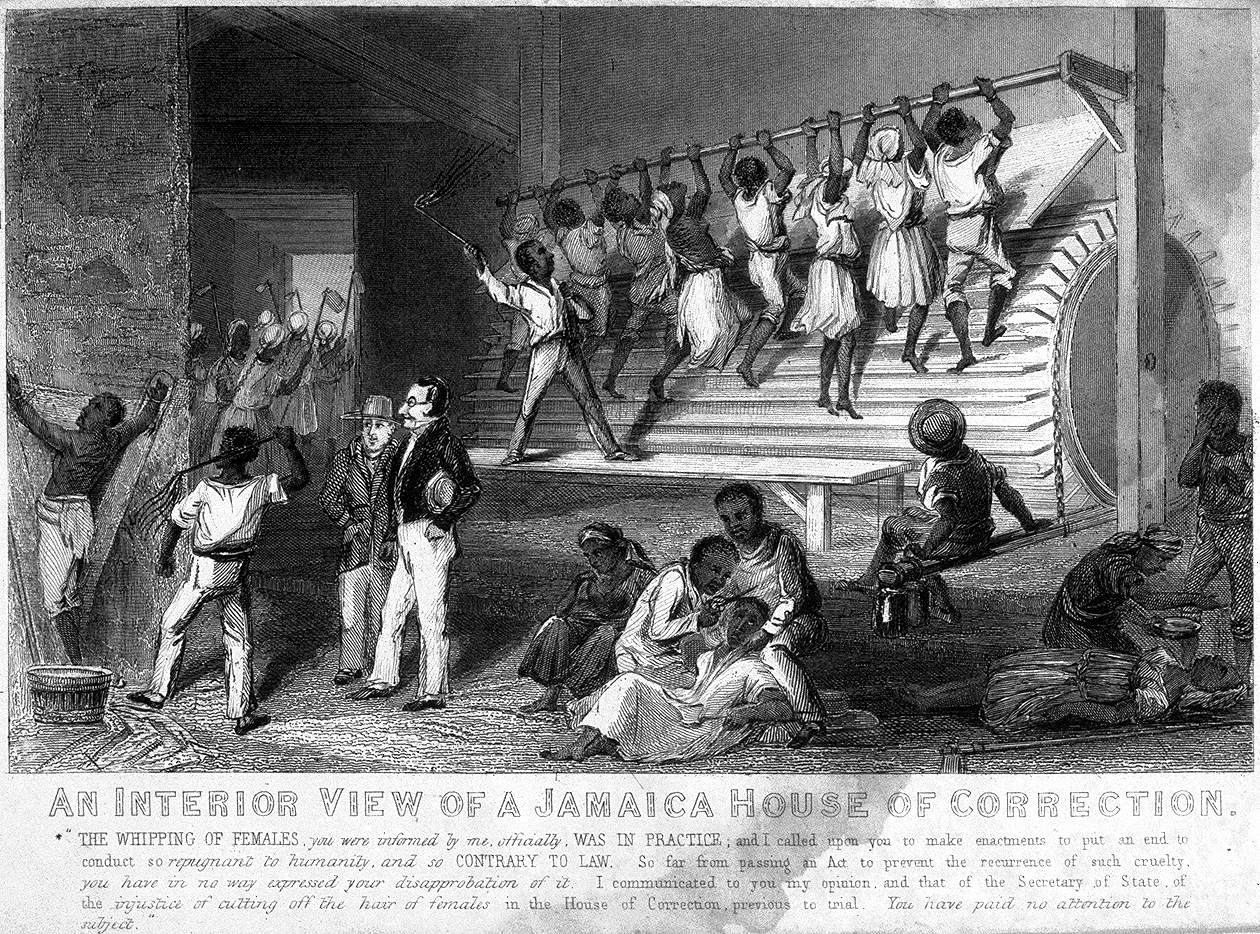
Source & credit
What Bogg Pen means in this family
In my family research, Bogg Pen formed part of the merged Arthur’s Seat property. The older name remained Joseph’s address in 1845; the 1878 directory later names Arthur’s Seat and Bogg Pens under one proprietor.
[2][9]Emancipation changed Joseph’s legal status, but he continued to live and work within the estate landscape. The birth entry records him as a labourer and parent at Bogg Pen.
Matilda and Robert Fyffe in Clark’s Town
On 10 April 1872, Matilda Kidston married Robert Fyffe at St. John’s Church, Ocho Rios. The entry records Robert as a shoemaker and both parties as residents of Clark’s Town. My family recollections also associate Matilda with Sand Hill, St. Mary.
[10]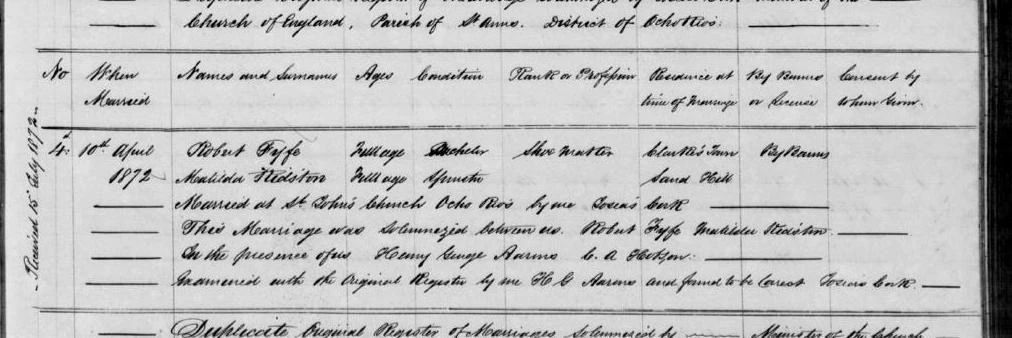
Source & credit
Their son Daniel was born at Clark’s Town on 27 February 1873 and baptised on 5 November. His entry names Robert Fyffe and Matilda Kidston as parents and repeats Robert’s trade. Boscoe and Buscoe are spellings followed in the family research.
[11]
Source & credit
Work, skill and earnings after slavery
Source & credit
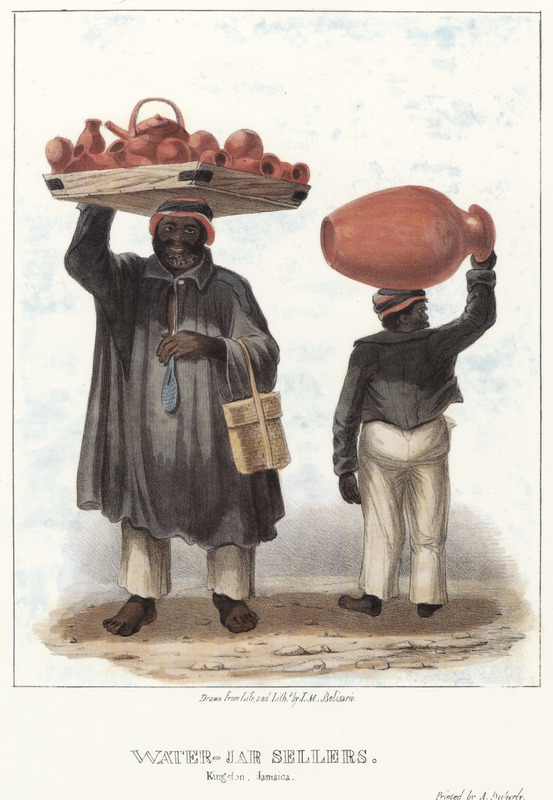
Belisario’s Water-Jar Sellers, published in 1838, shows one man balancing small vessels on a tray and another carrying a large jar. His description identifies them as apprentices. Their work belongs to the final year of the system through which Joseph had lived.
The family’s later records preserve different occupations: Joseph the labourer and Robert the shoemaker. Alongside births and marriages, those entries show the work through which households made a living.
Farm Pen, Gayle and the generations after Daniel
Matilda died at Farm Pen, Gayle district, St. Mary, on 6 May 1947. Her daughter Louise was the informant. The death registration gives her age as 103; the 1845 birth entry gives a calculated age of 102.
[12]Daniel Boscoe Fyffe owned land at Farm Pen in my family research. His daughter Gladys Fyffe, known as Va, appears in her 1948 marriage to George Murray, with Daniel named as her father. The selected maternal line continues through Gladys’s daughter Lurlene Williams, later Lurlene Smith, my mother Winton Murray, and me.
[2][13]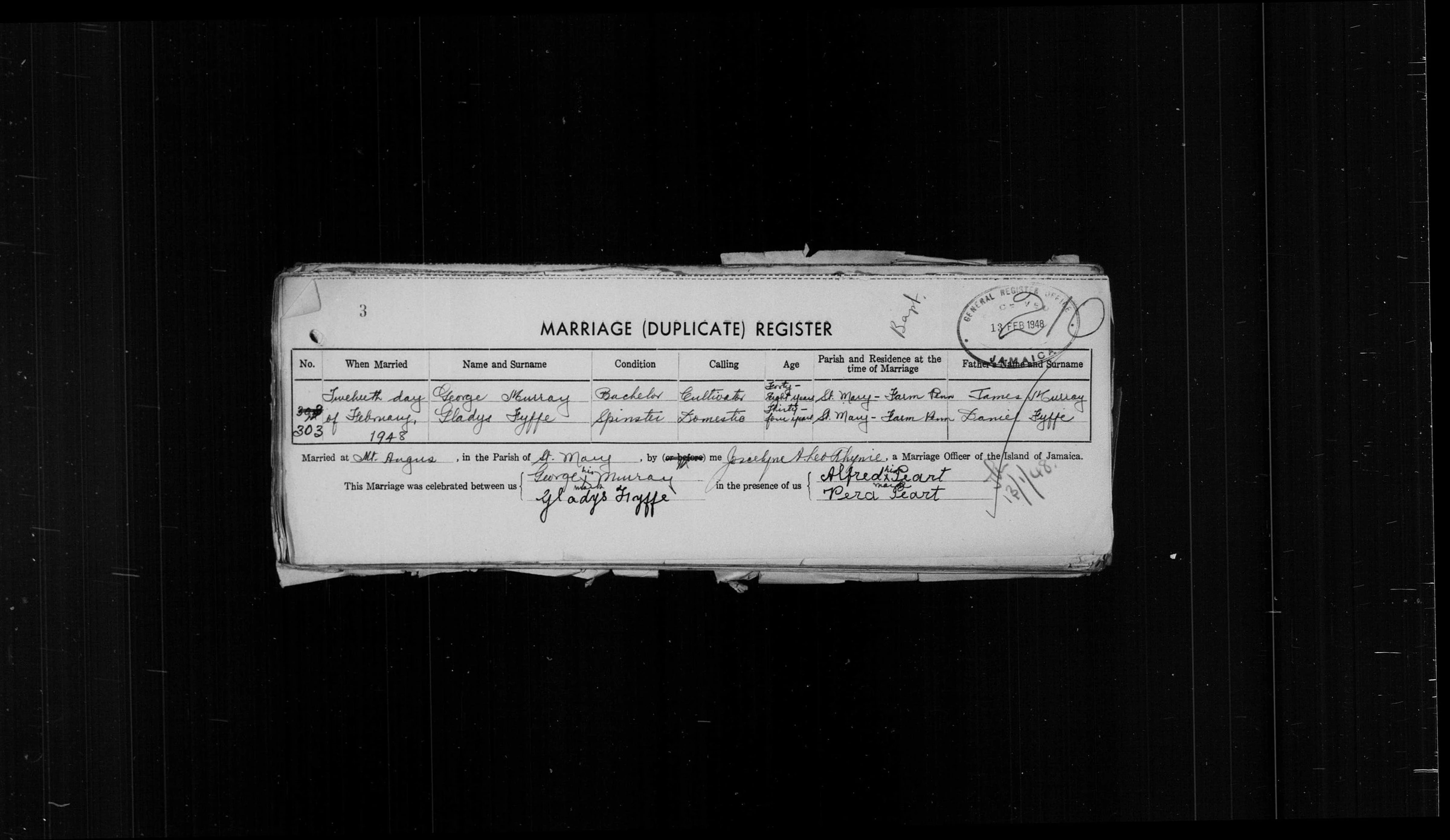
Source & credit
A family line through different kinds of record
| Person | Connection and documentary place |
|---|---|
| Marianne / Quasheba | African-born mother of Abba / Jane; the 1817 return states the relationship. Quasheba is her day name in the family research. |
| Abba alias Jane | Marianne’s daughter; mother of Joe / Joseph in the verified family research. |
| Joe / Joseph Kidston | Born about 1825; later labourer at Bogg Pen and father of Matilda with Catherine Kidston. |
| Matilda Kidston Fyffe | Born 1845; married Robert Fyffe in 1872; Daniel’s mother. |
| Daniel Boscoe / Buscoe Fyffe | Born 1873; father of Gladys and documented Farm Pen landowner in the family research. |
| Gladys Fyffe Murray, Va | Daniel’s daughter and Lurlene Williams’s mother. |
| Lurlene Williams, later Lurlene Smith | Daughter of Gladys and Cecil Williams; Winton’s mother. |
| Winton Murray | Lurlene Williams’s daughter and Anthony’s mother. |
| Anthony DePass | Descendant and narrator of this research. |
In Search of Marianne / Quasheba reproduces further family records and follows the African naming context, Lurlene Williams’s birth and the later generations.
Tony’s call: Joseph and Catherine’s household continues beyond the estate return, through Matilda, the Fyffes and the family at Farm Pen.
Sources and records
- Original St. Ann birth register, entry 435: Matilda, born 5 April 1845, registered 24 May; Joseph Kidston and Catherine Kidston; Joseph a labourer and informant at Bogg Pen. Family-archive image.
- Anthony DePass family archive and verified family research, with original records reproduced in this series and In Search of Marianne. Joseph’s early register sequence, the elder and younger Alexander, James’s relationship and Bogg Pen’s incorporation into Arthur’s Seat follow the supplied family research.
- Original St. Mary return for Mary Roche, 28 June 1817, manuscript p. 733. Marianne, forty, African; Abba alias Jane, twelve, Creole; “Marianne her mother.” Escape remarks June 1815 and 25 April 1817. Family-archive image 62711_73022001091_1665-00794.jpg.
- Original St. Mary return for Mary Ann Roche, 28 June 1823, manuscript p. 395. Jane’s row records a sale in 1822. Family-archive image 62711_314054001181_0644-00454.jpg.
- Original St. Ann return, 28 June 1826: James Kidston as owner in right of Mary Ann Roche his wife; Marianne recorded as long absent. Lower return in image 62711_314054001181_0640-00535.jpg.
- Original St. Ann return, 28 June 1829: James Kidston in right of Mary Ann Roche his wife; Marianne, “Runaway many years.” Family-archive image 62711_314054001181_0646-00078.jpg.
- National Library of Jamaica, History Notes: abolition in 1834, apprenticeship and full emancipation in 1838. Broad historical context, distinct from individual family records.
- Jamaica Almanac 1838; return of 28 March 1837. Alexander Kidston, Bogg: 117 apprentices. This is an apprenticeship return, not a pre-1834 slave count. Published transcription.
- Jamaica Directory 1878, Ocho Rios. A. A. E. Drysdale, proprietor of Arthur’s Seat and Bogg Pens. Published transcription.
- Original St. John’s, Ocho Rios, marriage register, 10 April 1872, p. 211, entry 4: Robert Fyffe, shoemaker, and Matilda Kidston, both residing at Clark’s Town. Family archive.
- Original baptism entry 49, p. 278: Daniel, born 27 February 1873 at Clark’s Town, baptised 5 November; parents Robert Fyffe and Matilda Kidston; father a shoemaker. Family archive.
- Original death registration, 6 May 1947, Farm Pen, Gayle district: Matilda Fyffe, reported age 103, daughter Louise Fyffe informant. The 1845 birth entry gives a younger calculated age. Family archive.
- Original marriage registration, 12 February 1948: Gladys Fyffe and George Murray at Farm Pen, St. Mary; fathers Daniel Fyffe and James Murray. Family archive.
- James Williams, A Narrative of Events since the First of August, 1834 (1837), opening account and pp. 5–9: Penshurst duties and St. Ann’s Bay workhouse. UNC Library copy, digitised by Internet Archive.
- An Interior View of a Jamaica House of Correction, abolitionist engraving associated with 1837; version reproduced in James Mursell Phillippo, Jamaica: Its Past and Present State (1843), facing p. 172. Public-domain scan, Wikimedia Commons. Slavery Images SI-OB-436 documents its 1837 circulation and subsequent versions.
- Isaac Mendes Belisario, Water-Jar Sellers, Kingston, 1838, from Sketches of Character (1837–1838). Slavery Images, SI-OB-916 / Belisario07. The plate’s original publication is public domain; scan credited to Slavery Images. Belisario’s accompanying description identifies the sellers as apprentices.
- Dates and places: Matilda’s reproduced birth entry records 5 April 1845, registered 24 May, taking precedence over the 1844 year in Anthony’s earlier post. Sand Hill, St. Mary, is retained as a family association; it does not replace Bogg Pen in the birth entry or Clark’s Town in the marriage entry. The reported age of 103 at death is preserved alongside the calculated age of 102 from the birth record.
- Evidence boundaries: the reproduced 1817 return directly joins Marianne and Abba / Jane. Joe’s birth around 1825, his relationship to Jane and continuity into Joseph follow Anthony’s wider register research. The 1837 Bogg total is not an individual entry for him. Williams’s testimony and Belisario’s print provide contemporary Jamaican context, not testimony about Joseph’s own daily tasks. Joseph’s labourer entry does not establish landownership; Daniel’s Farm Pen landownership follows the family research rather than a deed reproduced here.
- Anthony DePass, family-name clarification, 15 November 2026: his grandmother was Lurlene Williams and later used the married name Lurlene Smith.