Drax Hall: the waterwheel and the workers’ household
A surviving industrial feature and an excavated village tell different sides of a north-coast sugar estate. Read them together.
A wheel points to a working system
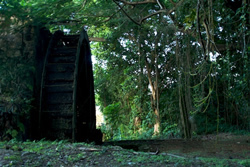
Drax Hall’s waterwheel is a tangible link with sugar production in St. Ann. JNHT describes water taken from a dam on the St. Ann Great River, carried through channels and across the road toward the estate works. The purpose was to turn mill rollers and crush cane. The important sight is not just a wheel: it is an arrangement of water, machinery, land and labour. A surviving component cannot show the whole arrangement without a map and explanation. [1]
The wheel made the labour system more productive
Cane had to be crushed before its juice could become sugar. At Drax Hall, water diverted from the Great River powered the rollers, linking a river, engineered channels and the works in one production system. JNHT’s account attributes much of the estate’s increased productivity before emancipation to improved milling. The waterwheel was therefore an investment in extracting more value from a crop grown under slavery.
Mechanisation did not remove the people whose labour sustained the estate. It changed one part of the process inside a coercive economy. The contrast with excavated household life is revealing: owners could invest heavily in machinery while enslaved residents repaired, reused and adapted domestic objects. Later switches from sugar to bananas, cattle and copra show another kind of change. An estate name could endure while its crops, equipment and working relationships altered around it. [1]
Source & credit
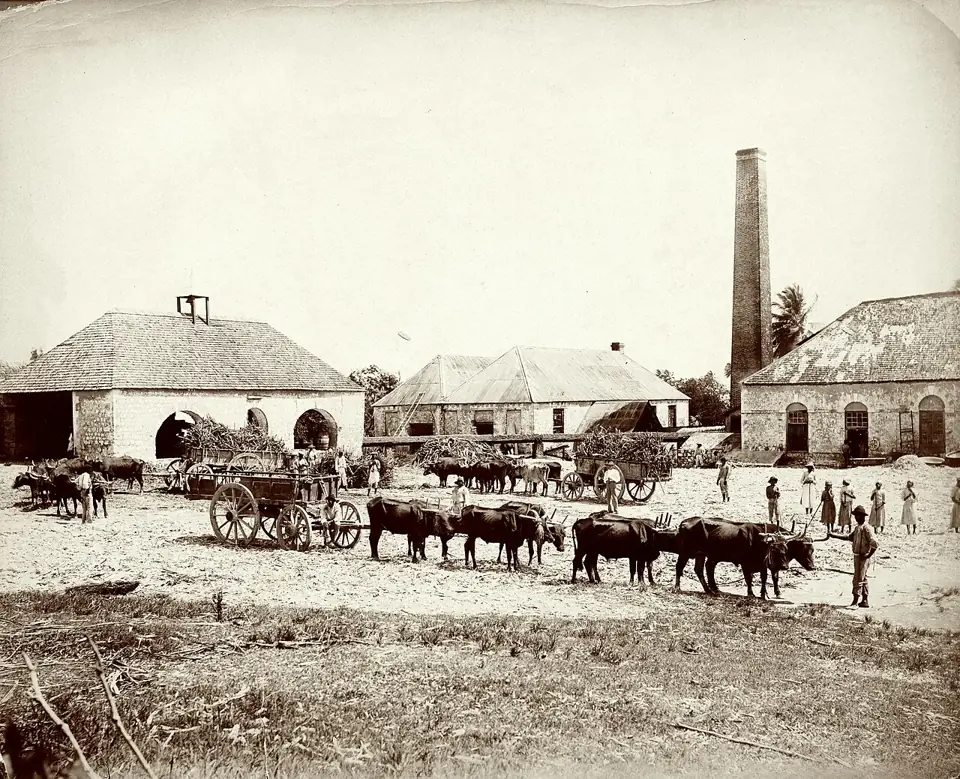
Look closely: A post-emancipation comparison from another St. Ann estate. Look at buildings, chimney and transport. This is not Drax Hall, a slave-period workforce, or the Seville burial site.
Source & credit
Better milling was not freedom
The heritage account links improved milling efficiency with increased estate productivity before emancipation. That tells us about output, not workers’ wellbeing. A more efficient mill could still depend on coerced field labour, transport and processing. Ask whose account defined “improvement”: the proprietor measuring production, the person repairing a roller, or the household finding time to prepare food. Those questions distinguish technical change from social change, which need not move in the same direction. [1]
Move from the works to the household
Douglas Armstrong’s archaeological study The Old Village and the Great House examines enslaved and later free labourer households at Drax Hall. Research at the village shifts attention from impressive estate structures to the smaller material traces of daily life. House sites, objects and their contexts can help researchers ask about food, consumption and changes across emancipation. They do not supply a complete spoken biography of every occupant. [2]
The yard is part of the evidence
A household is more than an enclosed room. Think about where someone cooked, discarded broken objects, worked or met neighbours. The relationship between house and yard offers questions that an owner’s portrait cannot answer. Archaeological context is crucial: an isolated ceramic fragment does not identify its user, and an attractive object removed from the ground loses information about where it lay. The household approach asks how people made lives within constraints rather than treating the estate population as machinery.
Compare Drax with Seville carefully
The Digital Archaeological Archive of Comparative Slavery’s Seville House 16 record describes a house compound, excavation history and a burial. It provides a useful neighbouring comparison, but those specific discoveries belong to Seville—not Drax Hall. Use the comparison to learn how evidence works, not to transfer a burial or object into the wrong village. Both places show why ordinary households belong beside the great house in St. Ann’s history. [3]
The name survives; the land changes
JNHT follows Drax Hall through sugar into later banana, cattle and copra production. Its account of later corporate ownership is an undated historical summary, not a current property search. Present development bearing the Drax Hall name does not guarantee that every old feature is open or intact. The inheritance is a documented estate landscape and surviving evidence, not a promise of an unchanged plantation visit. Look for continuity, alteration and disappearance together. [1]
Try the history yourself
Make two lists: evidence of production and evidence of household life. Put the waterwheel in one and an excavated house context in the other. Explain why neither list alone gives a complete history of the people at Drax Hall.
Explore with care
Confirm the waterwheel’s current access and condition with local heritage contacts before leaving your base. Do not enter works or disturb archaeological ground. Use Seville’s interpreted heritage setting as a separate learning visit, not as a substitute location for Drax evidence.