Seville: Indigenous settlement, colonial conquest and the homes behind the great house
One north-coast landscape contains several histories. The visitor attraction becomes more revealing when the great house is placed beside Taíno occupation, Spanish settlement and the villages of enslaved Africans.
Jamaica’s story did not begin with a European landing
Near present-day Seville was the Taíno settlement of Maima. The park’s account places houses, canoe-making and fishing in that Indigenous landscape before the Spanish founded Sevilla la Nueva in 1509. The first European capital was built in a place already inhabited and used. That sequence matters: European founding dates describe a change of political control, not the beginning of human life on the coast. [1]
The Spanish settlement included religious, defensive and productive structures; the park identifies a fortified castle, a church and a sugar mill. Africans arrived during the Spanish period, many under compulsion. Indigenous, African and European histories consequently overlapped in the same landscape. They were not three separate national costumes placed in order for a heritage display. Settlement, conquest and forced labor changed how people could live on and use the land. [1]
A new regime turned the landscape into an English estate
After the English capture of Jamaica in 1655, the former Spanish settlement became part of a plantation landscape. The Heritage Trust associates the allotment with Captain Hemmings and dates the great house built by his grandson to 1745, on an earlier house site. The surviving building represents a particular ownership period, not all the centuries enclosed by the park. [2]
Source & credit
The building itself changed. The Trust describes a second storey lost in a hurricane around 1898 and not replaced, together with timber floors, mahogany work, modified windows and a north-facing veranda. A present exterior is therefore a record of survival and alteration, not a perfectly intact 1745 household. Restoration can make a structure accessible while the source chronology explains which moment it represents. [2]
Two villages change the center of the account
Seville’s enslaved population did not live only as a supporting cast to the great house. Archaeological work led by Douglas Armstrong distinguished early and later African Jamaican village areas. A 1721 map shows tightly arranged rows of homes behind and upslope from the planter’s residence. A 1792 plan shows a later village with independently oriented houses and more yard space. That difference is the starting point for a history of domestic life and the organization of power. [3]
Armstrong and Kenneth Kelly interpret settlement change as evidence that enslaved residents modified the order imposed by planters. The work does not claim that altered housing ended enslavement. It shows people shaping community space within constraints. A plantation plan could arrange dwellings to fit supervision and production; lived practices could alter relationships among houses, pathways and yards. Both the imposed order and those adaptations are part of the site’s history. [4]
Household objects reveal more than poverty
At House 15, postholes and probable foundation evidence support an interpretation of wattle-and-daub construction. Excavators recovered European and locally made objects associated with food and other activities. The evidence is materially modest compared with a great house’s finished rooms, but historically rich: households cooked, consumed, worked and sustained social and spiritual life. A dwelling was not an empty container into which an owner placed labor. [3]
Locally made and imported things could coexist in the same household. That complicates the idea that material culture must be either wholly African or wholly European. People used available objects within lives organized by relationships, necessity and choices. Foundations do not identify every meal or the sleeping place of each family member, but the assemblage restores activities that a production account or an elite portrait would miss.
The yard belonged to the story
The space between houses mattered as much as the walls. A yard could connect cooking, work, gathering and visits; a change in orientation could alter visibility and contact. This is why the comparative plans are so valuable. They let the household appear as part of a community rather than as a standardized laborer’s hut. The house-and-yard article below develops that social dimension without presenting a modern reconstruction as an original dwelling.
The archaeological account also connects the later village to oral history through interviews with Carpy Rose, who had been born in one of its last standing houses. That extends the story beyond a plan’s date. Documents, excavated remains and remembered residence do different jobs, but together they prevent the village from disappearing once attention returns to the planter’s architecture. [3]
A place for public remembrance
The JIS Emancipation Jubilee film shows a modern gathering at Seville. It belongs to the history of how Jamaicans remember and publicly interpret emancipation. It is not footage of plantation life or of emancipation itself. Seen after the site chronology and household evidence, the film supplies a third layer: historical events, material remains and contemporary acts of remembrance.
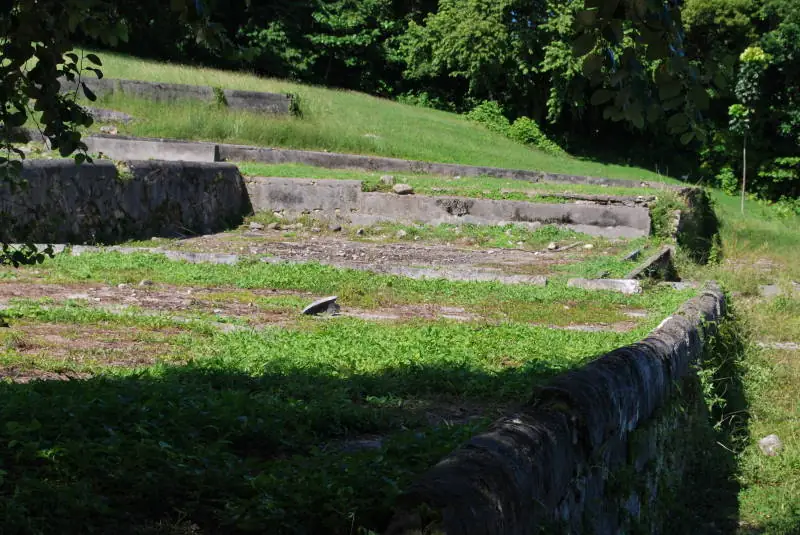
The ruins photographed in 2010 likewise identify a heritage landscape. They do not provide a camera-matched view of the 1721 map or a surviving interior of House 15. Their value is location and orientation. The explanation belongs on the page so a visitor can understand the layers before following any archaeological citation.
What a visit should leave visible
A complete account of Seville holds the Taíno settlement, Spanish capital, English estate, enslaved villages and later remembrance together without flattening them into one “colonial” past. The great house deserves attention, but not authority over the entire story. The people living in the villages were shaping households and a community at the same time that the estate extracted their labor.
That is the point to carry into the practical guide: a good visit should help you distinguish periods, buildings, archaeological interpretation and reconstruction. The attraction is one way into the history. The historical explanation should not depend on being able to travel there or gain access to an archive.
Keep the different settlements in view
Successive occupation at Seville makes the site a national history in a particular landscape. It also makes careless compression dangerous. Indigenous settlement, Spanish occupation, an English estate and later household evidence are not one unchanging village. Locate each claim in its period before making the continuity argument.
The two African Jamaican village layouts are especially important because they shift attention from the great house to residents' spatial arrangements. Houses, yards and objects give an account of domestic activity that an ownership history cannot supply. Archaeological interpretation then asks how those arrangements related to supervision and household autonomy.
A visit should leave you able to explain both the layers and the differences. Ask which remains you are looking at and how they were dated. Read the house-and-yard article before using a reconstruction to imagine the settlement. The goal is to make past lives materially understandable while keeping unknown occupants and undocumented routines out of the picture.
Sources and notes
- Seville Heritage Park. History of the Park: Indigenous, Spanish, African and English occupation. ↩
- Jamaica National Heritage Trust. Seville Great House: ownership, the 1745 house and later alterations. ↩
- Digital Archaeological Archive of Comparative Slavery. Seville House 15: maps, excavation and household remains. ↩
- Douglas V. Armstrong & Kenneth G. Kelly (2000). Settlement Patterns and the Origins of African Jamaican Society: Seville Plantation, St. Ann’s Bay, Jamaica. Ethnohistory, 47(2), 369–397. University of South Carolina record. ↩