Fairfield: a mission inherited from the plantation world
Manchester’s Moravian history joins a former estate, worship, schooling and uneasy relations between missionaries and people seeking freedom.
A plantation becomes a mission setting
Paul H. Williams’s account of the Moravian mission describes the purchase of an old plantation at Fairfield in 1823, after the earlier Carmel station closed. Buildings were adapted for a chapel and schoolhouse, and Fairfield became the mission headquarters; John Ellis arrived there in 1824. The site carried a plantation landscape into another institutional use before emancipation. This is Fairfield in Manchester parish, Jamaica—not the Moravian settlement near Manchester city in England. [1]
A mission depended on the ground beneath its message
A mission required land, buildings and resources as well as religious purpose. Fairfield’s connection to the plantation world therefore raises a material question inside the history of belief: how could an institution speak about spiritual life while operating within an economy built on enslaved labour?
The answer cannot come from a building’s appearance alone. The property and mission histories must be read together, with the people who worshipped kept distinct from those who controlled resources. That makes religious change more understandable. A message could be adopted and transformed by congregants even where the institution carrying it had an unequal and compromised foundation. [1]
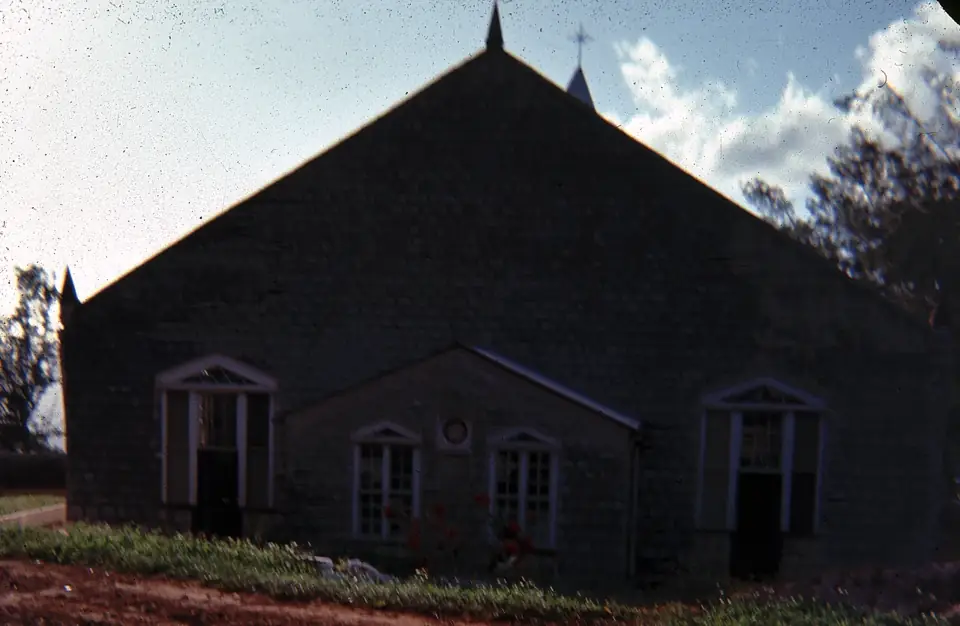
Source & credit
Look closely: Look at the entrance, roof and setting. This is the Jamaican church decades after emancipation, not Fairfield in England or an image of the 1823 plantation purchase.
Conversion of a building did not end slavery
A chapel established before emancipation existed inside a colony where people remained enslaved. Its religious purpose could alter the use of a room without changing everyone’s legal status. The wider mission history also records Moravian ownership of enslaved people at Carmel. That specific ownership statement belongs to Carmel, not automatically to every Fairfield building or congregation. A careful account follows the institution’s connections without transferring one station’s evidence into another. [1]
Private conversation worried proprietors
A Moravian church reflection on emancipation cites the 1854 history by J.H. Buchner, then associated with Fairfield. It describes proprietors’ suspicion of missionaries’ private conversations with enslaved people. Such encounters could give individuals a space to speak beyond an overseer’s hearing. The account reveals anxiety over communication; it does not preserve the words of every participant. Ministers’ later explanations are also perspectives to examine, not a substitute for congregants’ own accounts. [2]
Religious leadership and resistance were not identical
The same reflection acknowledges that missionaries were often anxious not to be seen as disrupting colonial order. That makes the story more complex than a straight line from preaching to liberation. Enslaved worshippers could give religious language meanings that differed from those of a minister protecting a mission’s position. Ask separately who demanded freedom, who offered pastoral support, and who sought to reassure authorities. A shared church affiliation does not mean shared political choices. [2]
Records carry Fairfield beyond emancipation
The transcribed 1851 Jamaica Almanac lists Fairfield in Manchester among Moravian mission stations. It is evidence of an institution in that later period, not proof that a particular pre-emancipation wall remained untouched. The 1877 ecclesiastical account also situates the superintendent at Fairfield. These records help trace institutional continuity through names, offices and locations, while leaving the condition and use of individual buildings to other evidence. [3][4]
Read the legacy through ordinary learners
A mission history can become a succession of European ministers unless we ask about the people who learned, taught, married, worshipped and argued there. School and congregation records may offer another route, though an institutional register still records people through the institution’s categories. Compare Fairfield’s mission setting with Maidstone’s free-village history. Both belong to Manchester, but one article asks about a converted estate and religious authority; the other asks about household land and settlement.
Try the history yourself
Compare the mission’s account of private conversations with the almanac’s list of stations. Which tells you about a relationship, and which about an institution? Write a research question about Fairfield’s learners that would need a school or congregation record.
Explore with care
Ask current church or community representatives about heritage interpretation and any access. Confirm the exact Jamaican locality before planning a route. Respect worship and private records; a historical mission listing is not a present visitor timetable.