Maidstone: freedom bought in instalments
Location: Maidstone, Manchester, Jamaica
Explore area in Google Maps ↗Map search for the named place or area. Arrange the actual entrance, guide meeting point and access with your host; this is not a confirmed tour departure.
In 1840 a Manchester coffee property was divided into village plots. Moravian land purchases, household payments, and a church rebuilt stone by stone show how residents made freedom a place to live.
A different centre of the story
In 1840, a coffee property in Manchester was purchased for a village of household plots. The Jamaica National Heritage Trust records 341 acres purchased near Nazareth under Moravian direction and divided into 98 lots, ranging from one to fifteen acres. For people building lives after slavery, land offered somewhere to make a home and cultivate food outside the estate’s control. But a place on the plan was not the same as a paid-for holding: some purchasers completed their payments only in 1850, ten years after the village’s foundation. [1]
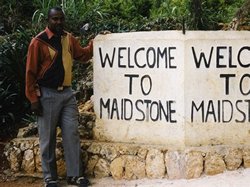
Source & credit
The church helped turn an estate into household land
The Nazareth Moravian Church at Adam’s Valley bought the Maidstone acreage and arranged its subdivision. That gave the congregation an institutional role in the village’s foundation: land passed from a coffee property into a scheme of household plots. The purchasers still had to meet their payments, cultivate their holdings and sustain the settlement. The church’s organisation and the residents’ work belong in the same account. [2]
The World Council of Churches connects Nazareth with Moravian settlement initiatives in the 1840s and a wider educational mission. Maidstone’s schoolhouse, also used as a chapel, joined teaching and worship in one building. [5] [1]
The ground shaped the village
Rocky, uneven ground prevented a regular grid of streets and squares. The village took shape around the land available to its residents, rather than an ideal town plan. Its schoolhouse also served as a chapel. Homes, cultivation, teaching and worship formed the practical foundations of settlement; each required effort beyond the purchase itself. [1] [1]
Stone by stone, from Adam’s Valley to Nazareth
Curator Ava Frith described the church’s move in a 2022 interview with the Gleaner. In her account, an earlier building at Adam’s Valley dated to 1834. When the congregation outgrew it, residents dismantled it stone by stone, carried the material through the hills and rebuilt on the hill at Nazareth. Work began in 1888 and finished in 1890. The relocation and dates are presented here as her account, rather than as a newly verified construction register. [3]
The story gives the building a history of collective labour. The congregation moved more than a place of worship: it carried familiar material into a new site. Frith also described continued stone-wall building and a desire to preserve older structures. Those practices connect the church’s fabric with the community’s everyday sense of inheritance. [3]

Source & credit
Source & credit
A congregation remembered in its landscape
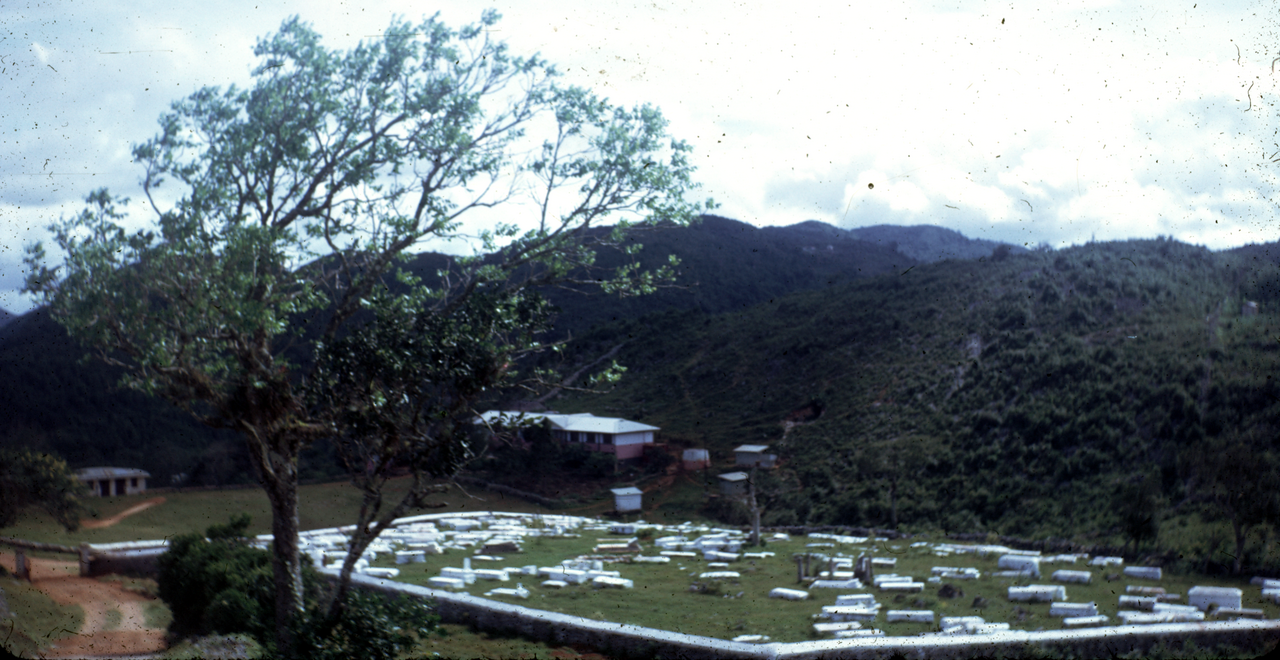
Jack Eden’s 1968 view places the burial ground among the hills, extending the story from church walls to the landscape of remembrance. It is a different viewpoint and date from the church photograph. [4]
A museum belongs to a living community
On 18 November 2015, Maidstone’s past acquired a new public home when a museum opened at Nazareth All-Age School. The Ministry of Tourism described a community walking tour and a display naming original plot recipients. Those names reconnect the 98 lots with particular people. Housing, schooling and family history can be followed together here, through a heritage project situated within the community that inherited them. The Ministry’s opening report records J$9.73 million in Tourism Enhancement Fund support and 45 people employed on the project; it specifically credits local participation. The museum thus represents another episode of community work, alongside the earlier purchase of land and rebuilding of the church. [2]
Sources and notes
- Jamaica National Heritage Trust: identified local site, historical account and source photograph. ↩
- Ministry of Tourism, 2015 Maidstone Museum opening and community interpretation project. ↩
- Olivia Brown, Gleaner, 29 July 2022: curator Ava Frith’s account of the Adam’s Valley church, stone-by-stone relocation, 1888–1890 rebuilding and continuing stonework.
- Jack Eden: Nazareth Moravian burial ground, Maidstone, 1968; CC BY-SA 2.0 UK; capture year differs from the 2008 upload.
- World Council of Churches: Moravian Church in Jamaica; settlements for formerly enslaved people, Nazareth’s community initiatives and education.
- Dreygo71: Maidstone church, identified as Nazareth Moravian Church; capture date 8 December 2012, uploaded March 2013; displayed through provider-supplied Flickr embed; all rights reserved.
Historical and image records were reviewed on 25 October 2026. The original entrance photograph remains undated; added views retain their separately recorded dates. Visit durations are planning estimates; current service operation and access require direct confirmation. The museum opening record does not establish current visiting hours; arrange school and community access directly.