Munro’s bequest: slavery wealth carried into education
A school founded after emancipation can still inherit resources accumulated under slavery. Follow the trust, the timing and the distinction between its origins and later students’ achievements.
A school’s history starts before it opens
JNHT’s Munro College account traces the institution through the estates of Robert Hugh Munro and Caleb Dickenson. It records legislation in 1834 authorising trustees to sell estate assets and apply the funds to their wills’ purposes. The proposed beneficiaries were poor boys and girls and an almshouse. This is a concrete form of continuity from the slavery era: assets and a legal trust could pass into a later institution, even though the school itself opened after emancipation. [1]
Education inherited money from the world it could help change
A bequest could cross emancipation without losing the history of how its resources were accumulated. The compensation-related funding discussed in the scholarship makes that continuity explicit at Munro. A school opening after slavery therefore does not settle the question of where its founding wealth came from.
The later educational life also has its own meaning. Pupils and teachers could use an inherited institution for purposes beyond the founders’ world. Those achievements deserve an account without turning them into repayment to the people whose enslavement helped generate the resources. Keeping origin and subsequent use together lets the school’s history explain a difficult Jamaican inheritance rather than end with either celebration or dismissal. [1] [2]
Source & credit
Compensation belongs in the account
Historian Ahmed Reid’s discussion of Jamaican slavery legacies cites the 1855 legislation establishing the school arrangements. He identifies proceeds from property, personal estate and compensation paid for enslaved people among the resources restored to the charity. Compensation went to those with claims over enslaved property, not to the people who had been enslaved. The funding history is therefore more specific than simply saying the school was old or a benefactor lived during slavery. [2]
The school and the buildings have different dates
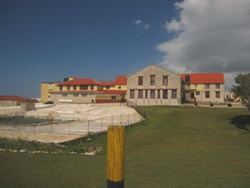
JNHT dates the boys’ free school near Black River to 1856 and its move to Potsdam in the Santa Cruz Mountains to 1857. Those dates should not be confused with the 1834 trust legislation or emancipation. Its account also dates later campus structures, including the 1925 hall and the chapel dedicated in 1914. A photograph of the campus does not show a school building operating during slavery. [1]
A complex benefactor is still accountable
The Munro College Old Boys Association’s profile discusses Caleb Dickenson’s life, family connections and benefaction. Read that commemorative perspective beside Reid’s funding argument. Biography, gratitude and an account of enslavement can ask different questions about the same person. Recognising educational generosity does not remove the need to examine the source of the wealth. Equally, a founder’s history does not reduce every later teacher or student to that origin. [3]
The inheritance changed purpose
A resource accumulated through an unequal economy could support opportunities that later people used in ways the original owner did not control. That change is important, but it is not retroactive compensation for those whose labour created the wealth. Ask two questions separately: where did the endowment come from, and what did successive generations do with the institution? Keeping both avoids a celebratory history that hides the origin or a reductive history that erases the later educational work.
Follow the trust, not just the façade
The strongest learning activity here is documentary. A building may be imposing, but legislation, trustees’ accounts and compensation records explain how resources moved. Reid’s article offers a route into that evidence; it does not identify the precise share of every present campus asset traceable to slavery. Do not assign a modern building’s entire cost to an old fund without accounts. This is a history of institutional inheritance, with room for more detailed financial research.
Try the history yourself
Make a timeline: 1834 legislation, compensation-era resources discussed by Reid, 1856 school opening and 1857 move. Write one sentence explaining why “founded after slavery” does not answer where the founding money came from.
Explore with care
Munro is a working school. Request permission for any heritage visit, respect safeguarding and school routines, and avoid photographing students. The campus image supports historical reading; it is not an invitation to enter.