Lacovia: an earlier capital, two stones and a story that needs testing
Location: Lacovia, St. Elizabeth, Jamaica
Explore area in Google Maps ↗Map search for the named place or area. Arrange the actual entrance, guide meeting point and access with your host; this is not a confirmed tour departure.
An inland settlement and a pair of tombstones offer different kinds of evidence for St. Elizabeth’s past. The inscription, the tale and the family claim should not be treated as equally secure.
The parish had a capital before Black River
JNHT’s Black River history records the transfer of parish-capital status from Lacovia in 1773. That gives the inland settlement an administrative importance easily missed by a guide organised entirely around coastal attractions. Read the two towns as successive centres, not as a story in which one place suddenly had no life after the transfer. The movement of an institution changes the geography of authority without erasing settlement, work or memory. [2]
A capital could move while a community remained
The transfer of parish-capital status to Black River changed where official authority was concentrated in St. Elizabeth. It did not erase Lacovia. The distinction matters because a history written only around today’s administrative centres can make earlier places seem to disappear when their official role changes.
The tombstones and the story attached to them preserve another scale of memory: named people and a dramatic local account. An inscription and a transmitted tale do different work. Together they reveal how a place can remain historically meaningful after institutions move elsewhere. Lacovia’s value lies both in the older geography of parish power and in the ways residents and heritage accounts have continued to remember it. [1] [2]
Source & credit
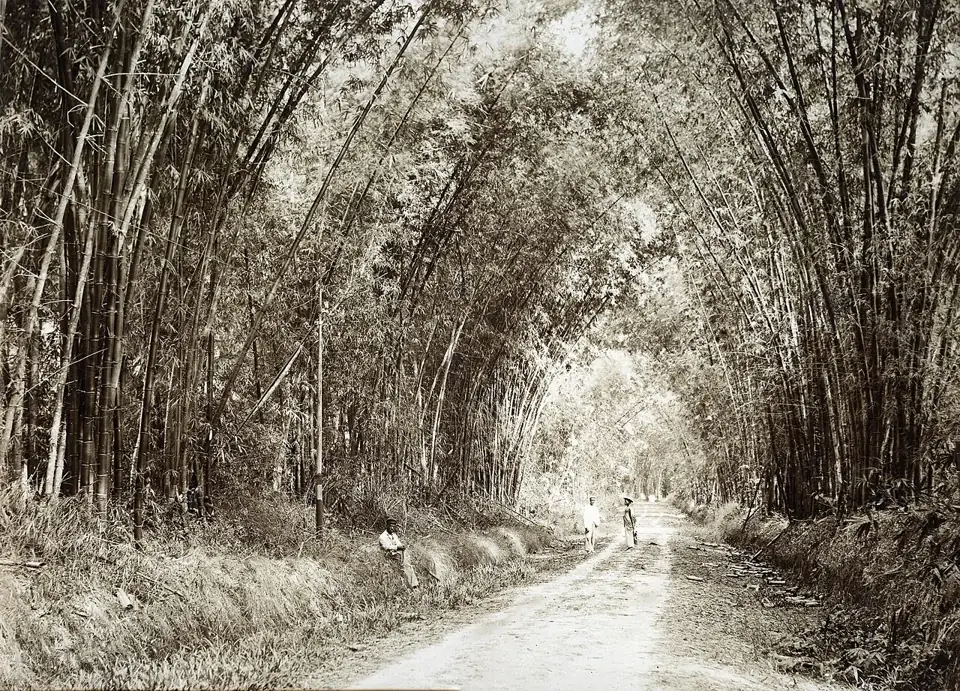
Look closely: A regional road landscape, not Lacovia’s tombstones or Munro’s campus. Follow the avenue’s enclosure and ask how a planted road shapes movement and the remembered appearance of estate country.

Source & credit
Two stones are not two complete biographies
The Lacovia site account describes two tombstones, one without a surviving inscription and the other dedicated to Thomas Jordan Spencer, who died on 17 September 1738. An inscription can establish what a commemorative text says; it does not automatically supply a complete life history. JNHT supplies the inscription’s name and date. [1]
The tavern story is explicitly a tale
JNHT introduces an account of a disagreement at a nearby tavern leading to a fatal fight and side-by-side burial as a tale. Preserve that status. Without contemporary records, the story does not establish the circumstances of both deaths, the identity of the second person or the exact sequence of events. Its cultural interest lies partly in how a memorable explanation attaches to an otherwise puzzling pair of stones. [1]
The Churchill descent claim fails a basic date check
The same page calls the person who died in 1738 a descendant of Sir Winston Spencer Churchill. That chronology is impossible for the later British prime minister, born in the nineteenth century. A shared name or a crest is not proof of the asserted relationship. This guide does not repeat the claim as genealogy. Establishing a family connection would require named generations, dates and records, including clarification of which historical person a source intended to identify. [1]
Heraldry is a clue to investigate
A carved crest may help identify a family association or the identity a memorial claimed for the deceased. It still needs a reliable transcription, a clear image and comparison with appropriate records. Symbols can be copied, misread or explained differently by later observers. Record the source’s statement separately from your own observation. That method is useful to family historians because it keeps an appealing surname connection from becoming an unsupported ancestor.
An earlier capital needs more than a tombstone stop
The stones are a distinctive local subject, but they cannot carry Lacovia’s entire settlement history. Parish administration, roads, markets and households need their own records. Start with the 1773 transfer and ask where the vestry met, what documents survived and how the older centre connected with inland places. A map can make the question clearer, but it does not establish every route’s date or the reasons for the administrative change.
Compare two forms of remembrance
Read the Lacovia site beside Accompong’s community history and Black River’s commercial landscape. They show different ways evidence survives: an inscription and tale, living institutions and sound, and buildings associated with trade. The comparison helps a reader resist one uniform picture of St. Elizabeth. It also makes the limits productive: a stone does not speak for a community, and a later recording does not reproduce an eighteenth-century event.
A source-checking exercise worth doing
Make three columns: inscription as reported, story as told, and relationship as claimed. Place the name and date, tavern narrative and Churchill assertion in the appropriate columns. Add the evidence needed to test each. For a respectful visit, use the permitted viewpoint and do not rub, chalk or climb the stones. A useful guide can make the tale engaging while allowing the monument’s actual evidence to remain more modest.