Independence, 1962: the people and papers behind 6 August
A statute, a constitution, a White House photograph and a letter to New Zealand reveal the political work and practical changes behind Jamaica’s independence.
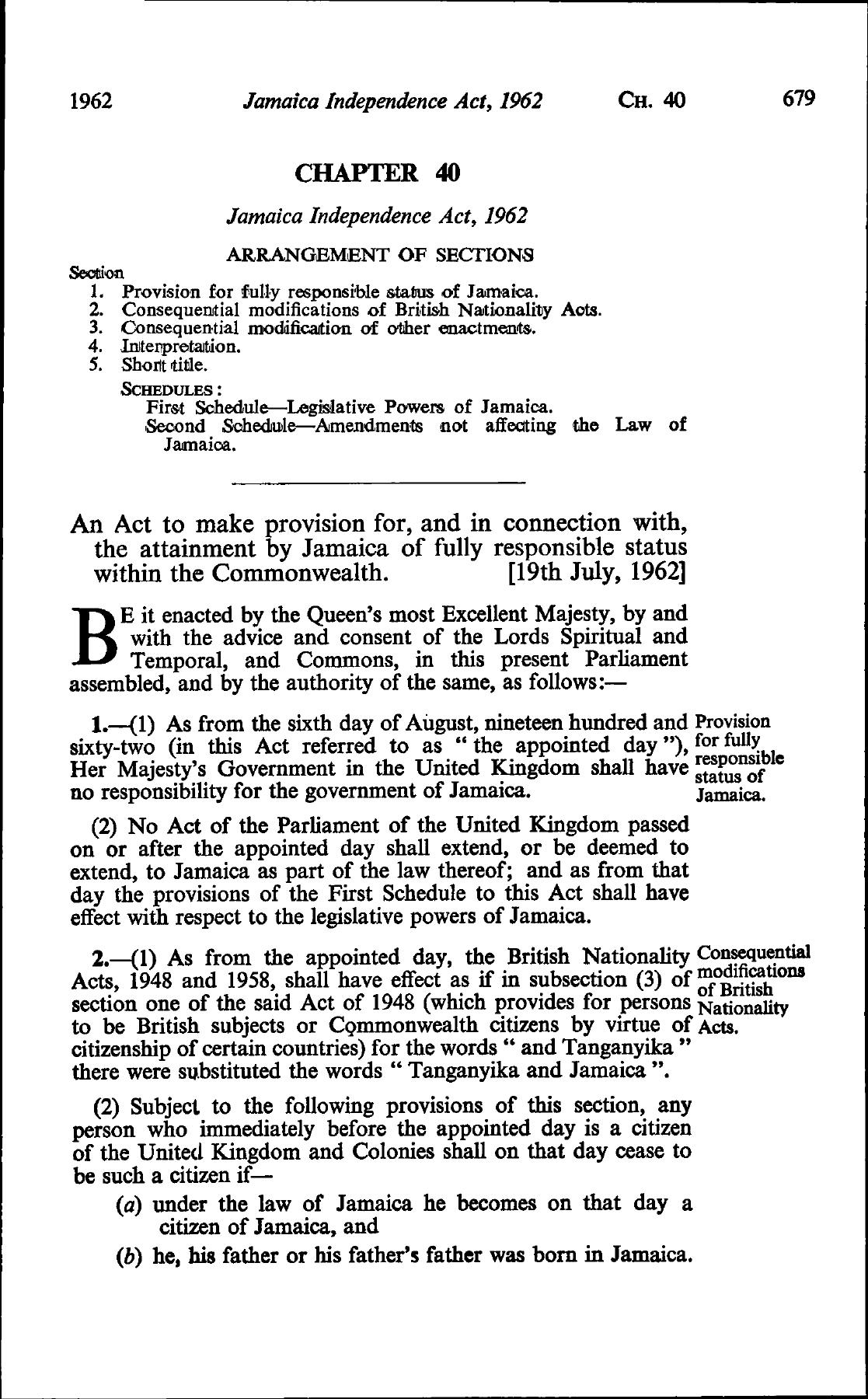
A date on a printed Act can look like the beginning of a country. Jamaica’s story is more crowded than that: voters deciding a disputed question, political rivals working on a constitution, officials preparing new arrangements and people gathering for a flag to rise. The first page below fixes one part of that history. It carries 19 July 1962, while its opening section appoints 6 August for the change in governmental authority. [1]
Source & credit
The decision had a Jamaican political history
Independence did not begin in a quiet room at Westminster. The labour unrest of 1938 helped drive demands for a different political order. The People’s National Party was launched under Norman Manley that year; Alexander Bustamante’s Jamaica Labour Party followed in 1943. The 1944 Constitution widened the electorate through adult suffrage. Working people’s claims and party competition were shaping government long before the 1962 statute. [2]
Another route to independence had involved joining other British Caribbean territories in the West Indies Federation, established in 1958. Manley supported remaining in it; Bustamante campaigned for withdrawal. On 19 September 1961, a majority voted to leave. The question on that ballot concerned membership of the Federation, not whether Jamaicans should remain a British colony indefinitely. Leaving made an individual Jamaican independence settlement the immediate task. [2]
Rivals worked on a common constitutional project
A joint committee drawn from the House of Representatives and Legislative Council worked on the constitutional draft during 1961–62. The National Library describes it as bipartisan. That is an essential distinction: the document belonged to a negotiated political process, not simply to the party that happened to win the next election. A shared framework had to govern competition between parties as well as the exercise of power by either one. [3]
JIS’s account of the committee names seventeen parliamentarians, including Iris King, its only woman. She had become Kingston’s first female mayor in 1958. Remembering her alongside the better-known party leaders gives the drafting process a fuller cast. The same JIS account dates the joint committee’s concentrated work from October 1961 to January 1962. [4]
The April 1962 general election changed who would lead the government into independence. The JLP won 26 seats to the PNP’s 19, and Bustamante became the first Prime Minister of independent Jamaica. Manley’s part in the constitutional work did not disappear with his party’s defeat. The sequence matters: negotiation, an election and the final legal instruments were connected steps, rather than one leader’s solitary achievement. [2]
Source & credit
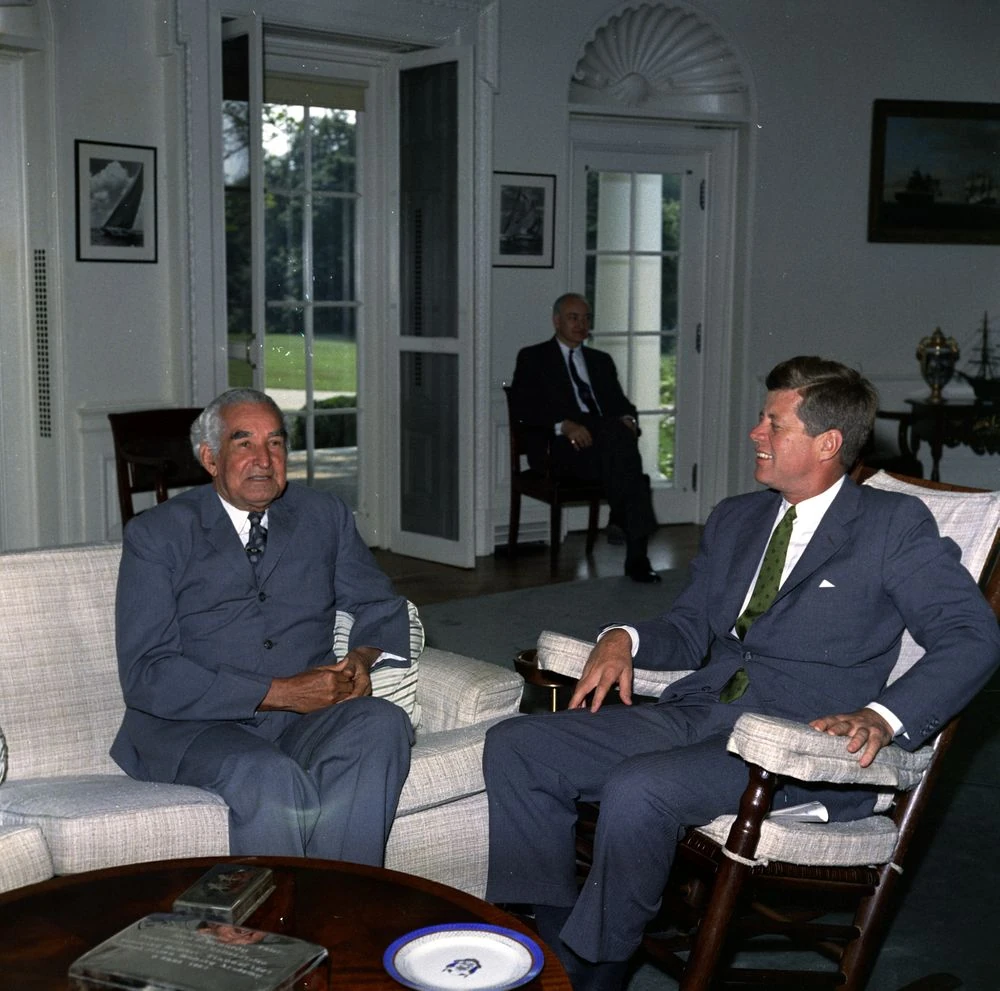
The White House photograph catches Bustamante meeting President John F. Kennedy on 27 June, weeks before 6 August. It is useful evidence of a political transition already under way. It does not show the independence ceremony or establish what either man promised in private. Its dated setting places an emerging Jamaican leadership within an international world it would soon address in its own right. [5]
What the July Act changed
Section 1 of the Jamaica Independence Act ended the United Kingdom Government’s responsibility for governing Jamaica from the appointed day. Future UK parliamentary Acts would no longer automatically extend to Jamaica as part of Jamaican law. The First Schedule removed the Colonial Laws Validity Act as a restriction on new Jamaican legislation. These provisions changed the relationship between two governments and legislatures; they were not merely a declaration of goodwill. [1]
The Act also dealt with nationality. Its provisions connected changes in citizenship status to Jamaican citizenship, birthplace, ancestry and other qualifications. That complexity is part of the historical document. A national transition had consequences for individuals as well as institutions, and those consequences could not be expressed fully by changing a flag. [1]
The Constitution was a second document
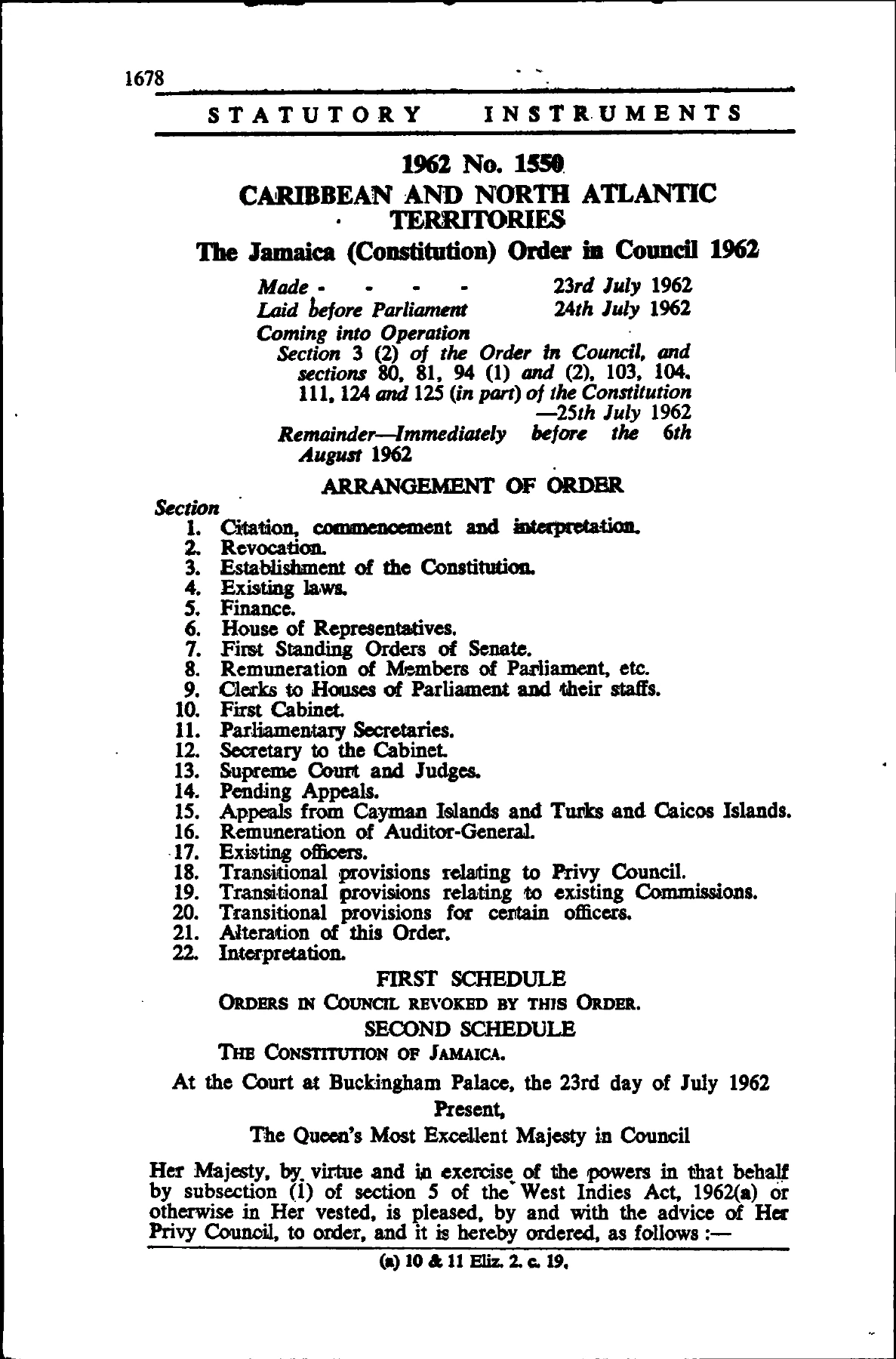
The Act should not be mistaken for the whole Constitution. The Jamaica (Constitution) Order in Council was made on 23 July, laid before Parliament on 24 July, and carried the constitutional text in its Second Schedule. Its first page distinguishes provisions beginning on 25 July from the remainder taking effect immediately before 6 August. The printed sequence shows the practical preparation needed to make new institutions function on time. [6]
Source & credit
The constitutional structure included citizenship, rights, Parliament, the executive, courts, finance and the public service. It placed limits and responsibilities around the new authority. The Order also continued existing laws, subject to later amendment or repeal. Independence therefore combined a change in sovereignty with legal continuity: administration could not simply stop while the country replaced its entire rule book. [3] [6]
A public occasion people could see and hear
The National Library’s independence exhibition describes celebrations spread across several days, not a single midnight ceremony. Princess Margaret represented Queen Elizabeth II. At the National Stadium the Union Jack came down and the black, green and gold flag rose as 5 August became 6 August. These public acts gave a visible form to a constitutional change whose details most people would never read in a statute book. [7]
The British Pathé film retained below records the occasion through the choices of a contemporary newsreel publisher. Watch the participants, public spaces and ceremonial arrangements, and listen to the framing of its narration. The footage documents a public event; it cannot tell us that every Jamaican held the same expectations for the country’s future. [8]
Independence changed the address on a letter
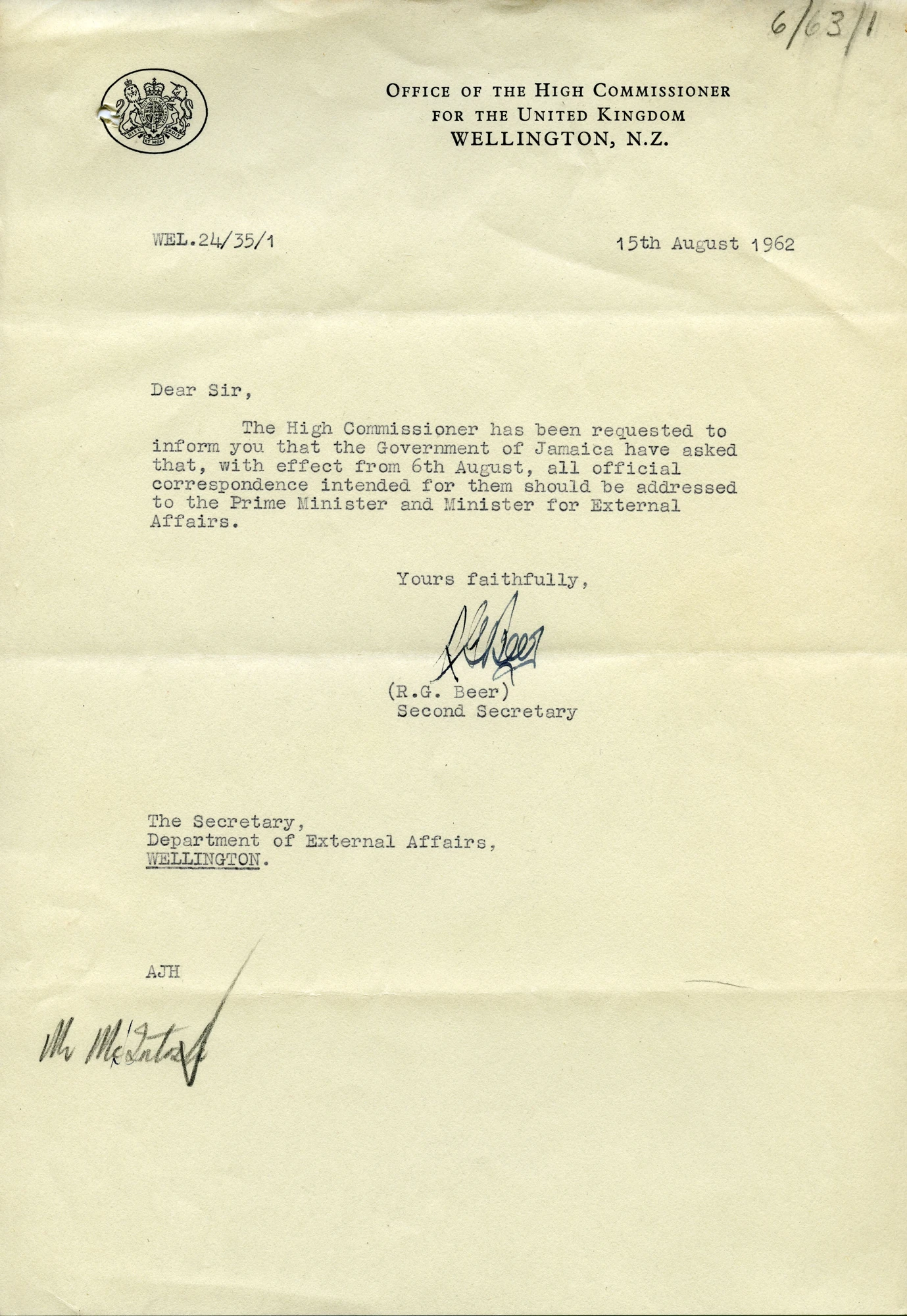
One less spectacular document makes the new relationship concrete. On 15 August 1962, R. G. Beer, Second Secretary at the British High Commission in Wellington, wrote to New Zealand’s Department of External Affairs. He relayed Jamaica’s request that official correspondence intended for its government should, from 6 August, be addressed to the Prime Minister and Minister for External Affairs. The letter survives in Archives New Zealand. [9]
Source & credit
The instruction is modest in appearance and large in implication. Jamaica’s government was identifying itself as the destination for the business of governing Jamaica. Set that letter beside the first page of the Act and the stadium film. The documents describe authority and its everyday consequences; the ceremony makes a nation’s public transition visible. Together they give 6 August a history with political work before it and administrative work after it.
Sources and notes
- Jamaica Independence Act 1962, original Chapter 40: section 1, nationality provisions in section 2 and First Schedule. Historical text, not an assessment of present citizenship eligibility.
- African Caribbean Institute of Jamaica/Jamaica Memory Bank, Timeline to Independence: labour mobilisation, party formation, adult suffrage, Federation referendum and April 1962 election.
- National Library of Jamaica, The Jamaica Constitution in Brief: bipartisan drafting and constitutional organisation. Used for historical background, not as a current consolidated legal text.
- Jamaica Information Service, The Architects of the Jamaican Constitution 1962: joint committee chronology, seventeen parliamentarians and Iris King.
- John F. Kennedy Presidential Library and Museum: Robert Knudsen, White House meeting with Sir Alexander Bustamante, 27 June 1962; photograph KN-C22493.
- Jamaica (Constitution) Order in Council 1962, S.I. 1962/1550: original making/commencement dates, Second Schedule and section 4 continuation of existing laws.
- National Library of Jamaica, Jamaica Independence, 1962: public celebrations, flag ceremony and Princess Margaret’s representation of the Queen.
- British Pathé, Jamaican Independence (1962): publisher-hosted newsreel. Historical footage and narration; external playback depends on the provider.
- Archives New Zealand, 15 August 1962 correspondence, ABHS 950 W4627 943 6/234/1 1; Commons/Flickr reproduction licensed CC BY-SA 2.0. Document date read from the letter, not its 2015 digital posting.
Historical sources, image identities and reproduction records reviewed 26 October 2026. Capture, publication and digitisation dates are distinguished where known.