Blenheim: Bustamante’s beginnings and a reconstructed house
Location: Blenheim, Hanover, Jamaica
Explore area in Google Maps ↗Map search for the named place or area. Arrange the actual entrance, guide meeting point and access with your host; this is not a confirmed tour departure.
A rural Hanover birthplace connects a national political life with the later decisions involved in preserving and presenting a home.
Start with the place and the name
JIS records William Alexander Clarke’s birth on 24 February 1884 at Blenheim, Hanover. The name later associated with national politics should not make the earlier person and locality disappear. A rural birthplace belongs at the beginning of the biography as a specific place, not a decorative preface to events elsewhere. It does not by itself explain every later belief or career decision; those connections need evidence from the life that followed. [2]
The replica records a later desire to remember
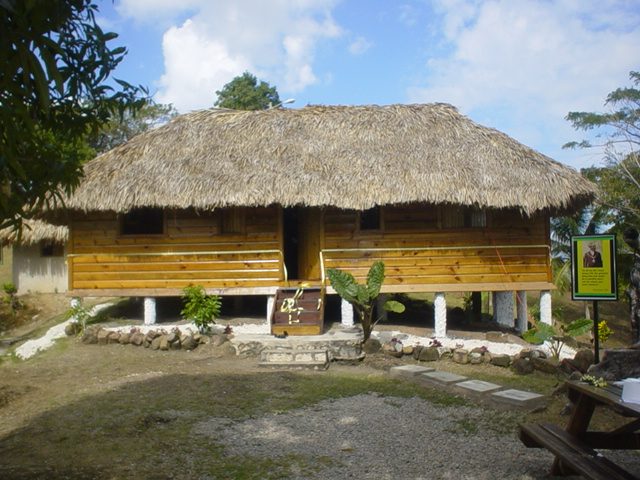
The fire that destroyed Bustamante’s original birthplace did not end the site’s public meaning. Reconstruction gave later Jamaicans a way to place a political biography within a domestic setting. The replica is therefore evidence of remembrance as well as an interpretation of the earlier home.
That distinction helps connect Hanover to the national labour story. The small-scale beginning and the later public leader belong to one biography, but the recreated house cannot explain the political transformation by itself. Frome, worker mobilisation and the institutions that followed supply that wider history. Blenheim gives the story a place to begin while the labour account explains why the person became nationally significant. [1] [2]
Source & credit
The photographed house is a reconstruction
JNHT explicitly labels the building as a replica reconstructed after the original was destroyed by fire. That distinction matters to the guide’s housing history. The photograph shows a later effort to represent the birthplace, not a camera’s record of the home in 1884. A reconstruction can be informative, but its layout, materials and furnishings require a stated basis if they are to illustrate an earlier household. [1]
Ask what the reconstruction is intended to preserve
A preserved birthplace can communicate scale, domestic setting and a connection between an individual and a district. It also makes choices about what visitors will see. Ask which documents, photographs or recollections informed the reconstruction and which features are modern. The question does not diminish the site’s value. It helps distinguish inherited fabric from a later interpretation, just as the guide separates a surviving great-house facade from its lost interior.
Labour politics moved the story beyond Hanover
JIS’s biographical summary places Bustamante’s advocacy during the unrest of 1937 and 1938 before his founding of the Jamaica Labour Party in 1943. Read that sequence beside Frome’s wage dispute, where this guide preserves differences between contemporary reporting and later accounts. Blenheim and Frome illuminate different stages and settings. A birthplace is not the location of every political event, and a labour dispute should not become merely an episode in one leader’s biography. [2]
Government and national honour came later
The same JIS account identifies Bustamante as independent Jamaica’s first prime minister in 1962, retirement from active politics in 1967 and National Hero recognition in 1969, during his lifetime. Those dates allow us to distinguish office, retirement and public honour. They do not make a complete evaluation of his policies. That requires legislation, debates, economic evidence and the voices of people affected, rather than relying entirely on a commemorative summary. [2]
Commemoration is another event, with another audience
The 2016 JIS report describes anniversary ceremonies at his shrine in Kingston and at his birthplace. That later observance belongs to the history of public memory. A tribute expresses what an institution or speaker chooses to emphasise at that moment; it is not a contemporary account from the labour unrest. Keep the date of the remembrance beside any photograph or quotation used to explain it. [2]
Compare Blenheim with Roxborough
Roxborough, associated with Norman Manley’s beginnings, offers another case in which a birthplace and a later preservation project need to be separated. The comparison should examine evidence and presentation, not make a competition between national heroes. What remains? What was lost? What was rebuilt? What do exhibitions choose to emphasise? Those questions turn two familiar names into a study of how Jamaica constructs a visible national past.
A house-and-life notebook
Make one timeline for the political biography and another for the building’s survival and reconstruction. Connect them only where a document establishes the relationship. On a visit, note how the exhibition explains the district and ordinary household setting alongside national achievements. A strong interpretation should leave you with both a better biography and a clearer understanding of what kind of evidence a reconstructed home can provide.