Devon House: wealth, household work and the public landmark
A carpenter and shipwright returned from South America wealthy enough to build Devon House. Follow George Stiebel’s family home through later owners, threatened demolition, Jamaican craftsmanship and a new public life.
The fortune behind the front steps
George Stiebel came home from South America with enough money to build a mansion. Earlier in life he had worked with his hands as a carpenter and shipwright. The African Caribbean Institute of Jamaica links his wealth to Venezuelan gold, while acknowledging uncertainty about whether he discovered a mine or invested in one. The broad journey is documented; a perfectly detailed rags-to-riches tale would promise more than that account establishes. [1]
The heritage site’s older biography supplies a family dimension: Stiebel married Magdalene Baker in 1851, and they had a son, Sigismund, and a daughter, Theresa. It also describes his shipping business and ventures in Venezuela. Read those episodes as the operator’s account, rather than treating every colourful adventure as independently proven. A household, as well as a fortune, stood behind the house. [4]
Source & credit
A mansion on church land
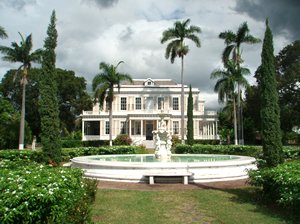
The operator’s chronology traces Devon Pen to Anglican church land and a rectory. It dates Stiebel’s purchase and the mansion to 1881. The location was then outside the dense city centre; today it is part of the wider Kingston destination, within the parish of St. Andrew. Its setting connects an individual’s success with the changing landscape around the capital. [2]
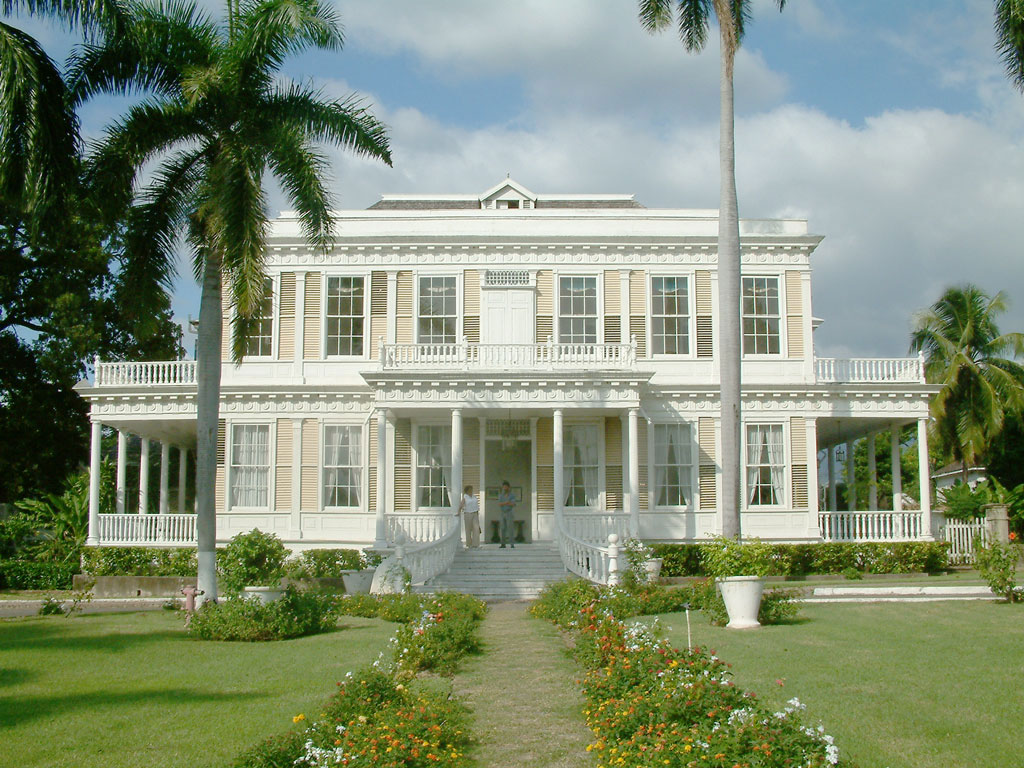
The white walls, broad veranda and formal approach make wealth immediately visible. They do not explain where it came from. Keeping Stiebel’s overseas work beside the architecture gives the visit a human route through the building: a Jamaican tradesman became a wealthy returning migrant and established a conspicuous family home.
Source & credit
The family home changed hands
Theresa inherited Devon House after her father’s death in 1896. She and her children continued living there into the twentieth century. The house subsequently passed to the Melhados and then the Lindos. These later families belong in its history, too; the mansion did not become a museum as soon as its first owner died. [1]
The operator dates the Melhado sale to 1923 and the Lindo purchase to 1928. Its account describes a smaller eleven-acre property after surrounding land was divided. A building that appears stable in photographs can sit within a much less stable story of inheritance, sale and urban development. [2]
The house almost disappeared
By the 1960s, Devon House faced demolition for development. Edward Seaga intervened with a preservation order, and the government acquired the property. The Ministry of Tourism confirms that public purchase in the 1960s and the mansion’s designation as a national monument in 1990. Preservation turned a private address into a national responsibility. [3]
That decision explains why the grounds now accommodate a mixture of historical interpretation, shopping and food. The ministry records the site’s designation as a gastronomy centre in 2017. A visitor buying ice cream and a visitor studying the mansion are using different parts of the same preserved property. Neither activity exhausts its purpose. [3]
Jamaican craftsmanship made another chapter
The Institute’s account identifies Things Jamaican designers and craftsmen in the restoration, with furniture reproductions and donated antiques used to create period rooms. That is labour we can actually name institutionally, rather than inventing the routines of unidentified nineteenth-century employees. The restored rooms also represent later Jamaican skill. [1]
Devon House became the National Gallery’s first home in 1974. The Gallery’s own anniversary history recalls those beginnings before its move downtown. The mansion therefore helped present modern Jamaican art as well as an earlier household. A tour becomes richer when it follows that sequence: family residence, threatened building, craft showcase, gallery and public landmark. [5]
Sources and notes
- ACIJ/Jamaica Memory Bank, History and Development of Devon House (June 2021), pp. 3–5. Family, trades, gold and restoration. Its Melhado-sale and state-acquisition dates differ from the operator’s chronology; those exact years are not resolved here.
- Devon House operator, property chronology. Gives 1881, 1923 and 1928; its 1965 acquisition wording differs from ACIJ’s 1967. Read the public purchase broadly as the 1960s.
- Ministry of Tourism, Devon House Development Limited: public acquisition in the 1960s, 1990 designation and 2017 gastronomy-centre designation. Listed services are not independently confirmed current opening arrangements.
- Older Devon House heritage-site biography of George Stiebel: family and business narrative, explicitly attributed rather than independently verified in every episode.
- National Gallery of Jamaica, 26 November 2024: establishment at Devon House in 1974 and institutional memory. The exhibition described ended in February 2025 and is not advertised here as current.