Kendal, 1957: a journey, a disaster and the work of remembrance
Location: Kendal, Manchester, Jamaica
Explore area in Google Maps ↗Map search for the named place or area. Arrange the actual entrance, guide meeting point and access with your host; this is not a confirmed tour departure.
A church excursion was meant to bring people home together. The derailment at Kendal on 1 September 1957 left families carrying a loss that later generations would still be trying to understand and commemorate.
Put the journey before the crash
JNHT describes an excursion that included members of the Holy Name Society at St. Anne’s Roman Catholic Church in Kingston. They left Kingston Railway Station for Montego Bay and were returning when the train derailed near Kendal late on 1 September 1957. The route joins a city institution, a day’s outing and a Manchester locality. Beginning with that journey helps restore the passengers as people travelling together, rather than an anonymous number. [1]
Fourteen relatives: the scale of loss within one family
Beverley East’s family lost fourteen relatives in the Kendal disaster, according to the JIS memorial report. That detail brings the account back from the scale of a train to the scale of relationships. For one family, the catastrophe did not mean mourning one passenger and returning to an otherwise familiar household. Many connected lives had been taken together.
East later explored the disaster through Reaper of Souls and public discussion of her family’s history. Her novel is a later literary response, not a substitute for the enquiry or a casualty list. It nevertheless helps explain why remembrance continued long after the wreckage was cleared. The 2025 monument belongs to that continuing work of naming loss and giving it a public place. The train journey ended in 1957; the family and community history did not. [1] [2] [3]
Source & credit
Separate passengers from fatalities
The heritage account gives approximately 1,600 passengers and nearly 200 deaths, while noting varying injury estimates. A September 2025 JIS memorial report identifies 187 fatalities. These figures describe different categories and levels of precision. One modern podcast page incorrectly describes more than 1,600 deaths; that conflates the passenger count with the death toll and is not used as a statistic here. The correction is essential to a story whose consequences were already devastating without exaggeration. [1] [2]
The machinery is only part of the history
JNHT’s summary attributes the accident’s cause to the enquiry’s finding about the accidental closure of an incorrectly positioned brake cock. The finding is reported here through the Trust’s account. The damaged wooden coaches also belong to the material history: a transport system connected bodies, vehicles, maintenance and procedures. A technically concise cause should not make the social consequences disappear. [1]
Look without turning distress into spectacle
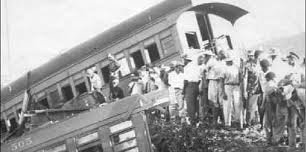
The source image shows a damaged carriage and people nearby. Use it to understand the scale of the vehicle and the disruption to its ordinary form. It does not identify every person’s role or tell us which moment of recovery it captures. A responsible account needs evidence, not a series of increasingly graphic scenes. The photograph belongs beside the explanation and the remembrance, not as a dramatic decoration.
Remembrance has its own chronology
JIS records a monument unveiling on 11 September 2025 and describes a defined memorial area. The report discussed a park and museum in future terms and a process for national-monument declaration. An announced project is not proof that every element now operates. Keeping that distinction makes the recent commemoration useful evidence without promising a completed visitor attraction that has not been independently confirmed. [2]
Family memory, testimony and a novel
The same report identifies author Beverley East, whose family lost fourteen relatives, and discusses her novel Reaper of Souls. The Strictly Facts interview with East offers a later conversation about family impact and writing. A historical novel, a descendant’s reflection and a survivor’s testimony are different sources. All can deepen understanding, but none should be labelled a recording made at the crash. Listen for how a later generation encounters inherited loss. [2] [3]
Compare a station with a memorial
Read the Kingston railway-station article first, then this account. One foregrounds trade and infrastructure; the other foregrounds a catastrophic journey and its continuing memory. In your notes, separate the 1957 event, subsequent interpretation and the 2025 memorial project. If considering a visit, ask what can presently be seen and which area is permitted, while treating burial and remembrance spaces with care.
Sources and notes
- Primary institutional or documentary account identified in the narrative. ↩
- Jamaica Information Service, September 2025: monument unveiling, 187 fatalities, future park/museum proposals and family remembrance. ↩
- Strictly Facts, episode 55 with Beverley East, 2023: retrospective family/literary discussion. Its webpage’s 1,600-deaths sentence is erroneous; do not use it for casualty counts. ↩