Migration after emancipation: Indian and Chinese Jamaican histories
Indenture and later migration brought new communities into an already unequal society. Their histories belong within Jamaican life, not in a footnote about colorful influences.
A new labor system followed slavery
After emancipation, estate owners continued to seek labor on terms advantageous to plantation production. Indian indenture was one response. Jamaica’s Indian Heritage Day commemorates the 1845 arrival of the first Indian indentured workers at Old Harbour Bay. Their arrival belongs within the changing labor economy after slavery, rather than outside Jamaican history. [1]
Indenture and slavery were different legal systems. A labor contract nonetheless operated within unequal power and could restrict the practical choices available to a worker. The shared plantation setting helps explain continuity in the demand for labor; the difference in legal status must remain explicit.
Arrival became settlement and community
Jamaica’s Indian Heritage Day commemorates the 1845 arrival at Old Harbour Bay. The modern observance records a community’s place in the public history of the country. Commemoration also shifts attention from an employer’s labor supply to the people who settled, raised families and maintained or adapted social and religious practices. [2]
A migration history therefore has several generations. Arrival documents concern recruitment and movement; settlement concerns institutions and relationships; later remembrance concerns which stories receive public recognition. Those stages should not be collapsed into a list of foods or festivals.
Chinese Jamaican history also extends beyond a shop stereotype
Jamaica Information Service’s account of the Hakka achievement awards names contributors and describes the exhibition “The Hakka Chinese in Jamaica 1854–2004.” The exhibition’s historical span provides a route into the community’s long presence. Its focus on named achievements is useful because it refuses to describe people only through one commercial occupation. [3]
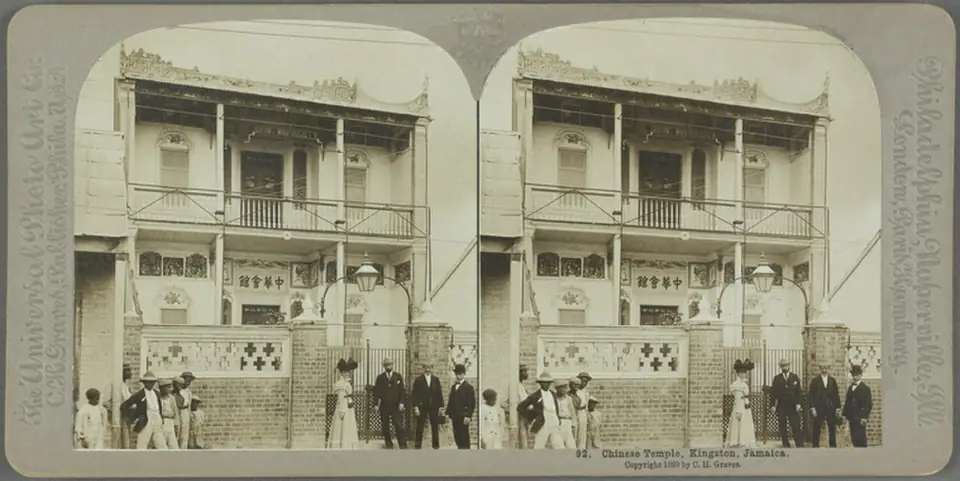
Source & credit
The paired view was made for a stereoscope. Look at the balcony, entrance, signs and people, then compare the two slightly different viewpoints. The original mount identifies the building as a Chinese temple in Kingston. It gives the community’s religious space a visible place in the city’s history; it does not identify each person photographed or tell us their migration history.
Shops and enterprise can be historically important without defining every member of a community. A family’s public role can also involve scholarship, sport, public service, cultural work and migration beyond Jamaica. A guide that reduces ancestry to a single occupational type misses the diversity it claims to celebrate.
Language and belonging did not remain sealed compartments
Communities living in Jamaica encountered Jamaican Creole and English alongside inherited linguistic and cultural practices. Descendants did not have to occupy an unchanged linguistic identity simply because an ancestor arrived from elsewhere. The language atlas consequently distinguishes heritage histories from claims that every present-day member speaks a particular ancestral language.
Belonging is made through schooling, work, neighborhood, family and public life as well as ancestry. Calling someone an influence on Jamaican culture can obscure that the person is Jamaican. The more accurate question concerns how people participated in creating a shared society while retaining different memories and institutions.
Put these histories into the national chronology
The chronology connects emancipation in 1838, indentured arrivals from 1845, Chinese Jamaican historical commemoration beginning with 1854, and the later struggles over representation and independence. These developments were not isolated chapters happening in separate societies. They unfolded within Jamaica’s changing labor economy and colonial institutions.
The story here is a foundation, not a census of every migrant community. It supplies a connected account of two important histories with explicit institutional sources. Further community histories should preserve the same standard: named people and organizations, a chronology and a distinction between migration, settlement and present-day identity.
The temple puts settlement in the picture
The Kingston stereograph below identifies a Chinese temple. Its presence changes the shape of this migration story. Recruitment and labour explain an arrival; a religious building directs attention to what people established afterward. People needed places to gather and institutions through which to organise life in Jamaica.
The photograph cannot name every person at the entrance. It can still keep the account from ending with the shopkeeper stereotype. Religious space, family life and the named contributions recorded in later community histories give settlement its own chronology. Indian and Chinese Jamaican histories belong within that larger making of society, with different routes of migration and different experiences, rather than as two interchangeable additions to a list of national influences. [1] [3]
Sources and notes
- Jamaica Information Service. Indian Arrival Day Celebration, May 2025: commemoration of the 1845 arrival at Old Harbour Bay. ↩
- Jamaica Information Service, Indian Heritage Day: 1845 arrival and present-day commemoration, May 2025. ↩
- Jamaica Information Service, Six Jamaicans to Receive Hakka Achievement Award: the 1854–2004 heritage exhibition and named contributors. ↩