Kenilworth: the sugar works behind the great-house view
Location: Kenilworth Ruins, Hanover, Jamaica
Explore area in Google Maps ↗Map search for the named place or area. Arrange the actual entrance, guide meeting point and access with your host; this is not a confirmed tour departure.
Hanover’s surviving industrial walls lead into crop accounts, changes of land use and the difficulty of finding workers in records organised around property.
The works come first
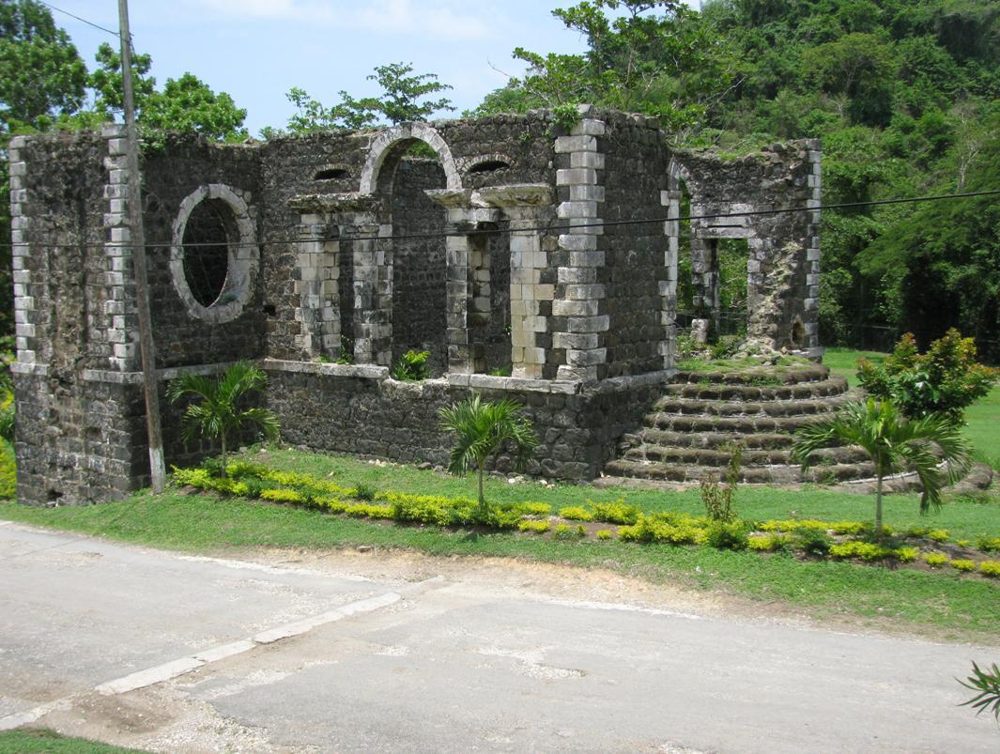
Kenilworth’s surviving walls invite a different kind of estate visit. Begin with the industrial buildings, then ask what the estate produced, who performed the work and what happened to the land after sugar. That order keeps the people and processes behind the picturesque stonework in view. The account books and the ruins answer different questions: one records quantities for an owner, while the other preserves parts of the place where production happened.
Source & credit
Maggotty before Kenilworth
The Jamaica National Heritage Trust identifies the earlier estate as Maggotty, appearing with Top River in the 1757 crop accounts. John Blagrove was then a minor, with Lachlan Shaw named as overseer. By 1810 the recorded sugar output was 231 hogsheads; the year ending December 1819 returned 89. These are separate recorded seasons, not a continuous measure of prosperity. The Trust does not establish why the property was later renamed Kenilworth. [1]
A return that counts people as property
A second document changes the emphasis. The 1818 Jamaica Almanac, transcribed by Jamaican Family Search, prints Hanover returns for the March quarter of 1817. Beside John Blagrove and Maggotty it lists 287 enslaved people and 119 livestock. The headings matter: those are two different columns, not a total workforce of 406. The reporting period also predates the publication year. [2]
The entry places enslaved people firmly within the estate’s history, but it does not name those 287 individuals, explain their relationships or identify their occupations. Children and adults cannot be separated from that single figure. Nor can we assume every person worked in the mill. A total constructed for property administration should be read as evidence of enslavement, not a substitute for the lives it compresses. The next step for family historians is to connect this property name with named registers and household records.
Read the crop accounts without smoothing them out
The Trust’s transcriptions allow a small comparison. Hogsheads, puncheons and casks are the units used in the records; they should not be treated as equal containers or silently converted into modern tonnes. Molasses and rum also represent different stages and products of the sugar economy. [1]
| Record | Sugar | Rum | Molasses |
|---|---|---|---|
| 1757 | 132 hogsheads | 43 puncheons | 50 casks |
| 1761 | 159 hogsheads | 36 puncheons | 53 casks |
What the walls can tell us
JNHT describes a two-storey mill building with curved stairs and elliptical windows, alongside a probable boiling-house complex. A space interpreted as accommodating a waterwheel and a possible connection toward a stream remain interpretations, not proof of an intact working system. [1]
On an arranged visit, compare openings, levels and the relationship between the buildings. Industrial work required movement between processes, so a doorway or difference in floor height can be more revealing than a decorative detail. The surviving fabric should guide questions rather than encourage an imagined demonstration of machinery that is no longer there. Do not enter unstable rooms or climb masonry to obtain a better photograph.
The land did not remain a sugar estate forever
The later property entries quoted by JNHT describe pasture, pimento, woodland and land no longer cultivated, followed by tenant occupation and coconut and banana growing. That sequence broadens the story beyond a single crop. It does not establish every tenant’s contract, income or access to land. [1]
The distinction matters when comparing Kenilworth with Frome. A surviving sugar work and a twentieth-century factory dispute belong to related but different labour histories. Here, the early returns document slavery; later cultivation requires its own evidence about tenancy and paid work. Keep both histories visible without treating emancipation as the end of the story or assuming that a change of crop automatically changed the distribution of power.
Sources and notes
- JNHT, Kenilworth Ruins: crop-account transcriptions, building interpretation and later property entries. Figures here follow that transcription, not a new inspection of the manuscripts.
- Jamaican Family Search, transcription of the 1818 Jamaica Almanac, Hanover: returns for March quarter 1817; column headings distinguish enslaved people and livestock.