Titchfield: the port, the people and the hotel behind the houses
Location: Titchfield, Port Antonio, Portland, Jamaica
Explore area in Google Maps ↗Map search for the named place or area. Arrange the actual entrance, guide meeting point and access with your host; this is not a confirmed tour departure.
Between Port Antonio’s two harbours, a fort, school, homes and hotel history reveal how defence, banana shipping and unequal tourism shaped a district.
Stand back from the individual houses and Titchfield begins to explain itself. This narrow part of Port Antonio lies between two harbours. Fortifications, homes, school premises and the memory of a large hotel share the same small landscape. Ships did not just provide a picturesque background. They connected the peninsula to colonial defence, the banana trade and a tourism business that offered different kinds of welcome to different people.
Source & credit
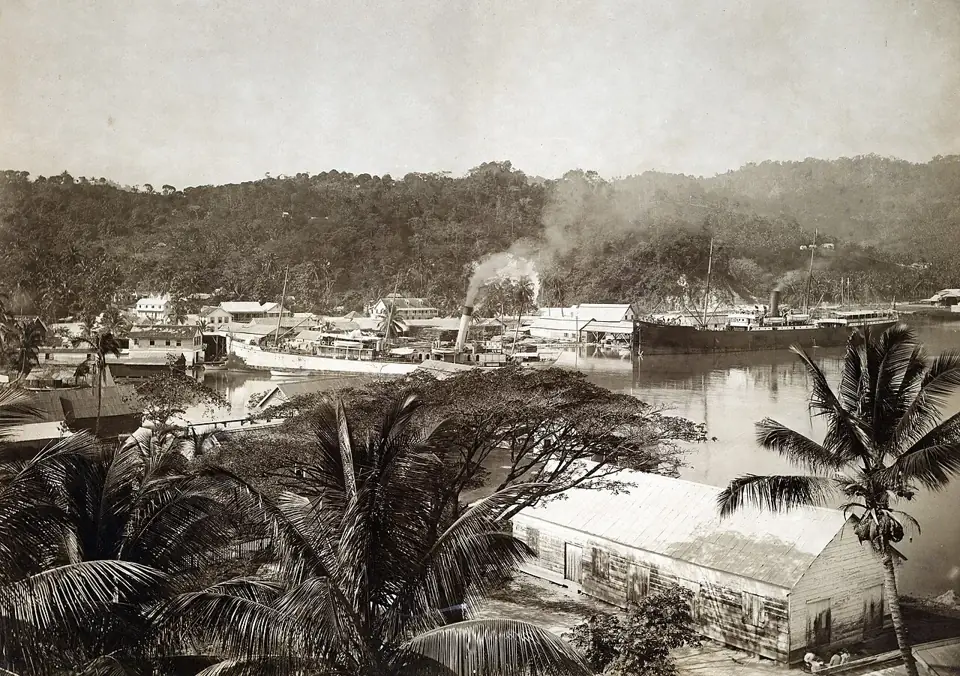
Look closely: Follow the waterfront buildings, vessels and hills. This working harbour view places Titchfield’s houses beside shipping infrastructure rather than treating the peninsula as an isolated postcard.
Why this piece of land mattered
Titchfield separates Port Antonio’s eastern and western harbours. Together with Navy Island, it shelters the deeper western harbour from prevailing easterly winds. JNHT describes it as the town’s earliest English settlement and records that high tide once cut it off from the town centre, before filling joined the areas. Geography made this a useful place to occupy and defend. It also shaped the relationship between streets, houses and the waterfront. [1]
The harbour photograph above makes that working setting visible. The waterfront has buildings and vessels, with hills behind them. Follow that relationship when looking at a handsome veranda: the house belonged to a port town, where people moved goods, maintained property and worked around shipping. The source does not name everyone in the scene, and appearance alone cannot tell us their occupations. But it does keep the town’s built history attached to the water.
Fort George looked inland as well as out to sea
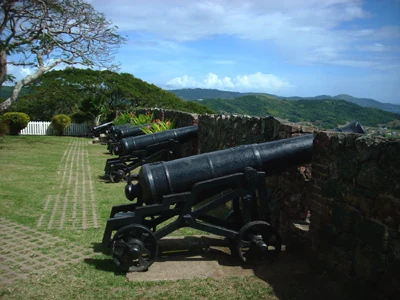
Colonial authorities discussed a fort in 1728–29, and Christian Lilly was assigned the building task in 1728. JNHT identifies two purposes: defence against a possible foreign invasion and action against Maroons in the surrounding country. The second purpose changes the view. These guns were part of a colonial system trying to control people who had escaped slavery and maintained communities beyond plantation authority. [2]
The Trust describes a fort designed for 22 guns, with walls ten feet thick, and records its use during the First World War. It also notes the later use of the barracks as Titchfield High School classrooms. Military and educational histories therefore meet in the same premises. That reuse is more revealing than treating the fort as a relic: buildings continued to serve purposes their original designers had not intended. [2]
Source & credit
DeMontevin Lodge has a named builder
One house brings the larger architectural story into focus. DeMontevin Lodge was built in 1881 by David Gideon, later Custos of Portland in 1923. JNHT identifies a Victorian mixture with gingerbread details and decorative ironwork designed and cast in Scotland. Its interior description includes carved doorway mouldings and tray ceilings. Those are documented particulars; they tell us more than simply calling the house “colonial charm.” [3]
The imported ironwork links a Port Antonio residence to overseas manufacture. Set that beside the district’s vernacular buildings, Georgian influences and different Victorian forms. Titchfield did not emerge from a single design plan or one moment of prosperity. It accumulated houses of different scale and treatment. For an exterior walk, compare roofs, galleries and the way a building meets the street, without assuming that every interior described in a heritage record is open to visitors. [1] [3]
Bananas and a railway widened the connections
The Heritage Trust places Lorenzo Dow Baker’s arrival in 1870 within the development of Port Antonio’s banana trade and tourism. The wider transport system mattered too. A 54-mile railway extension from Bog Walk reached Port Antonio in 1896, according to the National Library’s railway history. Railways connected the town more closely to an inland network; ships connected its harbour to overseas markets. [1] [4]
This was an expensive and uneven process. The National Library records the financial failure of the West India Improvement Company and government takeover in 1900. The railway’s arrival should not be mistaken for proof that every associated enterprise succeeded. What it demonstrates is the effort and capital invested in making movement possible. Port Antonio’s commercial story depends on transport infrastructure as well as a celebrated sea captain. [4]
United Fruit sold the journey as well as the destination
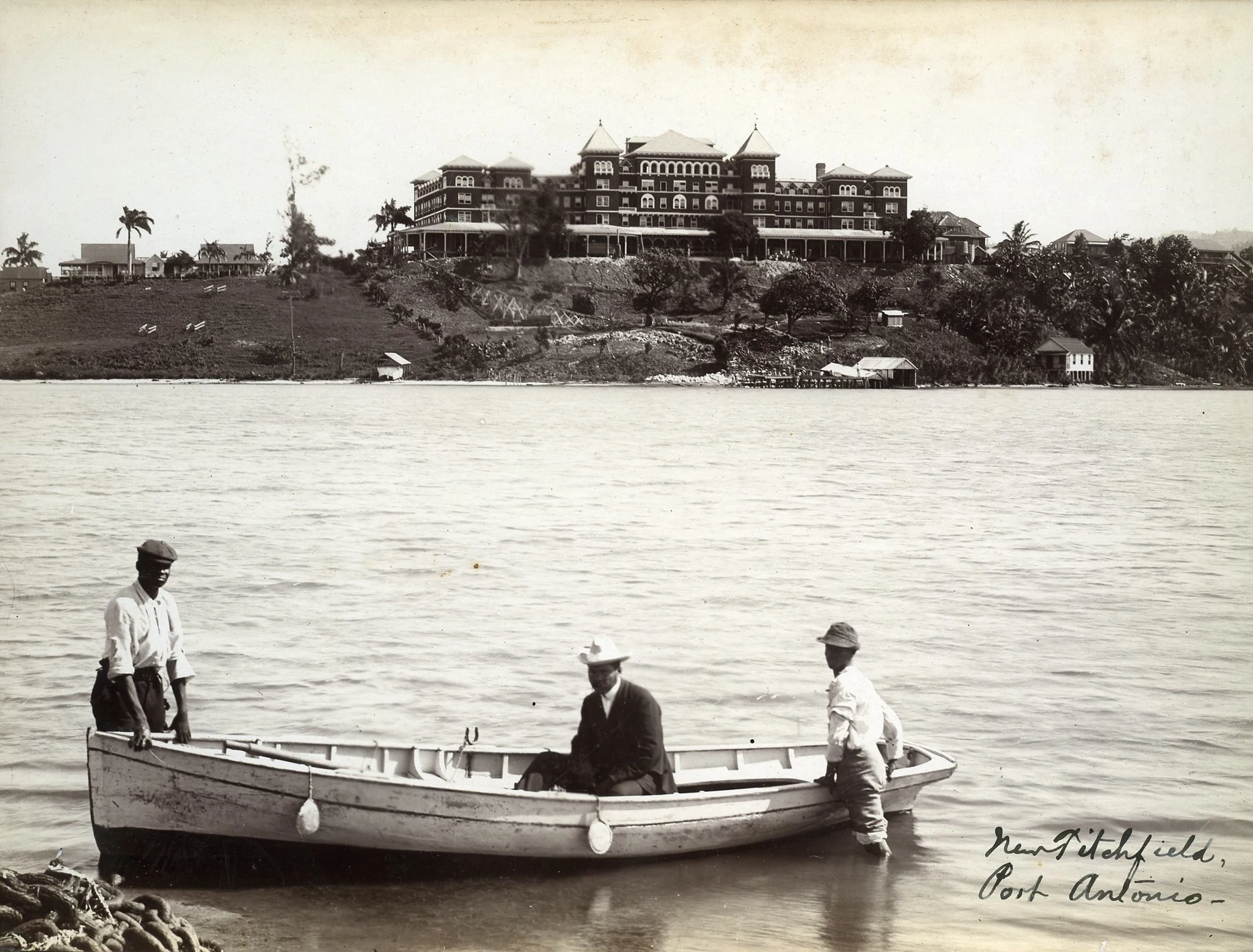
A 1904 United Fruit steamship brochure, Jamaica, the Summer Land, shows how the company presented a complete holiday. Its Titchfield Hotel account announced a large replacement hotel, with part of the earlier building retained as an annex. It advertised plans for 200 sleeping rooms and 60 private baths. These were the company’s announced arrangements, written to attract travellers, rather than an independent inspection of the finished building. [5]
Source & credit
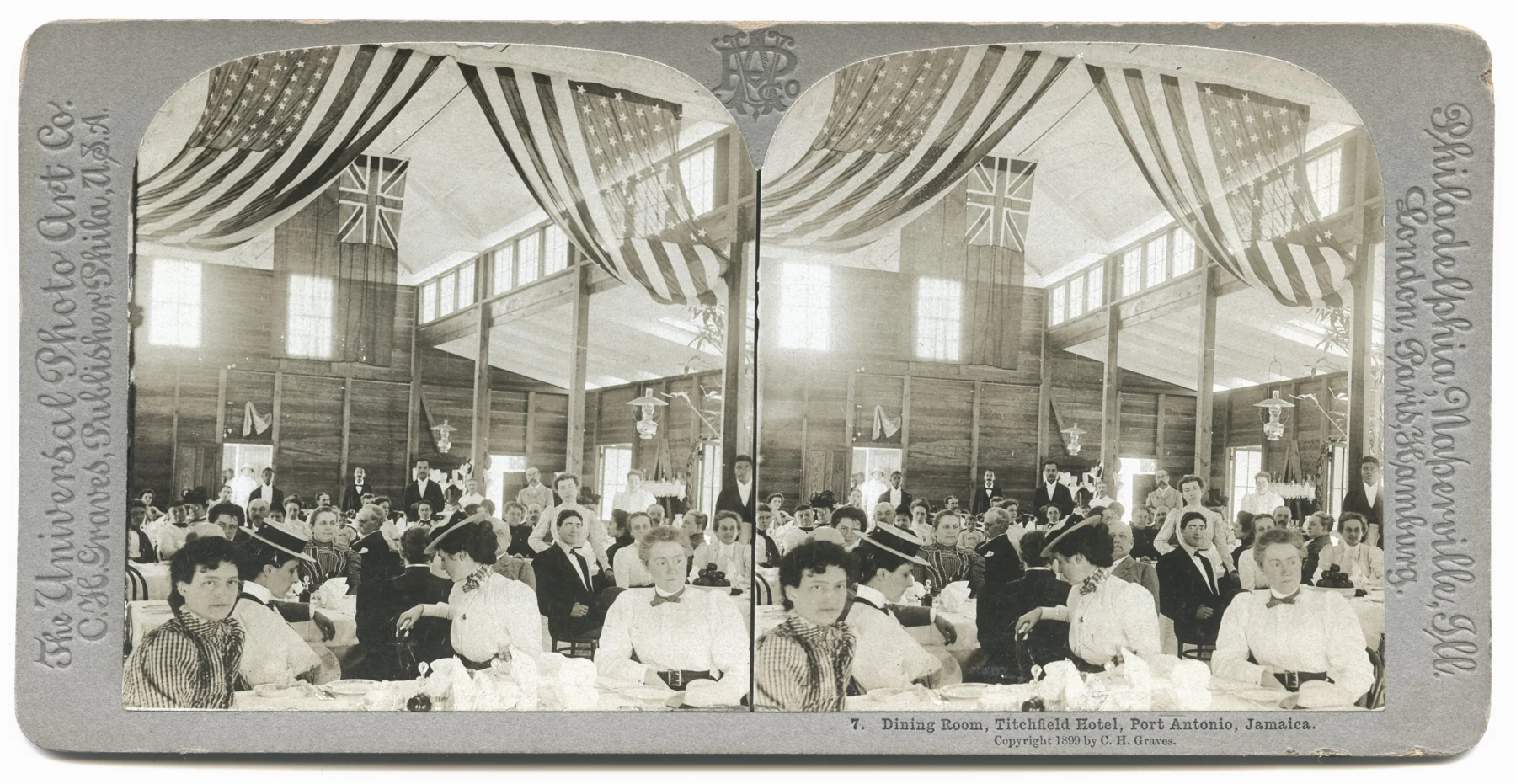
The brochure described arriving by steamer, being taken uphill by carriage and finding rooms designed for tropical comfort. Read it as a sales document. The guest’s route was being organised before arrival: sea passage, transfer, accommodation and leisure could be marketed together. The large hotel in the Duperly view and the earlier dining-room stereograph below make that business tangible, while documenting different moments in its development. [5]
Source & credit
Comfort for some depended on exclusion of others
Historian Alex Goodall’s research complicates the gracious-hotel picture. Drawing on period accounts and earlier scholarship, he describes United Fruit importing American service staff for the Titchfield and excluding Jamaicans from both its workforce and its property. Its integrated shipping and advertising supported an American-oriented resort enclave. This was not simply a local port sharing equally in a new visitor economy. [6]
That evidence belongs beside the hotel images. The photographs show selected spaces and people; they cannot establish the rules governing everyone outside the frame. Nor should one hotel’s arrangements be projected onto every Jamaican business. Goodall’s account identifies a particular way commercial power and racial hierarchy operated within the early tourism trade. The distinction makes the local history more precise. [6]
Read a district that continued to change
Titchfield became a protected National Heritage district on 16 April 1998. Its significance lies in the combination: vernacular houses, an imposing lodge, a fort reused for education, a working waterfront and evidence of an unequal resort economy. Follow more than the grandest building. The most useful walk asks how these neighbouring places related to one another and who could work, live, study or enter there. [1]
Sources and notes
- Jamaica National Heritage Trust: peninsula geography, settlement, architectural range, Baker and protected designation, 16 April 1998.
- Jamaica National Heritage Trust, Fort George: planning and Lilly assignment, colonial purposes, armament, First World War and classroom reuse.
- Jamaica National Heritage Trust, DeMontevin Lodge: David Gideon, 1881 building, Scottish ironwork and interior features; current operation not independently established.
- National Library of Jamaica, The History of Railroads/ways in Jamaica, pp. 2–3: 1896 Bog Walk–Port Antonio extension and 1900 government takeover.
- United Fruit Company’s Steamship Lines (1904), Jamaica, the Summer Land, hotel section, pp. 26–29; Library of Congress. Company promotional source; room totals were announced plans.
- Alex Goodall (2023), Passing the Torch? Journal of World History, 34(1), 15–45, especially pp. 35–36. Research on imported service staff, racial exclusion and United Fruit’s integrated tourism network; DOI 10.1353/jwh.2023.0001.
Historical and image records reviewed 26 October 2026. Image dates describe the photographed or published view, not present conditions. Current access must be confirmed directly.