Ward Theatre: the city learned to see itself on stage
Location: Ward Theatre, Kingston, Jamaica
Explore area in Google Maps ↗Map search for the named place or area. Arrange the actual entrance, guide meeting point and access with your host; this is not a confirmed tour departure.
A downtown theatre connects rebuilding after the 1907 earthquake with pantomime, Jamaican language and the people who made public performance possible.
The theatre before the Ward
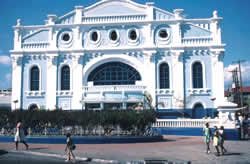
JNHT places theatrical use of this downtown site in the 1770s and identifies the Kingston Theatre and Theatre Royal as predecessors. The latter was destroyed in the 1907 earthquake. The Ward therefore belongs to a history of replacement as well as performance: a venue could disappear while the city’s desire for a stage continued. A photograph of the present facade cannot illustrate an eighteenth-century audience or the building lost in the earthquake. [1]
The stage changed who could recognise themselves in public
A theatre does more than house a performance. Its programme helps decide whose language, stories and bodies enter a prestigious public setting. The Jamaican pantomime history makes that choice visible, bringing local speech and familiar cultural material into a theatrical form with its own inherited conventions.
That shift gave audiences more than entertainment with a Jamaican reference attached. It created a place to recognise and argue about shared experience. Writers, performers, designers and musicians made the transformation through their work. The Ward’s national significance consequently lies in what people did on and around its stage, as well as in the city’s decision to build and preserve it. [2] [4]
Source & credit
A gift became a public institution
Colonel Charles Ward, then Custos of Kingston, presented the theatre to the city in 1912. The name records the benefactor, but a theatre’s cultural life is made by more people than the person who financed it. Actors, musicians, stage crews, designers, ticket sellers and audiences turn a building into an institution. The distinction matters in a guide: we can recognise the gift without letting one biography stand in for a century of Jamaican performance. [1]
Pantomime did not begin in 1951
The Little Theatre Movement’s own chronology starts the pantomime tradition in 1941 with Jack and the Beanstalk. Its account connects productions with both the Ward and the later Little Theatre. One municipal summary associates a Boxing Day opening at the Ward with 1951; that must not replace 1941 as the origin of LTM pantomime. A company’s beginning, its use of a particular venue and an annual opening custom are separate questions. [2] [3]
Look at the work behind the familiar titles
LTM’s first-decade record identifies Vera Bell as writer of Soliday and the Wicked Bird in 1943, Albert Huie as its designer and George Moxey as orchestral arranger. For Bluebeard and Brer Anancy in 1949 it credits Louise Bennett and Noel Vaz as writers. These credits show a collaborative art involving text, image, music and stagecraft. They make the history more concrete than a list of famous people said to have appeared at the theatre. [4]
Anancy belongs to a change in what the stage could contain
Compare the early titles Jack and the Beanstalk and Cinderella with the explicitly named Brer Anancy of 1949. The contrast offers a starting point for studying how an inherited theatrical form incorporated Jamaican subjects and language. It does not prove that every early production lacked local meaning or that one play completed the transformation. Read scripts, programmes and reviews together. A title can identify a direction; the actual performance needs more evidence.
Listen to language beyond the building
The guide’s Miss Lou and language articles provide a connected listening route. Hear the way a later recorded voice uses timing, address and familiar situations, then return to the pantomime credits. Do not label an unrelated recording as sound captured at the Ward. The connection is interpretive: Jamaican language can shape an audience’s recognition on a stage as well as on a record. Keeping the recording’s own date and setting visible makes that comparison useful.
A later photograph is a dated witness
Steven Brandist’s Flickr image is catalogued as taken on 18 January 2025. Open it beside JNHT’s undated facade view and compare visible details. The photographer’s commentary includes quotations from other sources; those are not independent proof of the theatre’s full history. Nor does a photograph establish today’s restoration progress or a performance schedule. The image is useful precisely as one identified later view, with its all-rights-reserved label retained. [5]
Build a programme rather than a celebrity list
Choose one first-decade production and make a small credit sheet: writer, director, designer, music and other named roles. Add a column for what the surviving programme does not tell you, including ticket prices and audience composition. Then describe how a public stage could connect cultural recognition with the practical work of producing a show. For a downtown visit, let the facade become the beginning of that enquiry, not the entire history.
Sources and notes
- Primary institutional account identified and attributed in the narrative. ↩
- Little Theatre Movement: pantomime history, beginning in 1941, and the Ward/Little Theatre context. ↩
- Kingston and St. Andrew Municipal Corporation: theatre account. Its 1951 sentence is not used as the origin date of LTM pantomime; earliest-site dates also differ from JNHT. ↩
- LTM first-decade production records: titles, years and named creative contributors. ↩
- Steven Brandist, Ward Theatre, 18 January 2025, Flickr. All rights reserved; linked for comparison, not copied. ↩