Hibbert House: the slave trade behind a Kingston landmark
At 79 Duke Street, an elegant merchant’s house carries a harder history: confinement, sale, colonial command and the power to decide whose past gets preserved.
Look behind the frontage
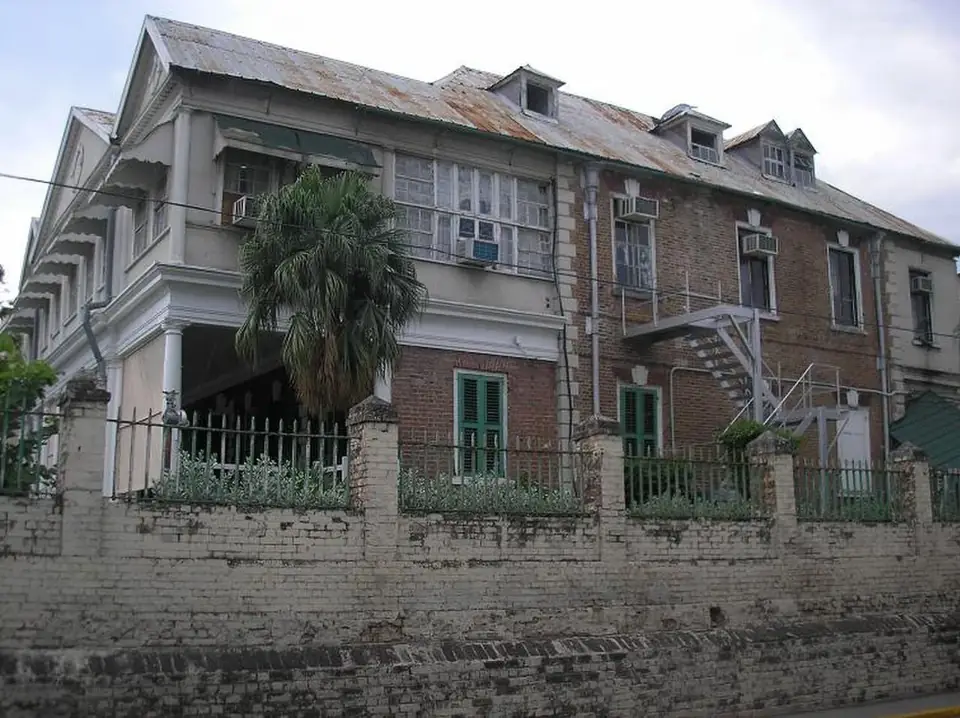
Start with the red brick, pale stone corners and orderly façade. Then ask what the money behind them bought. JNHT dates Thomas Hibbert’s house to 1755 and describes its Georgian symmetry, basement, upper rooms and rear courtyard. It is a surviving urban building, not a plantation great house. That distinction takes slavery out of the cane field and puts it in the city, where merchants, storage, credit and shipping connected African captivity with Jamaican estates. [1]
Domestic elegance could be financed through human sale
Hibbert House brings a merchant’s comfortable residence into the same account as the trafficking and confinement of enslaved people. Those histories belong together because commercial success was not separate from the means by which money was made. The attractive façade can conceal that relationship if its story begins and ends with architectural style.
Later public uses add another layer rather than cancelling the earlier one. A building can become part of the machinery of government while retaining an origin in private wealth accumulated through coercion. Understanding both makes a Kingston landmark more revealing: the material city inherited structures, resources and prestige from an unequal economy, then put them to subsequent purposes. [source]
Source & credit
Look closely: The street frontage survives; the picture does not show the cellar or authenticate the accommodation of enslaved people. Compare it with the nineteenth-century illustration below.
A merchant’s house could also hold captives
The scholarly study Slaves and Slavery in Kingston, 1770–1815 identifies Hibbert as a major slave trader. Drawing on architectural research, it discusses merchant-house cellars used for confinement, including Hibbert House, and the movement of captives into rear yards for sale. The article interprets a probable route from rear piazza to side gate and Duke Street; that is a reconstruction from evidence, not an eyewitness film or proof of every room’s use on every date. [2]
Follow the transaction through the city
The same study records the Jamaican Assembly’s 1792 requirement that newly arrived Africans be sold ashore. A shore-based transaction could pass through a warehouse, yard or merchant property before a purchaser moved someone inland. The physical nearness of polite rooms and places of confinement is the disturbing lesson. A person admired as a successful merchant could profit by separating other people from their families. The house makes it possible to examine the relationship between domestic comfort and commercial violence rather than treating them as unrelated histories. [2]
Authority changed occupants
JNHT describes the house’s purchase for military use in 1814 and its later role in colonial government. It links military residents to the suppression of the 1831 uprising and the 1865 Morant Bay uprising. Those episodes happened after the initial construction and must be dated separately. A building can carry several forms of power without every event occurring in its basement or courtyard. Its later government history did not erase the merchant history underneath it. [1]
What survives, and what is missing
The inheritance here is a building and an urban pattern of wealth and authority. It is not evidence that present occupants endorse the trade that enriched Hibbert. Nor does the façade tell us the names, languages or family ties of the people once confined. Read the house beside records of sales and movement: architecture locates power, while individual records may recover people. Keeping those two scales together produces a more honest downtown history than a list of distinguished residents.
A different way to read heritage
Imagine writing two labels for the same frontage. One describes masonry and style; the other explains who could enter freely and who could be held. Both concern the building, but only the second makes freedom of movement visible. The question is useful beyond this house: when a guide praises prosperity, identify the labour and transactions that made that prosperity possible. Do not turn an unnamed captive into a fictional character simply to make the story vivid.
Source & credit
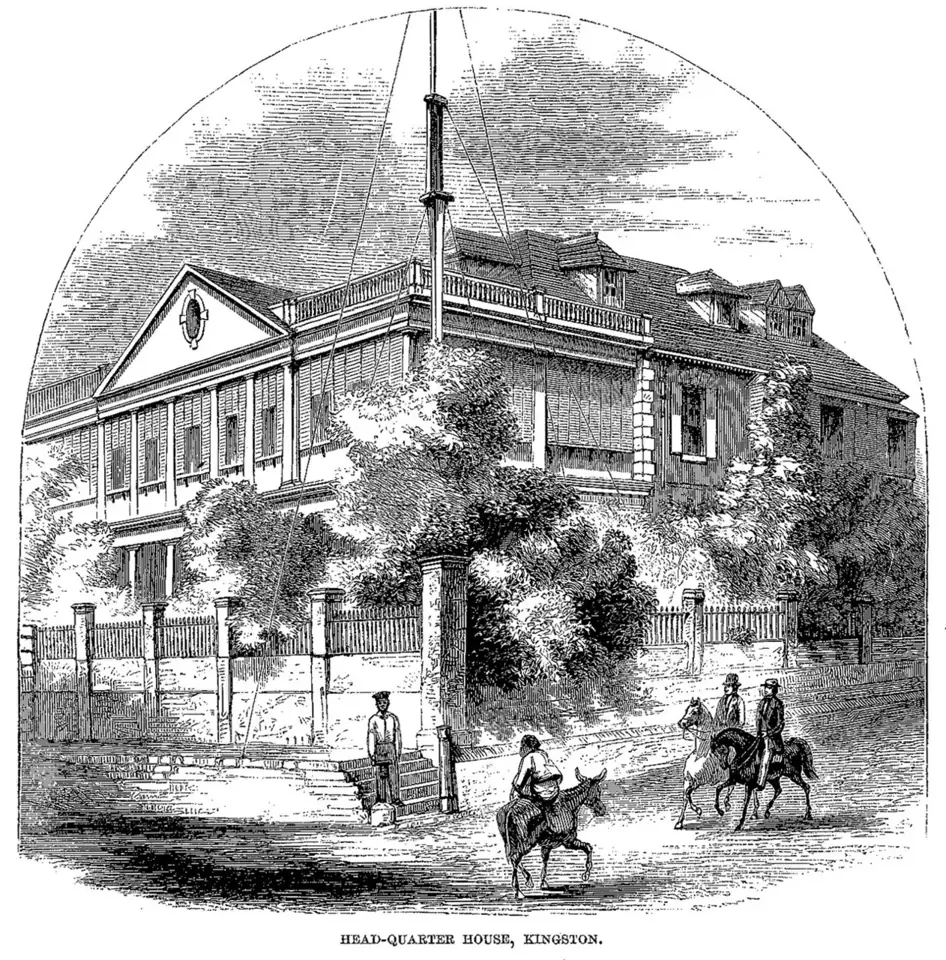
Look closely: Compare the stair and street edge with the modern photograph. The illustration was published after emancipation; it is not a photograph of a slave sale.
Try the history yourself
Trace five spaces on paper: harbour, merchant premises, cellar, yard and street. Mark which connections the scholarly account documents and which it interprets. Write a caption that mentions both architectural survival and the slave trade.
Explore with care
Begin with a locally guided downtown history walk. Ask JNHT about current access before assuming interiors are open. A street view can support discussion of the façade; it cannot verify cellar access or a historical sales route.