HISTORY RECONSIDERED · SECOND RUN · 19 OF 19
The postcard Jamaica was made, not simply found.
Jamaica’s beaches and hills were real, but the familiar tropical-paradise image was carefully selected and sold. Old photographs reveal work as well as scenery, if we look beyond the view chosen for visitors.
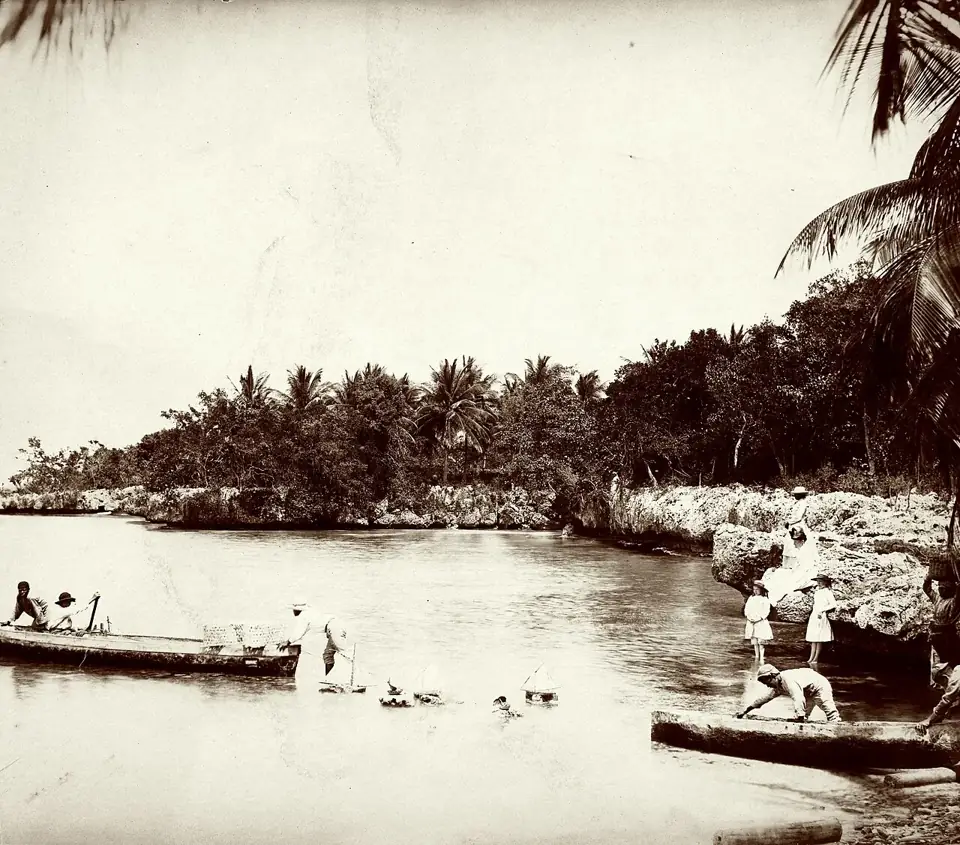
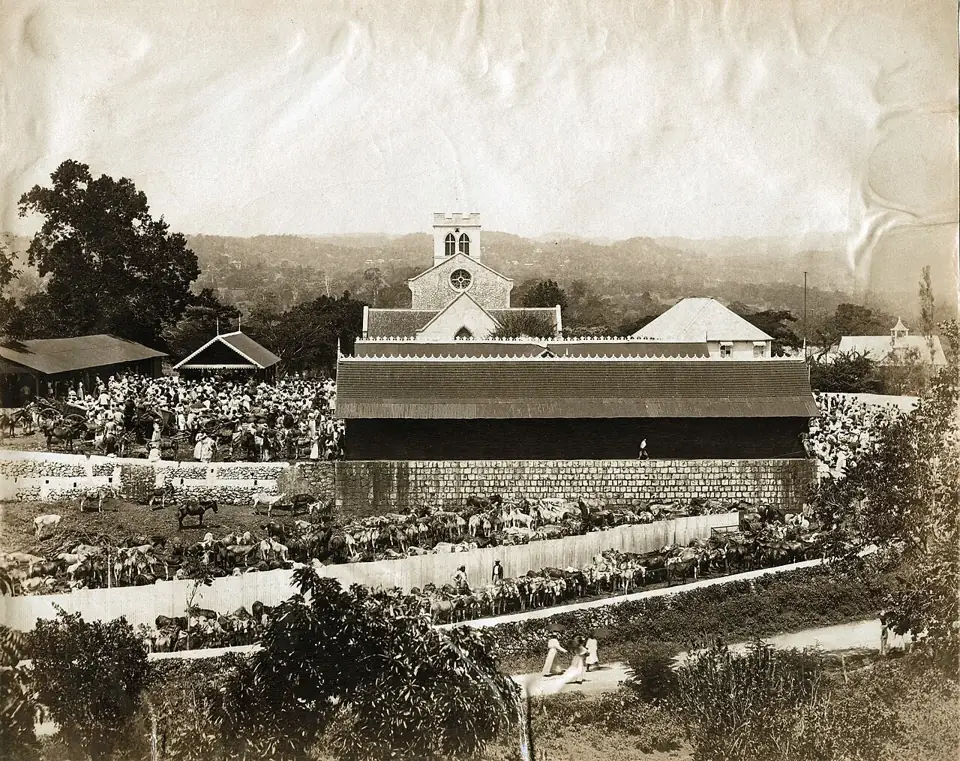
A photograph of fishing boats at Runaway Bay gives us a beautiful north-coast view. It also shows a place of work. Move inland to a photograph of Mandeville market and the crowded trading space tells another story. Both are Jamaica. Choosing only one changes the country a viewer is invited to imagine.
Art historian Krista Thompson traces how photographs and artwork helped market Jamaica and the Bahamas as tropical paradises from the late nineteenth century. Promoters selected scenes for overseas audiences. The landscape was real; the claim that a chosen view represented the whole country was made. [1]
Look at the fishing before calling it scenery
Source & credit
Look closely: Notice the boats and shoreline activity. Fishing gives this resort coast another history; the photograph does not identify every person or establish their circumstances.
Dr James Johnston’s Runaway Bay picture includes boats and shoreline activity. The catalogue suggests approximately 1890, with an available date before December 1921. It does not tell us the workers’ earnings, land rights or opinions of being photographed. Those questions remain outside the picture. [3]
A visitor may first notice the coast. A resident making a living there may have seen a workplace. The photograph invites both kinds of attention, even though we cannot recover each person’s thoughts.
Put the market beside it
Source & credit
Look closely: Compare the town setting and crowded foreground with the 1891 Linstead image. These views of different markets show the trading world in which the song’s story belongs.
Johnston’s Mandeville market photograph shows a different working landscape. Its approximate date is around 1880. It is neither the same place nor a matched view of the same year. Comparing the scenes still helps us see how selection works: shorelines and inland towns create different expectations. [4]
The comparison is ours. It does not prove that Johnston intended the market as a criticism of tourism. An editor makes another choice each time these photographs are selected and placed together.
The picture could change the place
Thompson’s research goes beyond advertising. Her publisher’s account describes hoteliers importing plants to make landscapes fit the tropical image, and examines exclusion from tourist spaces. What visitors expected could influence what operators built and who could use it. [1]
That is a history of particular decisions, not a claim that every palm tree was imported or every hotel followed one policy. The important question is how a marketed image acquired power in everyday life.
Hospitality also had a public face
Elizabeth Manley’s research on Air Jamaica examines flight attendants and other women in the promotion of a harmonious national identity between 1966 and 1980. The medium had changed from the postcard to airline promotion, but people were still being selected to represent the destination. [2]
Who looked welcoming? Who represented modern Jamaica? Who remained unseen? Those questions help us read a campaign as a choice about national identity, rather than a complete description of the country.
This guide makes choices too
Tony’s Guide uses attractive pictures. We therefore have the same responsibility to show more than a beach, a great house and a performer. Markets, ordinary towns, households, work and political history belong beside the attractions.
A beautiful view does not need to be rejected. It needs a larger story around it, with dates, places and credits that let readers understand what they are seeing.
Look again
Compare Runaway Bay’s fishing scene with Mandeville’s market. What different story of Jamaica would each picture tell a visitor?
Scholarship and evidence
- Thompson, K. A. (2006). An eye for the tropics: Tourism, photography, and framing the Caribbean picturesque. Duke University Press. Publisher description and contents. Original publication 2006; publisher currently lists the paperback March 2007. ↩
- Manley, E. S. (2022). Runway hospitality: Air Jamaica’s “rare tropical birds” and the embodied gender and race politics of tourism, 1966–1980. Hispanic American Historical Review, 102(2), 285–319. Journal abstract and bibliographic record. https://doi.org/10.1215/00182168-9653504 ↩
- Johnston, J. Fisher boys, Runaway Bay, Jamaica. Public-domain image record. Approximate dating retained; photograph is not proof of every subject’s circumstances. ↩
- Johnston, J. Mandeville Market, Jamaica, approximately 1880. Public-domain photograph record. Image and catalogue consulted; approximate date retained. Comparative interpretation is by Tony’s Guide. ↩