HISTORY RECONSIDERED · SECOND RUN · 18 OF 19
Before Windrush: Jamaicans building lives abroad.
Long before Windrush arrived in Britain in 1948, Jamaicans were travelling for work and building lives elsewhere. Panama’s canal records reveal workers, families and a racially divided system of wages, housing and services.
Jamaicans were among the West Indians who travelled to Panama for work on the canal. They entered a world of labour contracts, wage differences and segregated accommodation. They also formed families and communities. Birth, marriage and death records sit beside employment files in the history of that movement. [2]
This happened before the Empire Windrush arrived in Britain in 1948. That voyage remains important, but it cannot be the beginning of the whole Jamaican diaspora. Britain was one destination in a much wider story.
Work carried people around the region
Historian Lara Putnam follows African-descended working-class migrants from the British Caribbean into Panama, Cuba, Venezuela and North America after emancipation. People moved through a regional world of jobs, relationships and restrictions. Her research covers several Caribbean populations, not Jamaicans alone. [1]
The change in perspective is simple: begin with the routes people took, rather than assume that every migration story leads to one British port.
The canal was also a place to live
US National Archives guidance identifies Jamaica among the places supplying West Indian workers to the Canal Zone. It points researchers to sailing lists, contracts and employment records, but also to records of family life. A canal history can therefore follow households as well as engineering. [2]
Source & credit
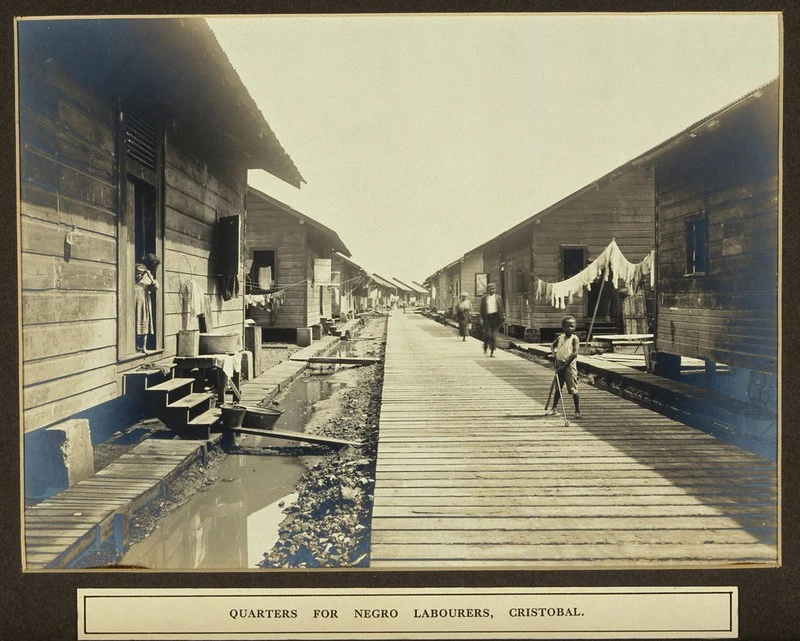
The photograph shows workers’ quarters at Cristobal around 1910. The catalogue identifies West Indian and Panamanian workers. It does not establish the nationality of each pictured person. Keeping that distinction protects a shared regional history from becoming an invented portrait of one Jamaican family. [3]
“Gold” and “silver” divided more than pay
The Canal Zone’s gold and silver payrolls helped organize an unequal system. Patrice Brown’s archival account describes differences in housing, schools, recreation and services as well as employment benefits. Race shaped that system, although citizenship and employment categories could make individual cases more complicated. [4]
A move abroad could offer earnings while putting a worker inside another hierarchy. Opportunity and discrimination could be part of the same journey. We need both the job and its conditions before deciding what a particular move meant for a family.
Some lives are harder to trace
The archives preserve less extensive employment records for West Indian workers than for white employees. That makes research harder; it does not make those workers less important. A failed name search may reflect gaps in the records, spelling differences or the wrong series. [2]
Start with a named person and a place or date. Then compare the available employment and family records. Do not turn an empty search result into a conclusion that someone never went to Panama.
People carried ideas as well as luggage
Putnam links migrant networks and popular culture with Black internationalism and anti-colonial politics. Overseas movement created connections through which people could exchange news and ideas, not simply send wages home. [1]
Windrush belongs in that longer history. Panama and the wider Caribbean basin help us see what one famous ship can leave outside the frame.
Look again
Look at the workers’ quarters and the archive’s record types. What would you need to trace a particular Jamaican family’s journey to Panama?
Scholarship and evidence
- Putnam, L. (2013). Radical moves: Caribbean migrants and the politics of race in the Jazz Age. UNC Press. Publisher account. Regional findings are not treated as exclusively Jamaican. ↩
- Brown, P. (2014). In celebration of 100 years of the Panama Canal: West Indian canal employee records. US National Archives. Archival guidance consulted; no individual worker record or family linkage claimed as established. ↩
- Wellcome Collection. Panama Canal workers’ quarters, Cristobal, approximately 1910. Reference 562002i. Catalogue description consulted. Nationality of individual pictured people is not established. ↩
- Brown, P. C. (1997). The Panama Canal: The African American experience. Prologue, 29(2). US National Archives. Full archival essay consulted, especially gold/silver roll, citizenship and facilities. Its African American cases are distinguished from Jamaican and other West Indian workers. ↩