HISTORY RECONSIDERED · SECOND RUN · 17 OF 19
Black Jamaicans helped make Christianity their own.
George Liele came to Jamaica in 1783 and helped build Black Baptist congregations. His letters describe schoolbooks, building costs, baptisms and land purchases. Christianity’s Jamaican history includes the people who organized it, not only colonial churches.
George Liele arrived in Jamaica in 1783 after the upheaval of the American Revolution. His passage involved a loan and indentured service. Once established, he supported himself while developing a ministry. His journey gives Jamaican church history a different beginning from the arrival of a European missionary. [2]
Liele was a Black preacher who helped people form congregations, learn and build. His story does not erase the churches’ connections to colonial power. It shows that Black Jamaicans were also making religious institutions of their own.
A congregation needed more than a sermon
Writing from Kingston on 12 January 1793, Liele described building costs, books for a school, baptisms and land purchased in Spanish Town for a burial ground and meeting house. The details survive in a later printed collection of correspondence. They are his reports to supporters, rather than audited accounts, but they show the practical work behind a congregation. [3]
A letter dated 12 April names Thomas Nichols Swigle as a deacon, schoolmaster and helper appointed with the church’s consent. Teaching and organization depended on people with responsibilities beyond the pulpit. [3]
The story reaches across Jamaica
Noel Leo Erskine’s research places Liele’s work in Kingston and Spanish Town alongside Moses Baker’s Baptist work in western Jamaica. It also follows connections beyond the island. Black religious leadership travelled through relationships, not simply through a one-way transfer of European beliefs to passive recipients. [1]
Source & credit
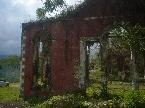
Look closely: Trace the surviving arches and broken wall edges. The ruin gives material form to a church history; the photograph does not establish who laid a particular brick or when a later fire occurred.
At Salter’s Hill in St. James, JNHT attributes the church’s 1825 construction to enslaved Africans. The pictured ruin is a later view of that site, not Liele’s Kingston meeting house. It brings another kind of labour into view: the people who physically built a place of worship. [4]
Why Liele’s date matters
Liele’s journey preceded William Carey’s better-known overseas mission. The Boston University biography uses this chronology to challenge a familiar Baptist origin story. Credit becomes more accurate when Liele is included; there is no need to turn him into the sole founder of all Jamaican Christianity. [2]
Church power and Black initiative coexisted
Anglican institutions were tied to colonial taxation and government. But the history of an established church cannot explain every preacher, denomination or congregation. People living within the same unequal society could use religious organization for different purposes.
The letters show a community acquiring land, teaching and arranging burial. Those actions matter alongside doctrine. They tell us how people made a shared life, even when the records cannot recover every member’s beliefs.
Look for the congregation
At a historic church, the memorial may name a minister or benefactor. Ask who supplied the labour, kept the school going and formed the congregation. Liele’s correspondence offers one answer: people were organizing and making decisions together.
Jamaican Christianity therefore includes both colonial authority and Black initiative. Keeping those histories together is more informative than treating the whole faith as either an instrument of oppression or a simple story of liberation.
Look again
Read the account of Liele’s letters. Which ordinary tasks made a congregation possible, and whose work disappears when we remember only a preacher’s name?
Scholarship and evidence
- Erskine, N. L. (2022). George Liele: Liberated slave and African American Baptist missionary to Jamaica. Missiology, 50(1). Journal abstract and bibliography; first published online 2021, issue year 2022. ↩
- Neely, A. (1998). Liele, George. In G. H. Anderson (Ed.), Biographical dictionary of Christian missions (pp. 400–401). Biography reprinted by Boston University consulted. Linked primary-source bibliography identified, not claimed as fully read. ↩
- Letters showing the rise and progress of the early Negro churches of Georgia and the West Indies. (1916). The Journal of Negro History, 1, 69–92. Public-domain re-publication consulted through Project Gutenberg; Kingston letters dated 12 January and 12 April 1793. This is a later transcription, not the original manuscript. ↩
- Jamaica National Heritage Trust. Salter’s Hill Baptist. Institutional historical account and later site photograph consulted; maker and date not recorded. ↩