HISTORY RECONSIDERED · SECOND RUN · 16 OF 19
Obeah: what a police case reveals about colonial power.
In a 1909 Kingston prosecution, marked coins helped police build a case against William Augustus Bruce. The episode opens a larger story: how colonial law decided which spiritual practices counted as religion and which became crimes.
In Kingston in 1909, a client working with police paid William Augustus Bruce using marked coins. The money later appeared as evidence at his trial. Historian Diana Paton uses the prosecution to show how an accusation of Obeah was built through a police operation and a courtroom. [2]
The coins were concrete evidence of a payment. They were not a window into every belief or action of the people involved. The story asks us to look behind the label and follow what the authorities actually alleged and proved.
Who decided what Obeah meant?
Obeah has not carried one fixed meaning through Jamaican history. Paton’s research traces changing laws and political arguments around it. A healer’s practice, a neighbour’s allegation and an official charge could become entangled under the same word. [1]
That matters because the legal label could decide how a person was seen before the details of the case were heard. Studying the accusation is part of recovering the person beneath it.
The law reached beyond a harmful act
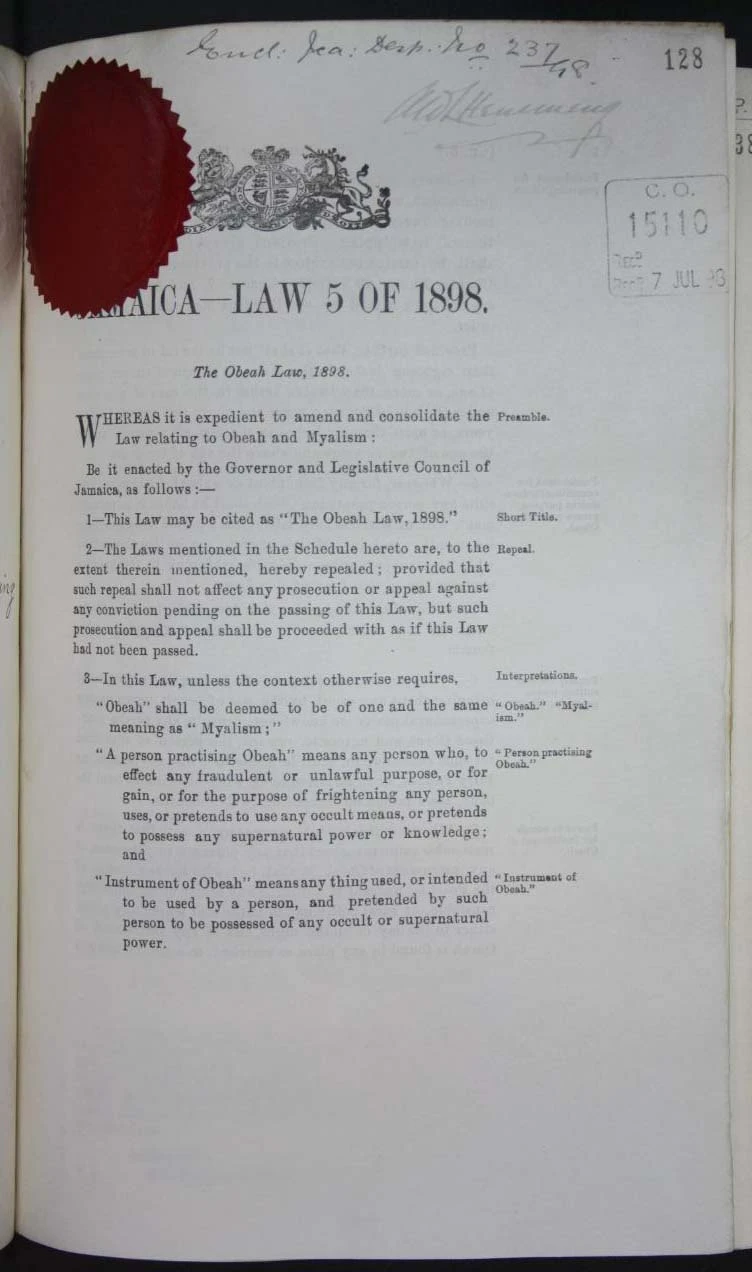
The 1898 law combined Obeah and Myalism in its definition. It allowed searches for objects classed as instruments of Obeah, treated their possession as evidence unless rebutted, and penalized specified consultation and promotional printed material. Objects, payments and publications could all draw someone into the law’s reach. [4]
Source & credit
This is the historical 1898 text. It shows what colonial lawmakers enacted, not the present legal position or the outcome of every prosecution. Court records are needed to see how particular officials applied it.
Why payment mattered in Bruce’s case
Paton argues that enforcement presented the practitioner as a fraud and the client as a victim of deception. Money helped authorities tell that story. She compares this treatment with payments accepted in Christian services, asking why different claims to spiritual authority received unequal recognition. [2]
The comparison does not prove that every practitioner was honest or every transaction harmless. It asks why one kind of spiritual work was presumed criminal while another was accepted as religion. Fraud or injury still requires evidence about a specific act.
More than the horror story
Obeah and Other Powers, edited by Paton and Maarit Forde, brings together research on healing, religion and political authority. That range is a useful reminder that the subject cannot be understood through sensational stories alone. [3]
We can examine what people believed, what officials feared and how laws worked without claiming that supernatural powers have been verified. Explaining repression is also not an endorsement of every practice described in the records.
A better way to read an old report
Keep four things separate: what someone alleged, the charge brought, the evidence heard and the judgment. Ask whether the accused person’s words survive, or whether we hear only police and magistrates.
Bruce’s marked coins bring the story down to earth. They let us follow a transaction and a prosecution, while leaving room to question the larger assumptions that made the case possible.
Look again
In the Bruce case, what did the marked coins establish? What could they not tell us about the beliefs of Bruce or his client?
Scholarship and evidence
- Paton, D. (2015). The cultural politics of Obeah: Religion, colonialism and modernity in the Caribbean world. Cambridge University Press. Publisher description and institutional abstract. ↩
- Paton, D. (2009). Obeah acts: Producing and policing the boundaries of religion in the Caribbean. Small Axe, 13(1), 1–18. Open article consulted, especially discussion of the Bruce prosecution and payment on pp. 7–8. ↩
- Paton, D., & Forde, M. (Eds.). (2012). Obeah and other powers: The politics of Caribbean religion and healing. Duke University Press. Publisher description and contents. ↩
- Jamaica. (1898). The Obeah Law. The National Archives UK, CO 139/108; facsimile and transcription, Obeah Histories. Primary historical law consulted, especially sections 3, 7–8 and 10. Present legal status is not inferred from this historical copy. ↩