HISTORY RECONSIDERED · SECOND RUN · 15 OF 19
1938: the workers and women behind the rebellion.
A wage dispute at Frome became part of the upheaval that changed Jamaica in 1938. Workers drove the protests, and women were among them. Their presence is easy to miss when the story moves straight to famous male leaders.
At Frome in Westmoreland, a dispute over wages was followed by a strike by factory-construction workers. Police opened fire on 2 May 1938. Two days later, the colonial secretary told Parliament that the governor’s report recorded four deaths. This was an early official account, not a final independent count. [4]
Frome became part of a wider upheaval over work and colonial conditions. The story is often remembered through Alexander Bustamante and Norman Manley. Their leadership mattered, but the people whose grievances filled the streets must come first. Women were part of that public history. [1] [5]
Before the party story, a workers’ story
Colin Palmer’s Freedom’s Children connects the labour rebellion with later party organization and constitutional change. Its starting point is workers challenging their conditions. Without those demands, the later speeches and political careers lose their setting. [1]

Source & credit
The early parliamentary exchange is revealing. Alongside the governor’s account are questions about hunger, labour conditions and representation. Even within the official record, there was disagreement over how to explain what was happening. [4]
Women are visible in the crowd
Source & credit
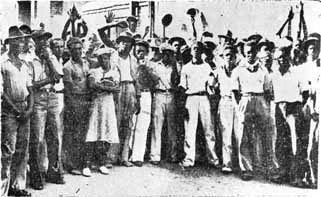
The National Library’s photograph brings women into the visual history of the 1938 labour unrest, alongside the men with whom they gathered. It was reproduced in The Daily Gleaner on 6 December 1938. [5]
The women’s presence in the crowd is documented, even where their individual experiences and actions remain unidentified.
Listen beyond the official report
UWI’s Social History Project identifies Not for Wages Alone, based on 35 oral testimonies about the conditions surrounding 1938. It also lists Linnette Vassell’s Voices of Women in Jamaica, 1898–1939. These are routes into workers’ and women’s accounts, through its published collection descriptions. [2]
A later memory needs context: who is speaking, when and about what they witnessed. The same care belongs with a governor’s report. An official title does not make one account automatically neutral while a worker’s recollection is dismissed.
The woman at the centre of a later play
In 1985, Sistren’s Ida Revolt inna Jonkonnu Stylee retold the upheaval with a woman at its centre. Karina Smith’s study identifies the account of Ida Homes throwing an initiating stone as a rumour. The play’s importance does not turn that rumour into a verified event. [3]
It shows a later effort to challenge a male-centred public memory. That is a worthwhile story in its own right: women using theatre to ask whose actions a country remembers.
What changes when workers stay in view?
The rebellion becomes more than a preface to two political biographies. Wages, working conditions, collective action and women’s experiences remain part of the explanation. Named records and testimony can deepen that account without replacing one oversimplified hero story with another.
Look again
Look at the 1938 crowd photograph, then read the early official account. Who appears in each source, and whose experience would you still want to hear?
Scholarship and evidence
- Palmer, C. A. (2014). Freedom’s children: The 1938 labor rebellion and the birth of modern Jamaica. UNC Press. Publisher synopsis. ↩
- UWI Mona, Social History Project. Publications, including Bryan & Watson (2003) and Vassell (1993). Institutional descriptions and publication inventory. ↩
- Smith, K. (2007). Re-telling history: Sistren’s Ida Revolt inna Jonkonnu Stylee as neo/colonial resistance. Thirdspace, 7(1), 17–36. Repository abstract. The abstract describes the story as a rumour. ↩
- UK House of Commons. (1938, May 4). Jamaica. Hansard, vol. 335, cols. 872–875. Full parliamentary exchange consulted; the reported casualty count is attributed to the governor’s initial account. ↩
- National Library of Jamaica. Labour unrest in Metropolis starts all over again. D0002591. Primary photograph and catalogue description consulted. Source publication: The Daily Gleaner, 6 December 1938, p. 7; capture date and individuals not established. ↩