HISTORY RECONSIDERED · SECOND RUN · 14 OF 19
Tacky: the man, the plantations and the fight for freedom
Tacky was enslaved on Frontier estate near Port Maria. In April 1760, he helped lead an armed uprising in St. Mary. The surviving accounts name places, describe a weapons raid and record his death, but leave much of his personal life unknown.
A man whose earlier life is only partly visible
Tacky was an African man held in slavery in St. Mary, not a figure invented to explain a rebellion. Reports examined by historian Vincent Brown identify him as a Gold Coast leader before his enslavement and connect him with another rebel leader called Jamaica. Those reports were written by his opponents. They give us a starting point, but not a secure birth date, a detailed royal genealogy or his own account of capture and transportation. [2]
What about his family? The cited accounts do not identify a wife, children or descendants. That gap does not mean he had no family. The pictures accompanying this account do not include an authenticated portrait of Tacky.
Frontier was his plantation; Trinity was an assembly point
Brown identifies Tacky and Jamaica as enslaved men on Ballard Beckford’s Frontier estate. He places Frontier overlooking Port Maria harbour, close to the main road behind the town. The rebels first gathered farther inland at Zachary Bayly’s Trinity estate, up the Western Port Maria River, with people from other plantations. The National Library of Jamaica also identifies Beckford as owner of Whitehall. See its catalogue record ↗ [2]
Source & credit
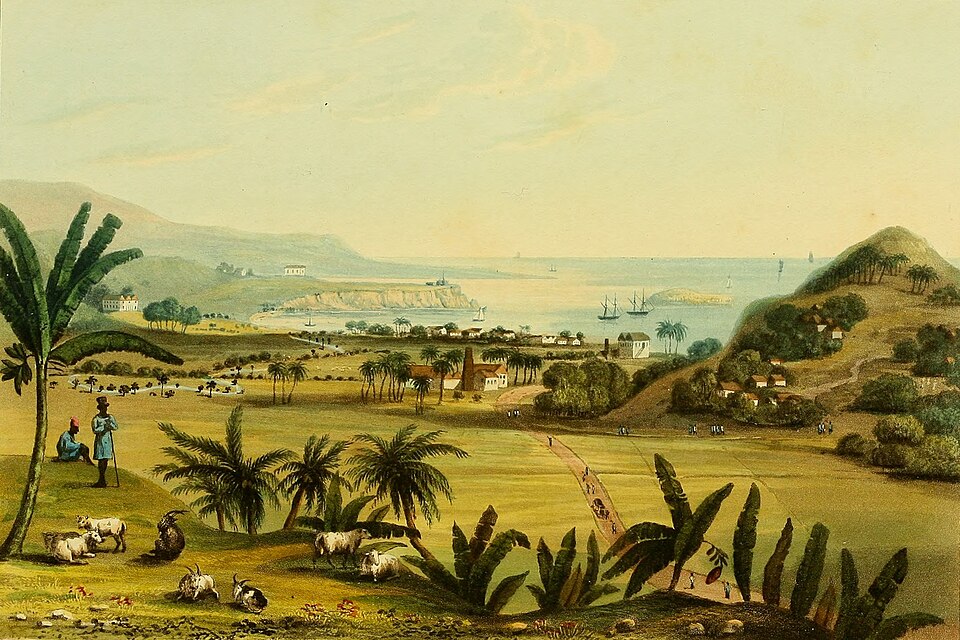
Hakewill’s later description helps us picture that setting. It places the fort and barracks on the left of his Port Maria view, and Frontier’s works and enslaved people’s houses on the right. It names a later owner, A. Stirling. That does not contradict Beckford’s ownership in Tacky’s time: this image describes the district 65 years after the uprising. It is landscape evidence, not a photograph of Tacky’s workplace in 1760. [3]
The first objective was guns and powder
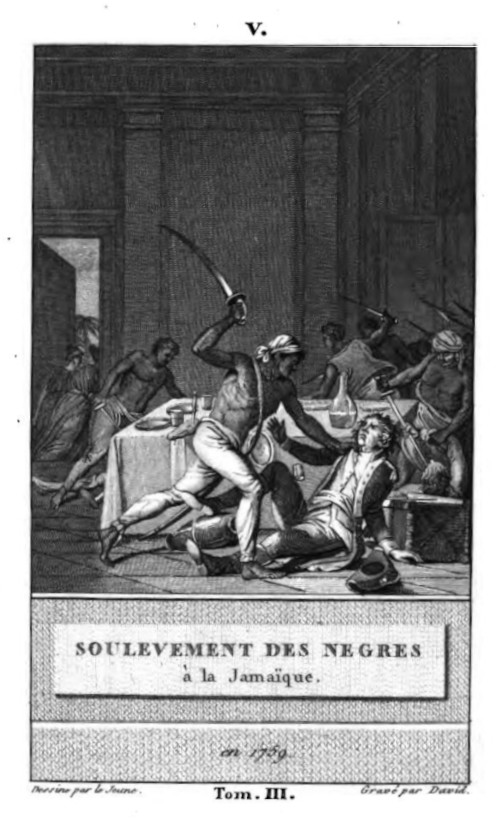
On the night before Easter Monday in April 1760, rebels went to the fort at Port Maria. Edward Long’s 1774 account says about 50 took part in this opening raid. They killed the storekeeper, broke into the magazine and seized four barrels of gunpowder and about 40 firearms. He also describes them taking lead sinkers from fishing nets for ammunition. These details show a practical military objective: obtain weapons that enslaved people were otherwise denied. [1]
Long names participants from Trinity, Whitehall, Frontier and Heywood Hall. His account then follows the rebels to Heywood Hall and Esher, describing fires in cane fields and estate works, attacks on white residents, and further recruitment. After returning toward Heywood Hall and Ballard’s Valley, he puts their number at about 400, including women. These are reported estimates at different stages, not 400 named soldiers all proven to have served directly under Tacky. [1]
The colony fought back
Local militia mobilized as news spread. The response also drew on sailors and Maroons. Long describes a naval vessel at Port Maria being used to hold prisoners, freeing militia members for pursuit. Rebels used wooded and rocky country to resist and hide; their opponents tried to find and break up those groups. The war involved supplies, intelligence and difficult terrain as well as battles. [1]
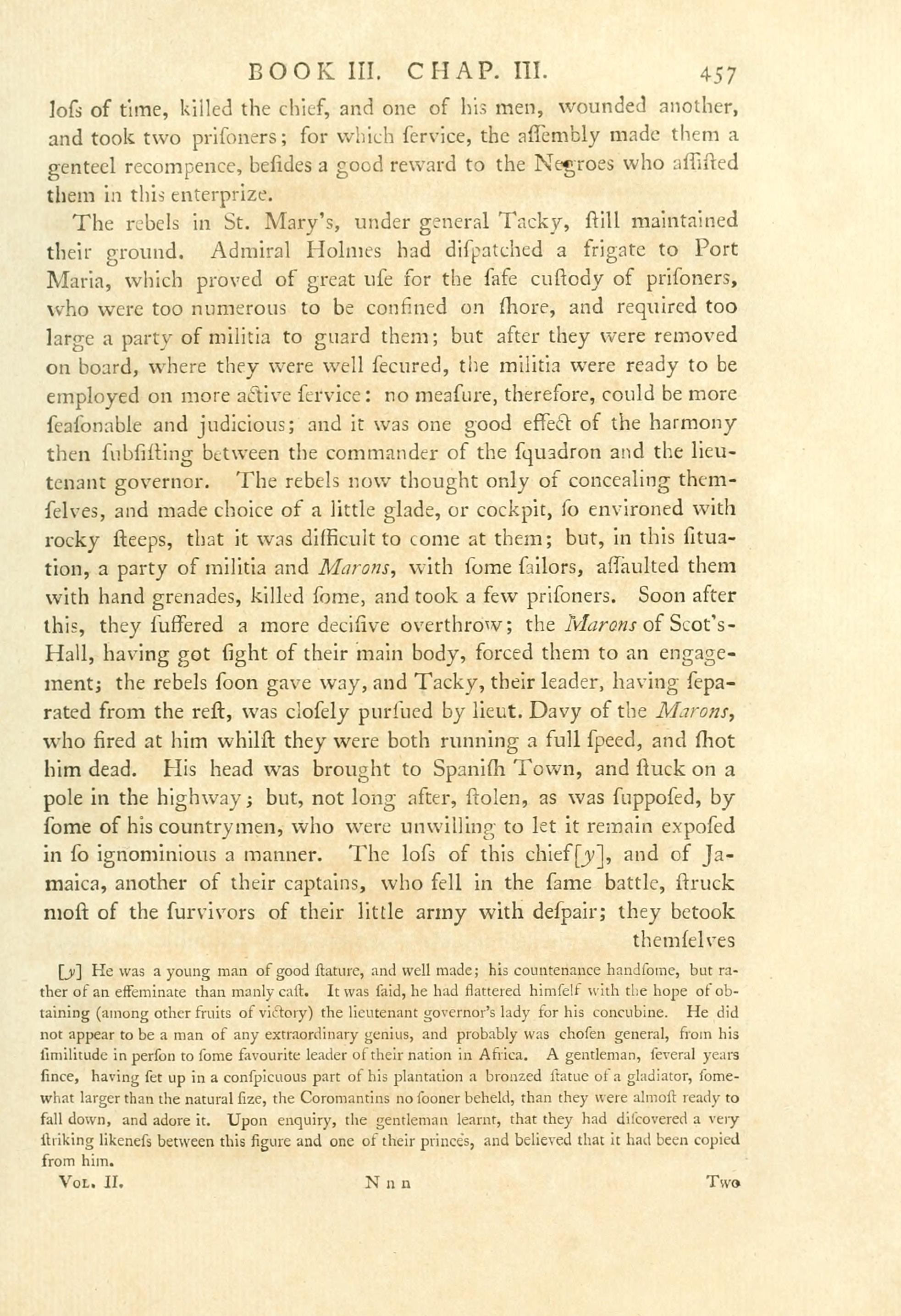
Long (1774, p. 457) says Davy, a Maroon lieutenant, pursued and shot Tacky after fighting involving Scott’s Hall Maroons. The authorities displayed Tacky’s severed head in Spanish Town. Long reports that it later disappeared and supposes that his countrymen removed it; the removal story is his report, and the identity of those responsible is not established. Another leader, Jamaica, also died in the fighting. [1]
Why were Maroons involved on the colonial side? Earlier treaties protected recognized Maroon communities while requiring assistance against rebellions and the return of later fugitives. Those obligations placed free Maroons and enslaved rebels in different positions. Read the treaty clauses and their consequences →
Source & credit
Captures, killings and payment: the Maroon role
Davy’s role should not disappear into the phrase “the rebels were defeated.” Long (p. 457) identifies him and Scott’s Hall Maroons in the pursuit that ended Tacky’s life. On page 458, Long describes about 25 rebels found dead in a cave. He reports a belief that they had killed one another, while the Maroons who found them claimed to have killed them and presented their ears to obtain a reward. This is evidence of a reported bounty claim and the treatment of the dead; it does not establish who killed those 25 people. [1]
Maroon forces helped uphold slavery by pursuing escapees and fighting enslaved rebels. For 1763, Helen McKee reports that a party described as Cudjoe’s men pursued 11 escapees, killed three and captured the rest, who faced colonial trials and executions. She also identifies conflicting colonial accounts of the 1760 fighting. Treaties and colonial pressure help explain the alliance; they do not erase the harm to people seeking freedom. These accounts concern particular towns, people and episodes, rather than every Maroon community. [6]
Can we say what Tacky looked like?
Long’s footnote describes a young man of good stature, well built and handsome. It also mixes that description with disparagement and speculation about his leadership. This is an adversary’s written description, not a measured physical record, eyewitness portrait or reliable basis for reconstructing his face. We can report what Long wrote without pretending to possess a likeness. [1]
Source & credit
His death did not end the wider war
The opening rebellion in St. Mary was one part of a wider conflict. Fighting moved to Westmoreland, and other leaders and groups continued the struggle into 1761. Brown’s mapping project follows the changing fronts rather than treating Tacky’s death as the end of every uprising. Open the historian’s animated map of the war ↗ [4]
Brown also places the conflict within African military histories and Britain’s Seven Years’ War. Enslaved people brought political and military experience with them. That wider explanation matters, but it should follow the concrete story: a man enslaved near Port Maria, people organizing across estates, an attack for weapons, resistance and a violent colonial response. [5]
The evidence is unequal: colonial accounts describe military operations in far more detail than Tacky’s household, childhood or private thoughts.
Sources and evidence limits
- Long, E. (1774). The history of Jamaica, vol. II, pp. 448–450 and 457–458. Public-domain original, digitized by Internet Archive; relevant passages checked in the OCR transcription, with page 457 also inspected in the original scan. A retrospective account by a defender of slavery, not the rebels’ testimony. Numbers and character descriptions below are attributed to Long rather than treated as a census or neutral observation.
- Brown, V. (2020). Tacky’s revolt, chapter 4, especially pp. 130–131. Belknap Press. Publisher-indexed excerpt consulted for Frontier, its owner and setting, and the assembly at Trinity.
- Hakewill, J. (1825). A picturesque tour of the island of Jamaica: Port Maria. Public-domain text and plate inscription checked. The 1825 publication date is visible on the plate; Commons also carries an inconsistent 1875 source date. The description identifies Frontier on the right of the view, but cannot establish 1760 estate boundaries or the survival of individual buildings.
- Brown, V. Slave revolt in Jamaica, 1760–1761: A cartographic narrative. Research project with Axis Maps: movements and the wider war. External interactive research map.
- Aggarwal-Schifellite, M. (2020, February 6). The war against colonial slavery. Harvard Gazette. Interview with Brown on African military experience, colonial evidence and the connected war.
- McKee, H. (2018; online 2017). From violence to alliance: Maroons and white settlers in Jamaica, 1739–1795. Slavery & Abolition, 39(1), 27–52. Author’s full-text copy, especially notes 65–71. For 1763, note 71 cites Thistlewood Papers, Folder 38, Box 7, Osborn Collection, Beinecke Library, Yale; diary evidence as reported by McKee. Uses colonial correspondence and accounts to examine the alliance, pursuit of escapees and conflicting descriptions of the 1760 fighting. The cited accounts do not establish an overall death toll attributable to Maroons.