HISTORY RECONSIDERED · SECOND RUN · 13 OF 19
The Taíno story does not end neatly with “extinction.”
White Marl, cassava preparation, old carvings and people reclaiming Taíno identity all challenge a story that simply ends with disappearance. Colonial conquest caused catastrophe, but “extinction” is too blunt a word for everything that followed.
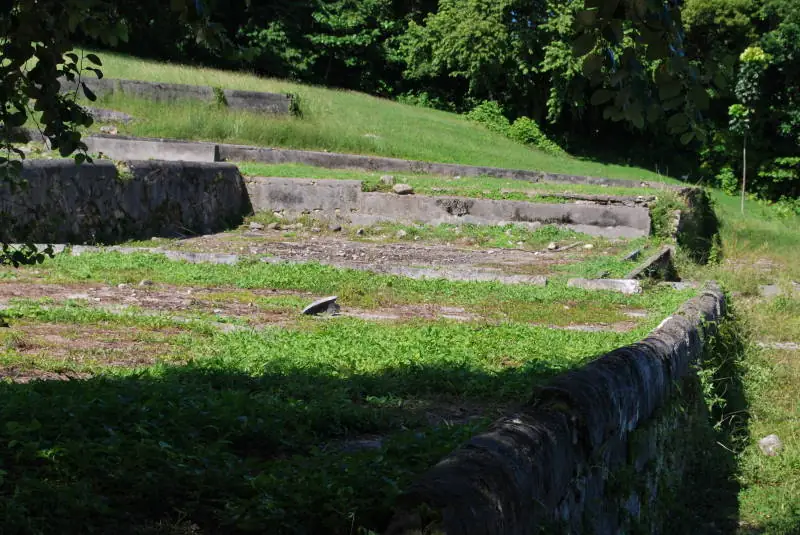
At White Marl in St. Catherine, the remains of a major settlement take us into Jamaica before European conquest. This was a place where people lived, obtained food and made useful things. It is a better beginning for Taíno history than a sentence announcing that a people disappeared. [1]
Conquest caused catastrophic loss and disruption. But a single word, “extinct,” can also hide the later lives of objects, knowledge and people who claim Indigenous identity. These are related histories, not one question with one answer.
A Jamaican place with a continuing history
Peter Siegel, Zachary Beier and Krysta Kaiman’s White Marl study examines archaeology alongside the relationships of residents, heritage managers and Indigenous descendants to the site. It asks what the place means in the present as well as what its excavated remains reveal about the past. [1]
Source & credit
Seville in St. Ann offers another route into the island’s long history. Its archaeological landscape brings Indigenous occupation into view alongside later colonial changes. Neither place should be treated as an empty stage on which Jamaican history begins only when Europeans arrive.
Knowledge could survive through change
JNHT archaeologist Lesley-Gail Atkinson discusses cassava processing, canoes and mound cultivation among Indigenous contributions to Jamaican life. These are practical skills: ways to prepare food, travel and work the land. Knowledge can pass between populations even when communities undergo profound disruption. [5]
She also follows older objects into later stories. At Rock Spring in St. Mary, a petroglyph became known in folklore as “One Bubby Susan.” At Aboukir in St. Ann, wooden carvings acquired new meanings. Those encounters show an ongoing relationship with the island’s older heritage, rather than proof that every later belief was unchanged Taíno religion. [5]
People are speaking in the present
Erica Neeganagwedgin’s 2015 study draws on oral histories from ten people in two rural communities in southern Jamaica. It concerns people reclaiming Taíno identity and challenging the idea that they do not exist. Their voices belong in the discussion, even though the accessible abstract does not give us the complete interviews or a survey of the whole island. [6]
What the DNA study does, and does not, show
Researchers studied an ancient person from Preacher’s Cave in the Bahamas and found relationships with Indigenous ancestry in some present-day Caribbean populations. This challenges a claim of total biological disappearance across the region. It is not a DNA survey of Jamaica and does not establish the ancestry of a particular Jamaican family. [3]
Ancestry, cultural knowledge and community identity are different things. A genetic result cannot tell the whole story of a language or a community. A living community should not be erased simply because a particular genetic study has not examined its members.
Keep the islands distinct
The name Taíno is useful, but the Caribbean’s Indigenous societies were diverse. The Smithsonian’s carved Lucayan seat comes from the Turks and Caicos/Bahamas region, not Jamaica. Regional comparisons are valuable only when we keep those origins clear. [2]
The stronger story neither minimizes conquest nor imagines an unchanged past. It follows the evidence of loss, survival and transformation in particular places and lives. If visiting an archaeological site, establish current access and permission first.
Look again
Choose one example: cassava preparation, a Jamaican carving or a DNA study from another island. What kind of continuity does it help explain?
Scholarship and evidence
- Siegel, P. E., Beier, Z. J. M., & Kaiman, K. N. Archaeological history, memory, and heritage at the White Marl site. Public Archaeology, 21(1–4), 3–33. Institutional abstract. Repository assigns the issue year 2022; DOI/publication copyright records refer to 2023. ↩
- Ostapkowicz, J. Lucayan duho. Smithsonian National Museum of the American Indian. Object interpretation consulted; regional comparison, explicitly not Jamaican provenance. ↩
- Schroeder, H., et al. (2018). Origins and genetic legacies of the Caribbean Taino. PNAS, 115(10), 2341–2346. Open article consulted for abstract, significance and sampling context; no islandwide Jamaican ancestry claim. ↩
- Morgan, K. (2023). The Taino. In A concise history of Jamaica (pp. 10–43). Cambridge University Press. Publisher chapter summary.
- Atkinson, L.-G. (2010). Taíno influence on Jamaican folk traditions. Jamaica National Heritage Trust. Full five-page heritage essay consulted; especially pp. 1–2. Cultural connections are attributed to the author, not treated as proof of individual ancestry. ↩
- Neeganagwedgin, E. (2015). Rooted in the land: Taíno identity, oral history and stories of reclamation in contemporary contexts. AlterNative, 11(4). Journal abstract of the interview-based study. DOI: 10.1177/117718011501100405. ↩