JAMAICA, RECONSIDERED · 2 OF 19 · COMPLICATION
Maroon freedom, slave-catching and colonial violence: what the records show
The treaties secured freedom for particular Maroon communities while making them allies of a slave society. Named people, payments, killings and original documents reveal what that alliance meant for other Black Jamaicans, from Tacky’s uprising to Paul Bogle’s capture.
Freedom for one community could mean capture for another
Maroon communities fought to remain free when plantation slavery surrounded them. The agreement made with Cudjoe in 1739 recognized liberty and land for his people. It also committed them to returning future fugitives and helping suppress rebels. Those provisions became actions with consequences for other Black people. Both the victory and those consequences belong in the history. [1]
The document reproduced here is Cudjoe’s western agreement, dated 1 March 1738–9 under the older calendar practice. Eastern Maroon agreements and communities had separate histories. Maroon positions varied between communities and episodes. [1]
The treaty made slave-catching a paid duty
Article nine required people who escaped their enslavers and fell into Cudjoe’s hands to be returned to the nearest parish magistrate. Section II of the confirming act directed the magistrate to pay ten shillings for each person delivered. Article six required efforts to take, kill or suppress rebels, subject to the clause’s terms. This is explicit legal evidence of capture, payment and military obligations, not an inference from later legend. [1]
The freedom and land clauses protected specified people. They did not abolish plantation slavery. An escapee returned to colonial custody remained exposed to the coercion of the slave system; the bounty rewarded the captor for interrupting that person’s attempt to become free. [1]
Who was Edward Long, and why does his account matter?
Edward Long (1734–1813) was an English-born Jamaican slaveholder, colonial politician and author of the three-volume History of Jamaica, published in 1774. He managed a slaveholding estate and served in Jamaica’s Assembly. He was also a vocal defender of slavery, whose racial arguments run through the book. He wrote from within the system that the rebels threatened, not as a detached observer of it. [7]
Historian Catherine Hall explains that Long’s presentation sought to defend slaveholders and cast African rebels as the source of danger. His book is nevertheless a major source for named people, events and the political attitudes of an enslaving elite. His approval of suppression reveals his political interests; his reported facts and speculation require separate evaluation. [8]
Tacky, Davy and Scott’s Hall in 1760
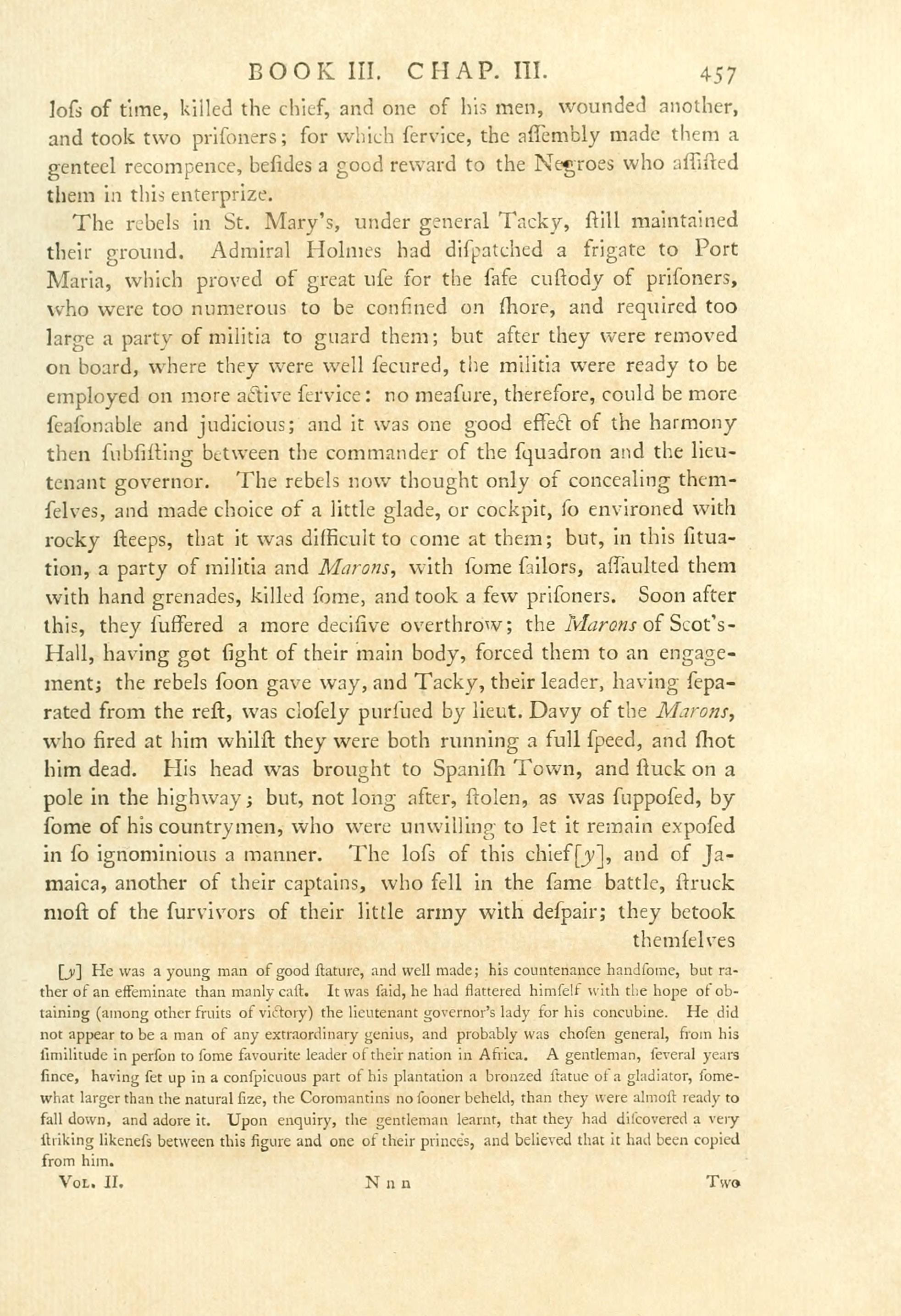
Long’s volume II, page 457, names Lieutenant Davy of the Maroons as the man who pursued and shot Tacky after fighting involving Scott’s Hall Maroons. It says Tacky’s head was taken to Spanish Town and displayed on a pole. Long also reports its later disappearance and supposes that Tacky’s countrymen removed it; he does not establish who did so. These are concrete statements that readers can inspect on the original page. [3]
Source & credit
Page 458 presents a more uncertain episode. About 25 rebels were found dead in a cave. Long records a belief that they had killed one another, but says the Maroons who found them claimed the killings and brought their ears to obtain rewards. This is evidence of a reported bounty claim and the handling of the dead. It does not establish that the Maroons killed those 25 people. An article should preserve that conflict rather than convert a claim into a confirmed toll. [3]
Long also describes Scott’s Hall men demanding overdue head-money before proceeding against the rebels (p. 451). His own narrative therefore connects the operations to payment. Read the fuller Tacky story, including Frontier estate and the weapons raid → [3]
Other pursuits: a count needs an incident and a source
Helen McKee reports a 1763 episode in which a party described as Cudjoe’s men pursued 11 escapees, killed three and captured the rest. Those captured faced colonial trials and executions. Her note 71 points to Thomas Thistlewood’s diary papers at Yale. This account of the incident comes from McKee’s research on the diary. The three pursuit deaths should be distinguished from the subsequent executions by colonial authorities. [2]
The deployments continued into the Baptist War. Joy Lumsden records 107 men from Moore Town and Charles Town arriving at Falmouth in January 1832 under Fyfe to search the woods during the suppression. That is a deployment count, not a death toll. [4]
Paul Bogle: capture and killings after emancipation
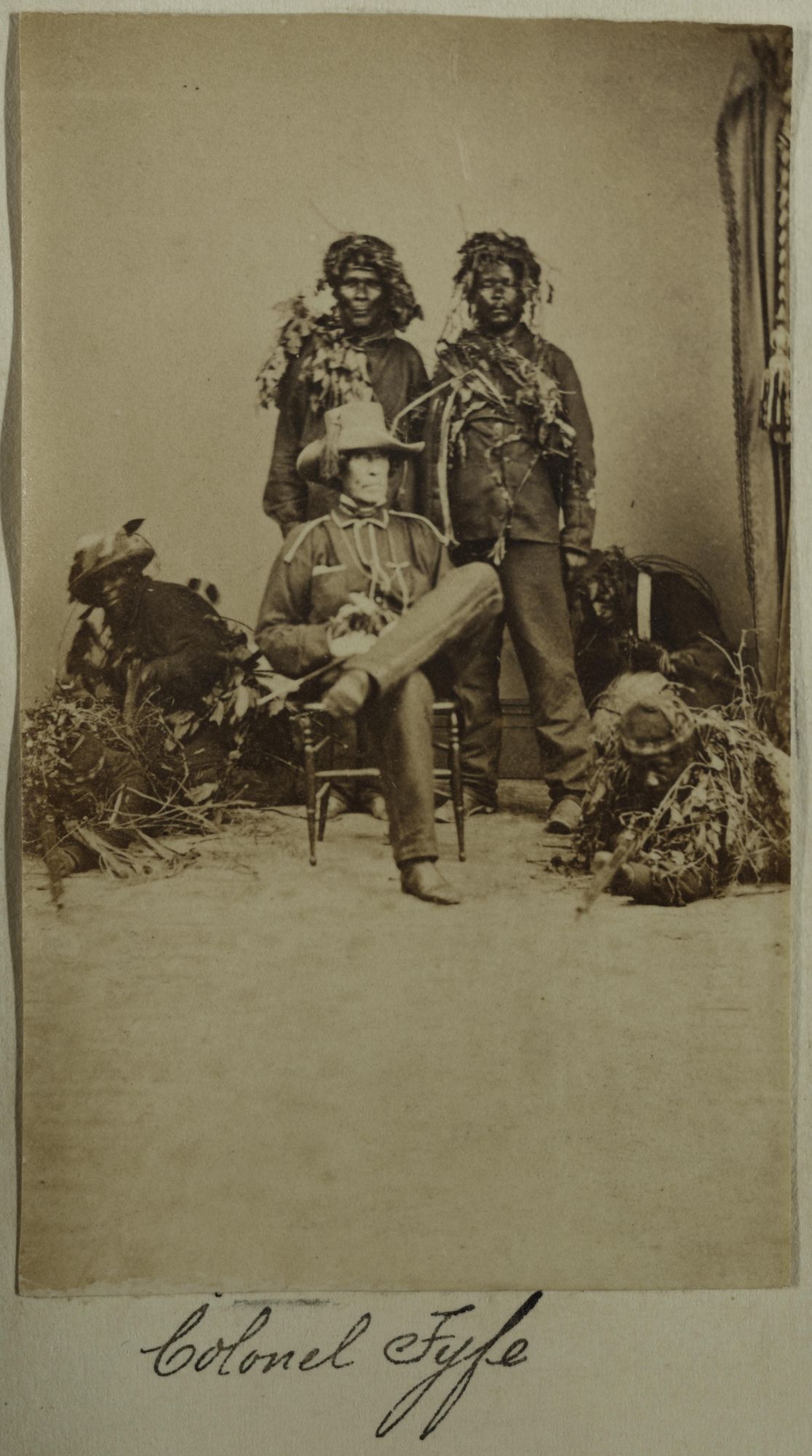
By 1865, the people pursued in the Morant Bay suppression were free Black people, not legally enslaved plantation fugitives. The force associated with Moore Town, Portland served under the white commander Alexander Fyfe. Kenneth Bilby identifies Captain Joseph Briscoe as the officer credited with capturing Paul Bogle. Bogle was taken alive and later hanged by the colonial authorities. Read the capture chronology in the Bogle article → [5]
Source & credit
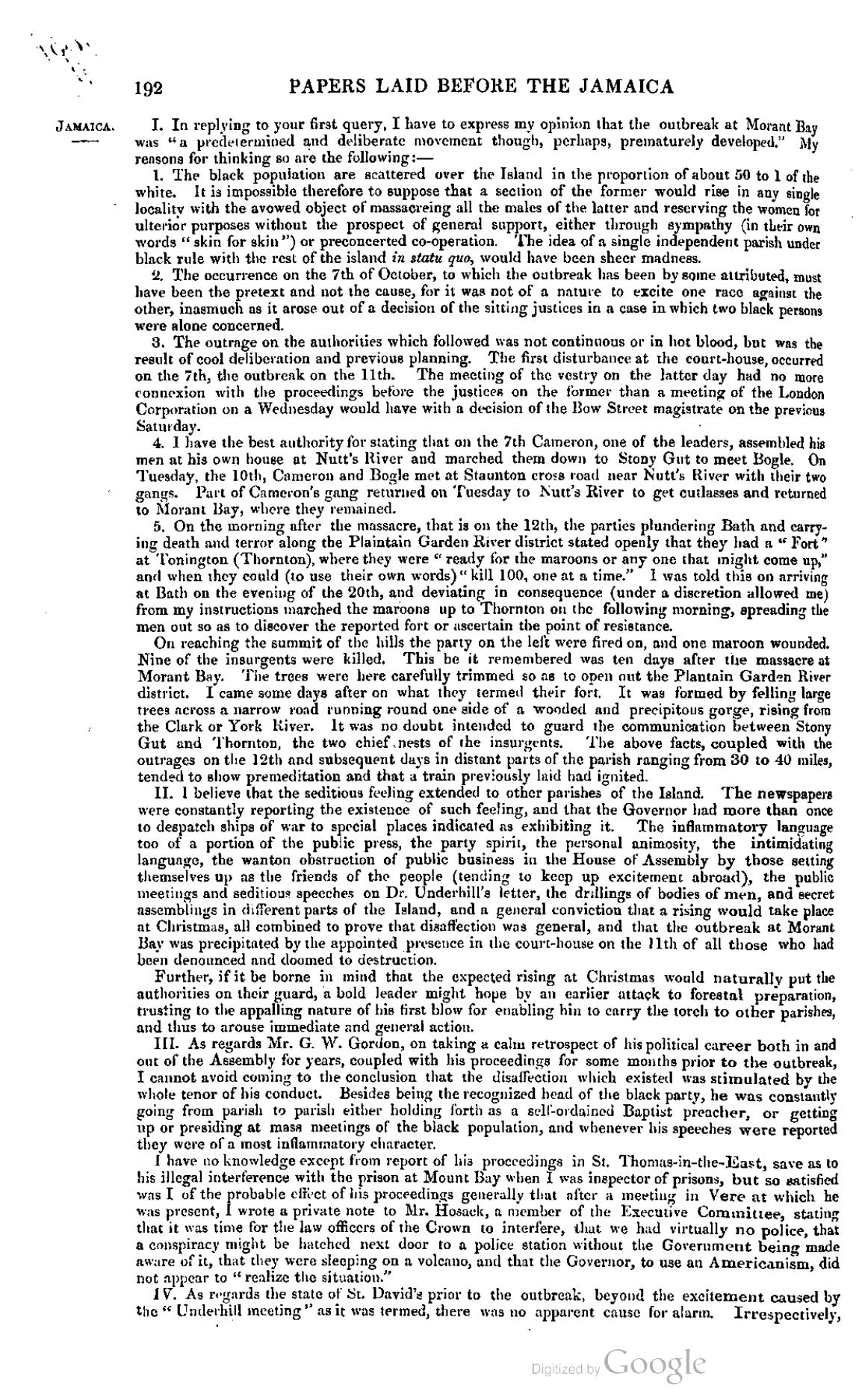
We also have Fyfe’s own later account of killings. In a letter to W. R. Myers dated 9 February 1866, printed on pages 191–192 of the papers presented to the inquiry, he described advancing on Torrington, also called Thornton, after reaching Bath on 20 October. He said the advance party was fired upon, a Maroon was wounded and nine people were killed. The label “insurgents” is his; it is not independent proof of each victim’s conduct. This page supports a specific reported episode, not an overall Maroon death toll. [6]
Source & credit
Who praised them, and what was being praised?
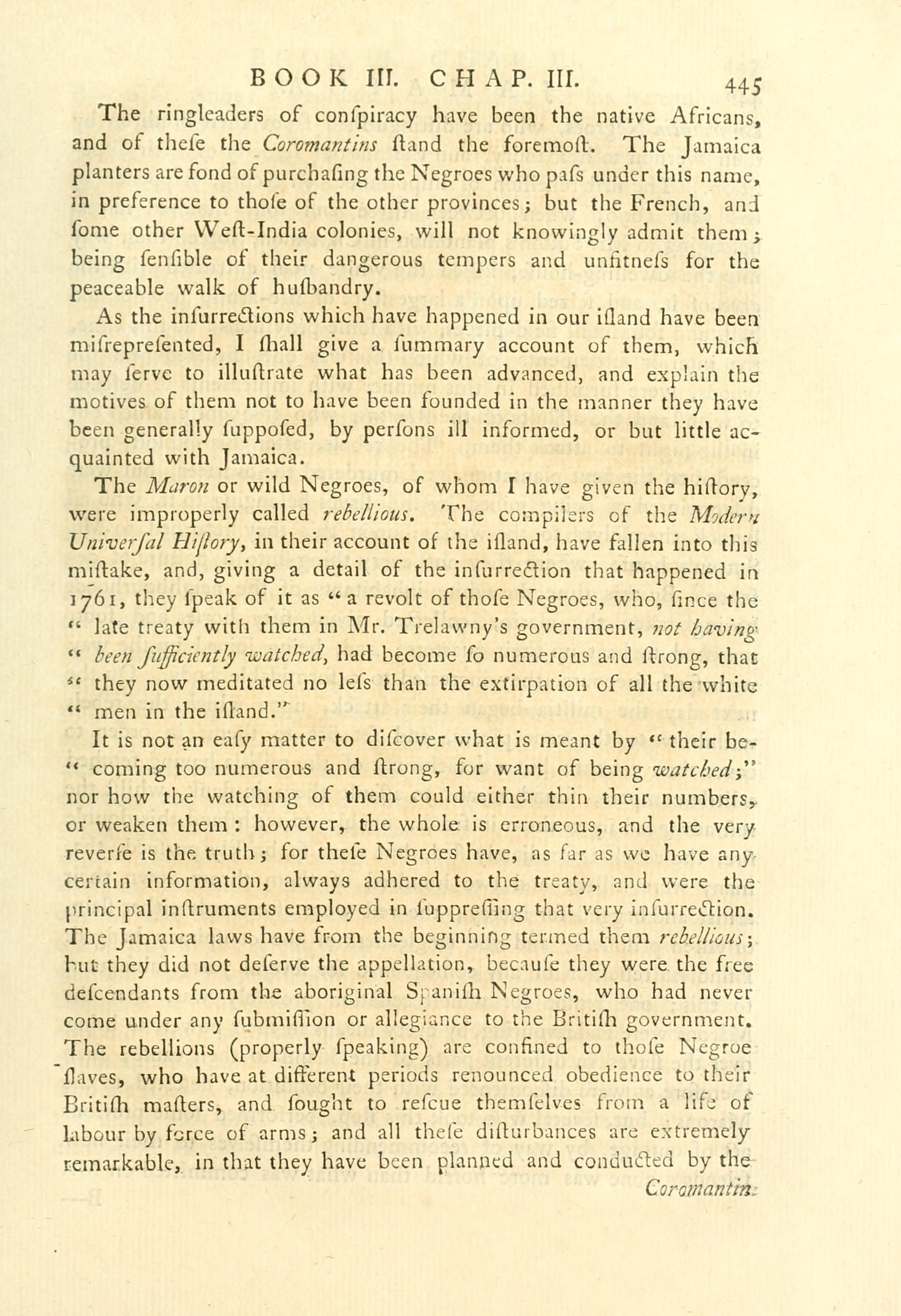
Long defended the Maroons against a writer who had mistakenly placed them among the rebels. On page 445 he called them the “principal instruments” in suppressing the uprising. On page 447 he credited them with searching the woods and apprehending people who had deserted their owners. His praise was for helping preserve a society based on enslavement. It should be read alongside what happened to the people being pursued. [3]
Source & credit
Material rewards also appear in Long’s account. Page 461 records an Assembly grant of £450 to the Maroons of Trelawny and Accompong towns, covering arrears and encouraging future service. This was a collective payment, not a verified sum paid to Davy or a head-count of captives. The distinction matters when explaining how colonial power rewarded the alliance. [3]
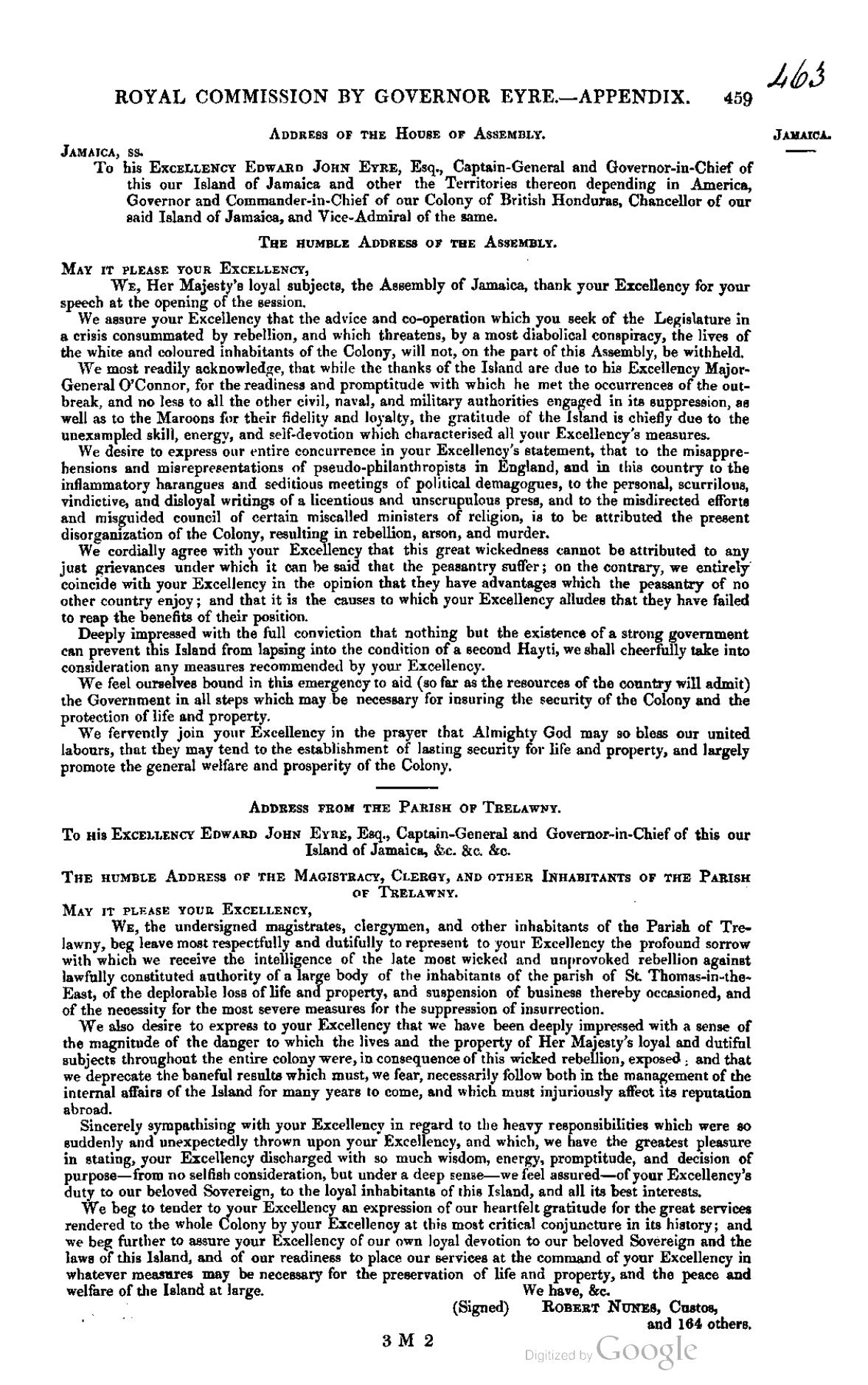
After the 1865 suppression, the colonial legislature offered public praise. The House of Assembly’s address, printed on page 459 of the 1866 collection, thanked the Maroons for their “fidelity and loyalty.” The Legislative Council’s address on the preceding page praised their services under Fyfe. These documents show whose loyalty the governing elite valued. Because emancipation had already occurred, this later praise concerns colonial repression, rather than the defence of a still-legal slave system. [6]
Source & credit
What the evidence establishes, and what it does not
The record establishes paid obligations to return escapees, named participation in killing Tacky, later pursuits and captures, a reported 1865 combat toll, and praise from colonial authorities. It does not provide a reliable overall total of people killed or captured by every Maroon community across the period. Bounties, soldiers deployed, people captured, people killed in pursuit and people later executed are different quantities. They cannot simply be added together.
Nor does an alliance remain identical across generations. McKee discusses disagreements even among colonial writers about the Maroon role in 1760. Reading named communities and incidents closely gives a firmer account than either an uninterrupted heroic story or a blanket accusation against everyone with Maroon ancestry. [2]
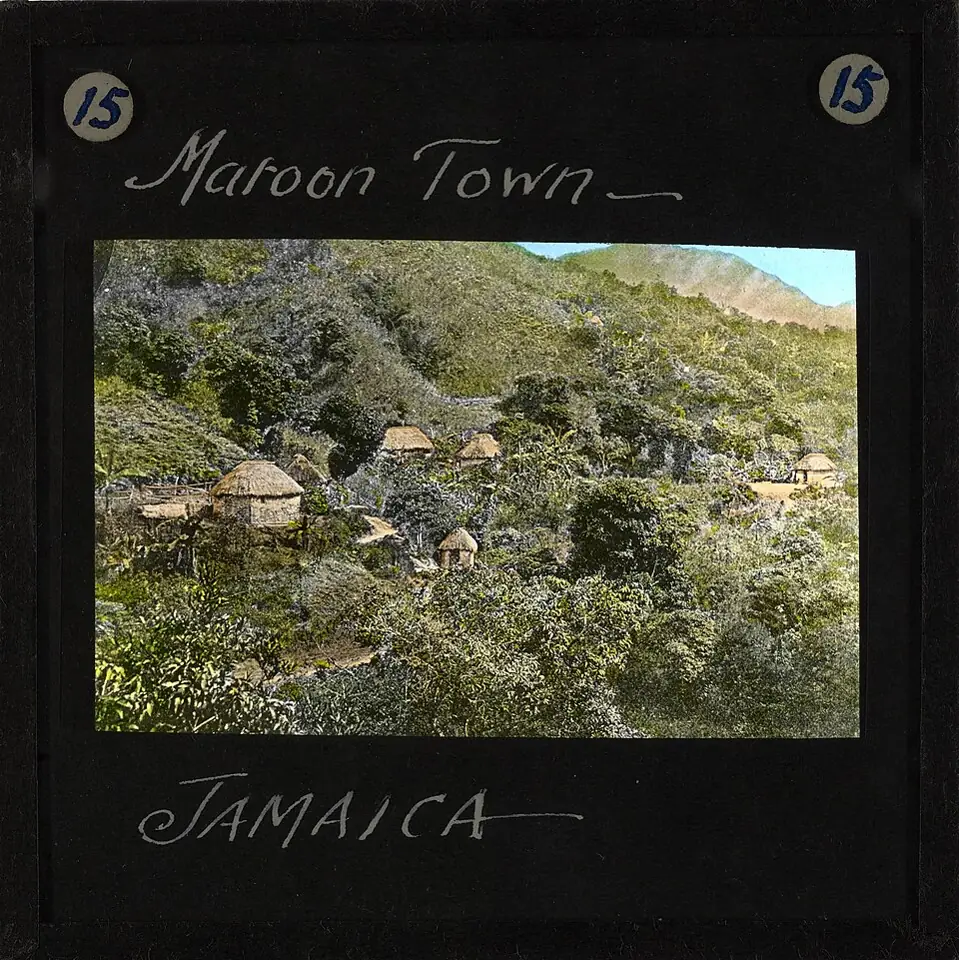
Accompong and Moore Town remain living communities with cultural traditions and people whose lives cannot be reduced to these operations. Recognizing that present does not require concealing the people harmed in the past. UNESCO’s heritage account and the named performances on Drums of Defiance provide cultural context; neither substitutes for the operational records examined here. [9] [10]
Source & credit
Read the record from the other side
Read the treaty’s bounty clause beside Long’s praise and Fyfe’s report. Who gained security, payment or honour, and who faced capture, death or the destruction of a home? Keep each answer attached to its named source.
Explore the companion portrait essay: named officials and unnamed Jamaicans →
Sources, page references and research limits
- Jamaica Assembly (1739). Act confirming the articles with Cudjoe; Acts of Assembly (1787), vol. 1, pp. 176–180. Full primary transcription checked: articles 2–3, 6, 9 and confirming-act section II. Public-domain law, including original historical classifications.
- McKee, H. (2018; online 2017). From violence to alliance: Maroons and white settlers in Jamaica, 1739–1795. Slavery & Abolition, 39(1), 27–52. Author’s ResearchGate full text consulted, especially discussion of 1760 and note 71. That note cites Thistlewood Papers, Folder 38, Box 7, Osborn Collection, Beinecke Library, Yale; diary evidence as reported by McKee. Full-text copy ↗.
- Long, E. (1774). The history of Jamaica, vol. II, pp. 445, 447, 451, 457–458 and 461. Relevant OCR passages checked; original page scans 445 and 457 directly inspected and reproduced. P. 445: praise; p. 447: apprehending escapees; p. 451: head-money dispute; p. 457: Davy and Tacky’s head; p. 458: disputed cave deaths; p. 461: £450 collective grant. Retrospective pro-slavery account, published fourteen years after 1760; not treated as impartial testimony.
- Lumsden, J. A brave and loyal people: the role of the Maroons in the Morant Bay Rebellion in 1865. Chapter full-text copy consulted for January 1832 deployment and the wider campaign. A deployment count is not a casualty count; underlying records not all independently reviewed.
- Bilby, K. (2011). Picturing the Maroons in the Morant Bay Rebellion: Complicating the imagery of commemoration. The Princeton University Library Chronicle, 72(2), 574–583. Author’s full-text copy checked, especially Moore Town, Fyfe and Briscoe, pp. 574–576 and 582. The proposed identification of Briscoe in a photograph is explicitly conjectural. Author copy ↗.
- Papers Laid before the Royal Commission of Inquiry by Governor Eyre (1866), pp. 191–192 and 458–459. Original PDF text and reproduced scans directly inspected. Fyfe’s 9 February 1866 letter begins p. 191; paragraph 5 on p. 192 reports the nine deaths. Legislative Council and Assembly addresses on pp. 458–459 supply direct evidence of praise. These are participant and government statements supplied to the inquiry, not the inquiry’s independent findings. Full original PDF ↗.
- Dwyer, D. (2018). The History of Jamaica, Volume III (1774): A scholarly introduction. Early Caribbean Digital Archive, Northeastern University. Scholarly introduction consulted for Long’s estate management, Assembly service, publication and advocacy of slavery. This provides context for reading the primary account.
- Hall, C. (2024). Colonizing the state. In Lucky Valley: Edward Long and the history of racial capitalism. Cambridge University Press. Publisher’s chapter summary on Long’s defence of slaveholders and representation of the rebellion.
- UNESCO. Blue and John Crow Mountains Jamaica. Institutional cultural-heritage context, not evidence for casualty figures.
- Smithsonian Folkways (1992). Drums of Defiance. Named communities and performances; a modern album release, not eighteenth-century field audio.