Bath Fountain: remembering Jacob beyond the discovery story
A spring’s origin story names an enslaved fugitive. Follow what the story preserves, what the public institution records, and what remains unknown about the man himself.
Begin with the person in the story
Bath Fountain’s familiar origin account names Jacob, an enslaved man escaping his owner, who encountered the spring and found relief for a leg ulcer. The Ministry of Tourism places the discovery in the 1690s. The parish history explicitly presents the Jacob account as tradition. Preserve that distinction: a transmitted story can keep an enslaved person visible without becoming a fully documented biography. The cited accounts contain neither Jacob’s own description of the encounter nor an authenticated portrait or documented later biography. [1][2]
The name resists a story told only through proprietors
Jacob’s presence in the Bath tradition matters because so many accounts of colonial places begin with an owner or official. Here the remembered encounter belongs to a man escaping enslavement. The story gives him action and need, rather than treating him only as a unit of labour in someone else’s property history.
That significance can be explained without claiming a verified biography. The transmitted account and the later public institution have different kinds of support. Keeping both allows readers to understand why Jamaicans remember the spring through a fugitive’s experience, while leaving the details that cannot yet be established open. Oral tradition becomes part of the history of remembrance, not a story discarded merely because every step lacks a surviving document. [1] [2]
Source & credit
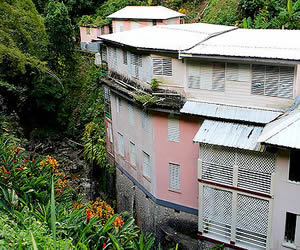
Look closely: Separate the visible later hotel buildings from the older story of a person escaping enslavement. Which details are in the image, and which come from the written account?
Escape is not a decorative detail
A retelling that reduces Jacob to a lucky discoverer strips away the risk in the account. He is remembered as hiding from enslavement. Returning to report a valuable spring would have meant approaching the person from whom he had fled. That tension is contained in the tradition itself; it does not justify inventing dialogue, a reward or a grant of freedom. The useful question is whose knowledge became valuable and who could turn that knowledge into recognised ownership.
A public institution emerged from private land
The St. Thomas parish history records the legislature’s purchase of the spring property in 1699 and establishment of directors for the Bath of St. Thomas the Apostle. The Ministry describes a continuing public body under that name. The institutional legacy is firmer than the details of the discovery narrative: a named spring became a governed asset. Published accounts disagree on the purchase price, so this story does not choose a figure without the underlying transaction. [1][2]
The remembered healer and the recorded owner
The contrast is revealing. A history may identify Jacob’s action but devote its numerical detail to land, directors and payment to an owner. That is how an unequal archive can work: the transaction is preserved more precisely than the person whose encounter made the property useful. A responsible article can draw attention to that imbalance without pretending it has recovered the missing record. Ask a local historian which early deeds, Assembly papers or hospital records might sharpen the account.
A spa building is not the spring’s first form
The photograph supplied by JNHT shows later buildings at Bath, not a seventeenth-century bathing scene. JNHT describes both hot and cold water at the mineral spring. Buildings, management and treatments have changed around the natural feature. Those changes matter because continuity of place does not mean continuity of every practice. Historical claims that water cured an illness belong to the account’s history; they are not a medical promise to visitors. [3]
Connect Bath without merging its institutions
Bath Fountain and Bath Botanical Gardens are separate histories, even though both belong to the town. Read the gardens story for imperial plant collection and the fountain story for fugitive memory, public ownership and the use of water. Then compare Milk River’s runaway-origin tradition in Clarendon. Similar stories invite comparison, but are not proof that the same person, date or legal transaction lies behind both places.
Try the history yourself
Write two short labels: “tradition about Jacob” and “institutional record of Bath.” Put each claim beneath the correct label. Add one question about Jacob that the available accounts cannot answer.
Explore with care
Confirm the current Bath Fountain service, price and access directly. Ask about slopes and walking surfaces before setting out. Read the origin account as heritage; choose any treatment using appropriate personal advice, not an eighteenth-century cure story.