Salter’s Hill: a church built by enslaved Africans
Rural church ruins carry the history of people creating a congregation under slavery, then confronting the unfinished questions of freedom and land.
The builders belong at the beginning
JNHT describes Salter’s Hill Baptist Church in St. James as voluntarily constructed by enslaved Africans in 1825. That wording identifies agency within unfreedom: people could build and sustain a religious institution while still being held as property. “Voluntary” work on a chapel did not make their wider working lives free. The surviving ruin invites a history centred on the congregation and its labour, not only on the ministers later commemorated there. [1]
Building a church was work undertaken within unfreedom
A congregation needed somewhere to gather, and making that place required materials, labour and organisation. At Salter’s Hill, the history of enslaved Africans building a church gives religious life a material form. People whose labour was claimed by an estate were also helping create a shared institution.
The later connection to the emancipation struggle shows why that mattered. A congregation could hold relationships and expectations beyond those an owner intended for the people under control. The ruins preserve only part of that achievement, but they connect worship to the practical work of making a community. The church belongs in the history of resistance because people made it useful within their own social world. [source]
Source & credit
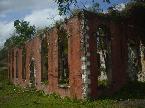
Look closely: Trace the surviving arches and broken wall edges. The ruin gives material form to a church history; the photograph does not establish who laid a particular brick or when a later fire occurred.
A gathering place could do more than worship
A congregation brought people together repeatedly, creating relationships through which news and ideas could travel. That is an interpretive reason to examine the church beside plantation resistance. It is not proof that every worshipper joined an uprising or that every chapel meeting planned one. Distinguish what the site record says from what a network of institutions makes possible. Both religious conviction and everyday relationships belong in the question of how people organised under slavery.
December 1831 brings disagreement into view
The scholarly study The Jamaica Slave Rebellion of 1831 places an opening of a new chapel at Salter’s Hill on 27 December 1831 within its account of the developing conflict. This date should not simply replace JNHT’s 1825 construction claim: building work, establishment and a later opening can be different events. The wider Baptist history also contains disagreement between missionaries and enslaved congregants. Resistance cannot be credited entirely to visiting ministers while the people risking punishment disappear. [2]
Freedom raised a land question
JNHT reports a post-emancipation address at the site in which a formerly enslaved speaker highlighted injustice and the need for land to become self-supporting. Its short account does not identify the speaker, so this article does not supply a name. The point is nevertheless important: emancipation changed legal status but did not automatically deliver independent livelihoods. A chapel could remain a place where people discussed what freedom needed in practice. [1]
A memorial and a ruin say different things
The site record describes a Walter Denby memorial, surviving stonework, arches and a baptismal font. A memorial honours particular people; architectural remains show parts of a building. Neither is a full register of its congregants. The site account does not establish a precise year for the fire. The protected-sites inventory records the ruin’s designation on 13 May 1999, a much later act of preservation. [1][3]
Read the rural site beside Montego Bay
Sam Sharpe Square and Burchell’s church tell urban parts of St. James’s Baptist and resistance histories. Salter’s Hill makes a rural congregation visible. Reading them together helps prevent the parish’s history from shrinking to one hero and one square. At each site, ask who did the building, who used the space, and whose name the memorial carries. Those answers may differ, and the differences are part of the legacy.
Try the history yourself
Create a timeline with three labelled entries: JNHT’s 1825 construction claim, the scholarly account’s December 1831 chapel opening, and the 1999 heritage designation. Explain why a date for one event cannot automatically date the others.
Explore with care
Arrange a locally informed visit and confirm road approach, landholder consent and the ruin’s stability. Do not enter damaged openings. A church ruin is not evidence of a current worship or visitor programme; ask locally about present arrangements.