Burchell Memorial: a congregation, an uprising and the work of rebuilding
Location: Burchell Memorial Baptist Church, Montego Bay, Jamaica
Explore area in Google Maps ↗Map search for the named place or area. Arrange the actual entrance, guide meeting point and access with your host; this is not a confirmed tour departure.
Montego Bay’s Baptist history joins an earlier Black-led religious movement, Sam Sharpe’s leadership and a church rebuilt after violent repression.
Begin before the missionary’s name
JNHT dates the congregation’s establishment to 1824 with twelve members under Thomas Burchell. It also makes an important connection: Burchell, James Phillippo and William Knibb supported work already begun by George Liele and Moses Baker. The movement did not begin with the arrival of a white English missionary. A church named in his memory should still place that earlier Black religious initiative at the beginning of its history. [1]
A congregation could make trust into collective power
A church joined people through repeated gathering, shared teaching and relationships of trust. In the setting of slavery, those connections could matter well beyond worship. Burchell’s place in the history of the 1831 uprising brings the congregation into view as part of the social world in which organising became possible.
The building and later memorial history preserve different moments in that relationship. A church remembered after the struggle is not identical to the gathering that preceded it, but it can carry the earlier history into public life. The significance lies in people making an institution useful for purposes of their own, including a challenge to the labour system under which they lived. [1]
Source & credit
A congregation could become a network
The heritage account describes Baptist growth among enslaved and free Black people. Religious belonging created relationships within an intensely unequal society. It does not follow that every convert shared one political position or that every chapel meeting planned resistance. The useful historical question is how worship, literacy, leadership and communication related in particular places. Seek congregation records and testimony rather than treating an entire denomination as a single actor.
Sharpe’s role belongs inside this local history
Sam Sharpe was a deacon at the church associated with the 1831–1832 uprising. That specific role connects a national hero with a local institution. Read the dedicated square article for the trial and subsequent commemoration, then return to the congregation. The two places illuminate different aspects of his history: one foregrounds prosecution and public memory; the other the relationships in which leadership developed. Neither building should be made to carry the whole uprising’s story. [1]
Destruction and rebuilding have separate dates
JNHT records the original church’s destruction during the conflict and the rebuilding of its successor: cornerstones on 7 February 1835 and dedication on 26 March 1837. Those dates prevent a later church photograph from becoming an illustration of the intact building in which Sharpe served before the uprising. A congregation can continue while its physical setting changes. The distinction is central to interpreting heritage that has been rebuilt after violence. [1]
Do not turn an uprising into a missionary achievement
The Trust connects the brutally suppressed conflict with the passage of the 1833 emancipation legislation. That relationship should retain the initiative and sacrifice of enslaved participants, rather than casting them as passive recipients of missionary concern. The legislation also belongs to a wider political history, followed by apprenticeship before full freedom in 1838. Read Sligoville for the constrained choices people made during that intervening period. [1]
The manse is a different building
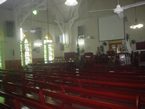
The property at the corner of King and Market Streets is described by JNHT as the former manse. Its architectural account distinguishes a brick ground level, timber cladding above, ventilating windows and an entrance arcade. Those features make the residence useful for the guide’s housing enquiry, but it is not the church sanctuary. The inline photograph instead shows the church interior; it is not a view of the manse. A familiar address or an institution’s name must not erase the difference between domestic and congregational space. [2]
Memory can move as well as architecture
The heritage account says Sharpe’s remains were moved from an initial harbour-side burial to the church vault. That is an attributed institutional account; the brief webpage does not reproduce the exhumation records. Burial, reburial and memorialisation are different stages of public memory. Keep them separate in a timeline and ask what contemporary documents or church records support each stage. The story’s significance does not require pretending that every archival question has already been settled. [1]
Read the church beside the square and a free village
Use three headings: congregation, repression and land after slavery. Place this church, Sam Sharpe Square and Sligoville under them, then connect the documented events. The exercise shows how national change emerged through local institutions and people’s decisions. For a visit, agree a historical conversation with the congregation and respect worship as the building’s living purpose. An informative account should include ordinary members and present community memory alongside the famous names.