Suttons: the plantation name and the memory of resistance
A place-name in Clarendon carries more than ownership. It opens a history of enslavement, an early uprising and the challenge of recovering people behind an estate label.
A familiar name can carry an unfamiliar history
The government’s Clarendon heritage account identifies Suttons among place-names surviving from the plantation landscape along the Rio Minho valley. It also places an uprising at Suttons Plantation in 1690. The inheritance is not necessarily an intact building: it is a name attached to a locality and a remembered event. A road sign can therefore be an entry point into the slavery experience, provided we establish which historical property the name refers to. [1]
The estate name can carry resistance as well as ownership
An estate label usually directs attention toward the proprietor and the productive property. Suttons also carries the memory of an uprising and escape. That changes what the name can mean in Clarendon’s history: the place was not only somewhere slavery operated, but somewhere people acted against it.
The surviving account leaves individual motives and relationships only partly recoverable. The absence of a full biography should limit the detail, not remove resistance from the story. Read beside the later administrative return, the earlier uprising makes two forms of evidence meet: a system counting enslaved people and a memory of people refusing that system. The locality deserves both histories. [source]
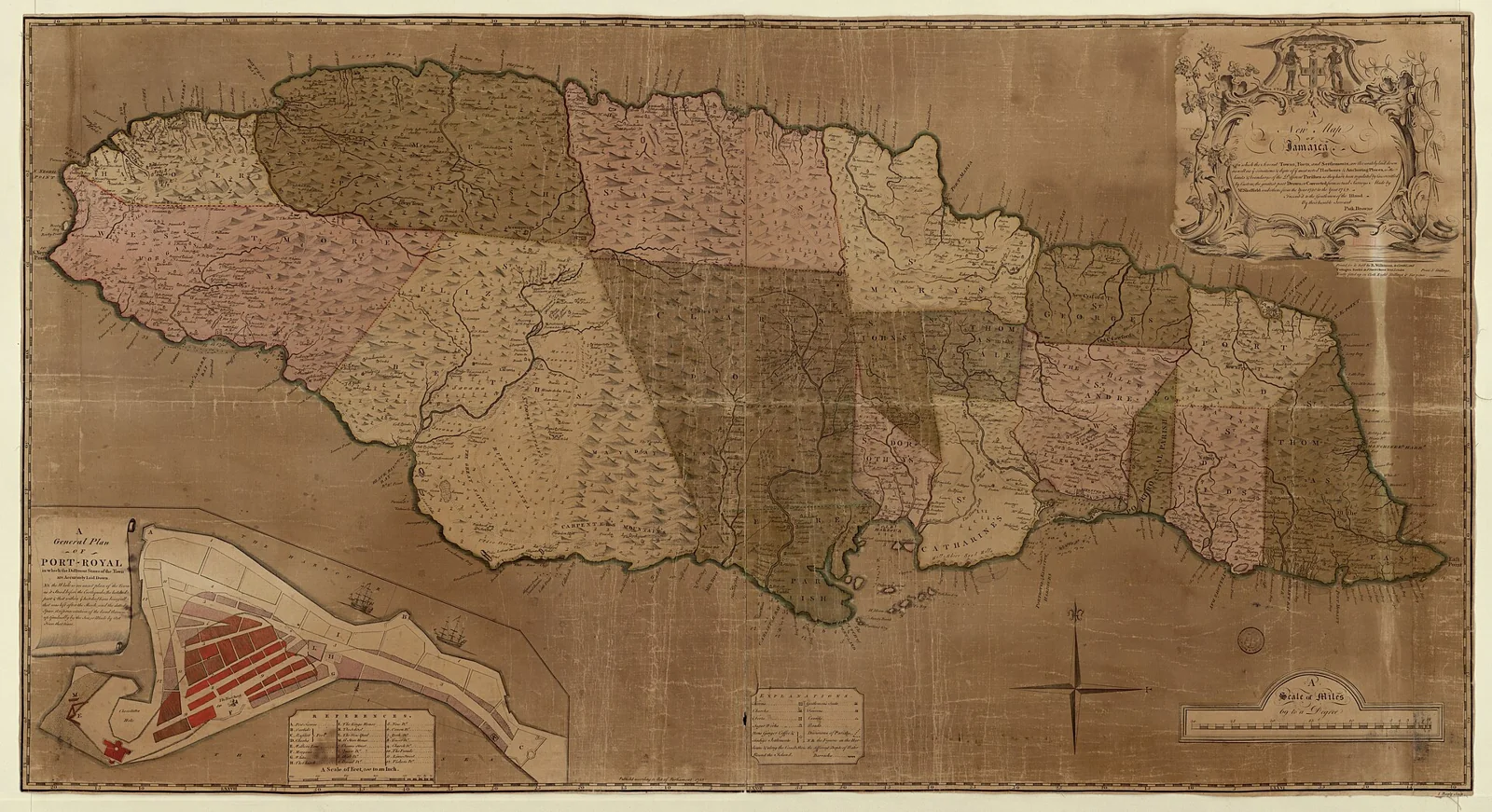
Source & credit
Look closely: Find the separate labels for Clarendon and Vere. This 1755 map helps explain older parish geography; it was made after the 1690 resistance and does not locate an uprising site or authenticate a modern place-name.
The uprising belongs before emancipation
The 1690 event sits much earlier than the better-known 1760 and 1831 uprisings. The short heritage account links escape from Suttons with the developing Maroon history. Its precise family relationship claim remains uncorroborated. What the account securely demonstrates is that Clarendon’s official history remembers resistance at Suttons, and the place-name carries that memory into later geography. [1]
The estate appears through another kind of record
The transcribed 1825 Jamaica Almanac groups Clarendon, Manchester and Vere returns and identifies their reporting context as the March quarter of 1824. Such returns organise property through proprietors, estate names and totals of enslaved people and livestock. Read them as administrative evidence, not a neutral portrait of community life. The headings themselves teach a lesson: historical Vere and today’s Clarendon geography must be reconciled before assigning an estate to a modern parish. [2]
A name is a lead, not a complete identity
Property names can persist through changes in boundaries, owners and use. A later Suttons address does not automatically locate the precise 1690 uprising site or prove a household connection to its participants. Start with the spelling and historical parish; add a map, return, deed or register with a date. This method prevents a familiar local name from becoming a container for unrelated facts. It also allows a resident to investigate the history of a place they already know.
Put resistance beside production
Sugar histories often emphasise output, owners and machinery. Suttons brings another question into the same landscape: what did people do to resist being treated as property? An official summary can establish that an uprising is remembered, but its brevity leaves motives, relationships and individual experiences unresolved. The broader heritage story should include escape and community formation without turning uncertain details into a dramatic script. The absence of named testimony is part of the research problem.
Carry the question into present Clarendon
Read Suttons alongside Halse Hall and Alley. A great house, a parish town and a plantation-linked place-name preserve different aspects of power and movement. Their proximity in one parish is an invitation to compare, not proof that their people or events were identical. A useful local learning walk begins with one visible name and ends with a source trail. It should leave room for community knowledge while recording clearly when an account is oral, documentary or interpretive.
Try the history yourself
Choose a local place-name and build a dated evidence card: spelling, historical parish, present parish, source and what it establishes. For Suttons, keep the 1690 uprising separate from the 1824 reporting context and from a present-day address.
Explore with care
Treat this as a research outing through Clarendon’s named landscape, not an advertised uprising-site tour. Ask local historians or heritage officers about mapping the old estate; obtain consent for any private property and avoid presenting an unverified ruin as the 1690 location.