Alley: whose names survive in the church?
Location: Alley, Clarendon, Jamaica
Explore area in Google Maps ↗Map search for the named place or area. Arrange the actual entrance, guide meeting point and access with your host; this is not a confirmed tour departure.
St. Peter’s opens a local history of the Vere landscape through masonry, sound, elite memorials and the people missing from them.
A parish church built through local demands
St. Peter’s stands at Alley in the former parish of Vere, now part of Clarendon. JNHT dates its foundation to 1671 and the present brick structure to about 1715. Cundall’s earlier account supplies a glimpse of the organising behind those dates: inhabitants of Withywood and Dry River petitioned in 1671 after buying land and beginning a church for their minister. They wanted relief from contributing to another parish church. Worship, land and parish taxation met in the same request. [1] [2]
Source & credit
One building, several periods
The church was extended rather than completed in a single campaign. Cundall reports rebuilding in progress in 1715 and an eastern extension consecrated in 1872. Those details explain why a founding date cannot describe every part of the structure. The tower, the body of the church and a later addition belong to a history of maintenance and changing needs. [2]
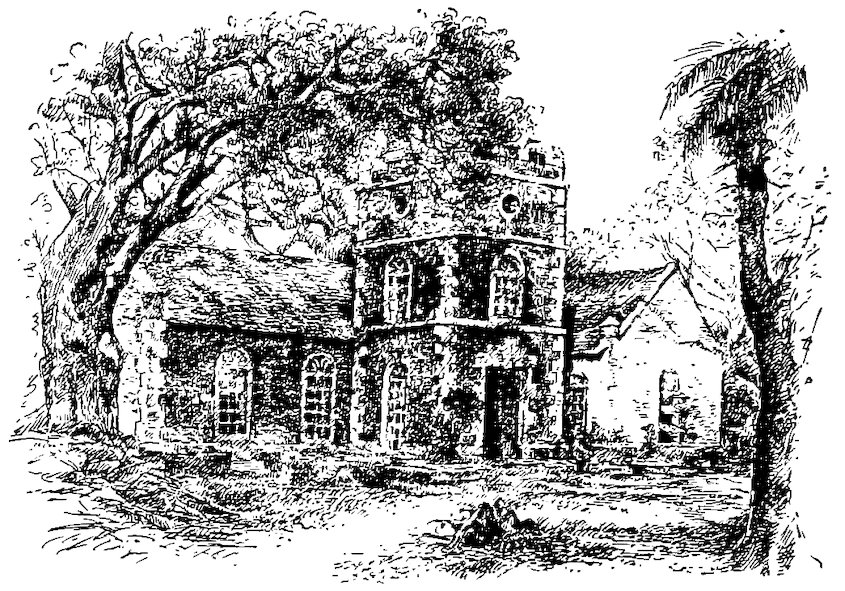
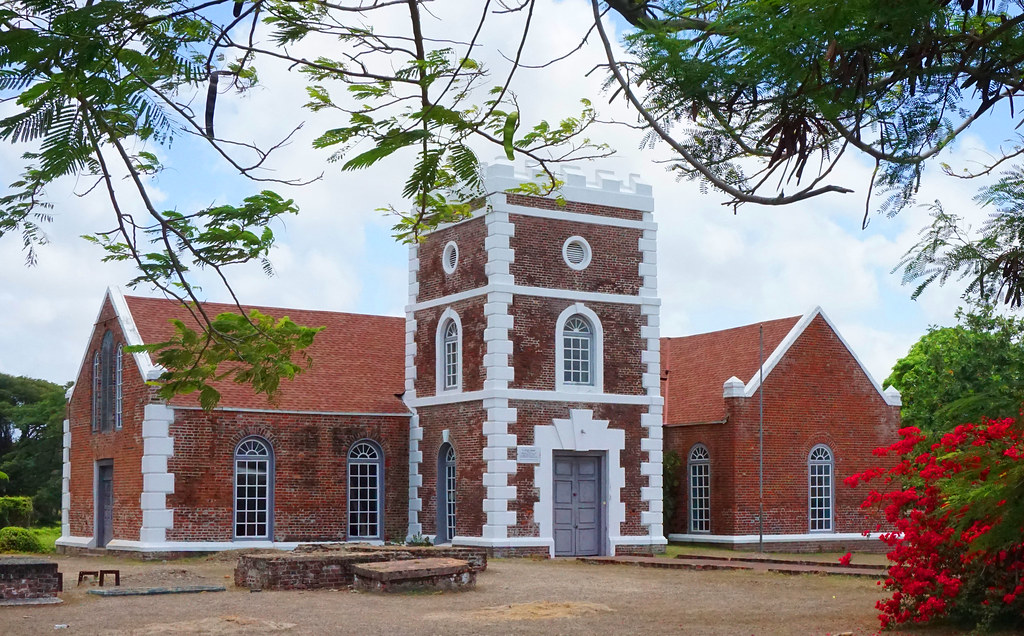
In the illustration, the entrance tower rises between the trees; its corner blocks and battlement-like top make it a useful landmark for comparison with the later photograph. The artist chose a viewpoint and emphasised particular lines. Read it as an illustration, alongside the photographic record.
Source & credit
Land and gifts kept the institution going
Among the benefactions Cundall records is Joseph Taylor’s 1689 gift of fourteen acres for the minister and the poor. A church depended on more than the initial act of construction: land, donations and parish arrangements helped support its continuing work. That history belongs beside the tower and memorials, because it shows how an institution acquired resources and responsibilities. [2]
A named woman inside a family memorial
The families become more specific in Cundall’s transcription of a memorial to Elizabeth, daughter of John Gale and Elizabeth his wife. She died on 30 April 1761; her husband, Daniel McGilchrist, commissioned the monument. A stone that can first appear to be a display of a prominent surname also records kinship, bereavement and the person who paid to preserve a memory. [2]
JNHT identifies the Morant, Gale and Sutton memorials with families connected to the Council and Assembly. Their prominence joins religious space to colonial public office. The people named in expensive monuments are one part of the congregation’s and district’s history. Burial registers, estate papers and family records can extend the enquiry to others. [1]
Listen to the later life of the church
The organ dates to 1847 and the bell to 1857 in JNHT’s account; the bell was cast by Mears of Whitechapel. Both arrived after emancipation. The congregation continued to use and furnish a building whose older memorials recalled earlier generations. This is a history of worship and renewal as well as inherited wealth. [1]
At an arranged visit, look at the tower from outside, then follow one memorial and one later object through their dates. Ask permission before entering or photographing worshippers. The comparison works best when an inscription, an object and the wider parish landscape are allowed to tell different parts of the story.
Sources and notes
- Jamaica National Heritage Trust: foundation, building, tower, organ, bell and principal memorial families.
- Frank Cundall, Historic Jamaica (1915), Clarendon chapter, pp. 380–388: petition, building phases, benefactions, memorial transcriptions and Alley illustration. A historical account, not a current building survey.
- Claude Fletcher / amataiclaudius: St Peter’s Church, Alley; captured 6 August 2015, uploaded 8 August 2015. Public Flickr embed; copyright retained by photographer.
Reviewed 25 October 2026. Illustration publication dates and photograph capture dates are kept separate. Historic accounts and older photographs do not establish current access or condition. Visit durations are planning estimates.